 Astrum

AI Summary
Worlds Orbiting Supermassive Black Holes
Most known planets orbit stars, while rogue planets drift freely through interstellar space after forming from collapsing dust or being ejected from their home star systems. A radically different class of world—known as a black hole planet, or "blanet"—may form directly inside the accretion disk of a supermassive black hole at the center of a galaxy. Rather than being captured by gravity after forming elsewhere, these planets could originate in place. Models suggest that millions of such worlds could orbit a single active supermassive black hole, potentially making them the largest population of planets in the universe—even though none have been detected so far.
Why Active Galactic Nuclei Seem Hostile to Planet Formation
Most large galaxies harbor a supermassive black hole at their core with a mass millions or billions of times greater than the Sun. When abundant gas and dust surround the black hole, its gravity pulls the material into a swirling, flattened belt of debris called an accretion disk. This intense feeding process turns the galactic center into an active galactic nucleus (AGN)—one of the hottest and brightest persistent objects in the cosmos. Spanning trillions of kilometers across (thousands of times the distance from the Sun to Neptune), an AGN's inner disk whips debris around at nearly the speed of light, generating temperatures up to 10 million degrees Celsius and emitting radiation across the entire electromagnetic spectrum that outshines all the stars in its host galaxy combined.
On the surface, an AGN disk resembles the protoplanetary disks around young stars where normal planets form. In detail, however, an AGN lacks every condition that conventional planet formation requires:
-
Extreme heat and ionization: Forming rocky planets typically requires temperatures between a few hundred and a few thousand degrees Celsius, while gas giants require sub-zero conditions. In an AGN, extreme friction heats gas to millions of degrees, knocking electrons loose from atoms and ionizing the gas.
-
Magnetorotational instability: When a magnetic field passes through cold, neutral gas, little happens. When it passes through hot, ionized gas, the Lorentz force deflects charged particles perpendicular to their motion, while the moving charges generate their own magnetic fields—locking the gas and magnetic field lines together in a state called flux freezing. Just like two tennis balls connected by an elastic band, a parcel of gas orbiting closer to the black hole moves faster and stretches the magnetic field line forward. The stretched field line drags the inner gas backward—causing it to sink closer to the black hole—while pulling the outer gas forward into a wider orbit. This runaway stretching eventually snaps the magnetic field line, releasing tension and plunging the disk into violent, chaotic turbulence known as magnetorotational instability, where colliding particles shatter instead of clumping together.
-
Lack of sticky ice: In cool, calm protoplanetary disks, dust grains smaller than a micron (roughly the width of an E. coli bacterium) are coated in ice. Because ice has a higher surface energy than bare silicate dust, icy grains cushion impacts and fuse together rather than fragmenting. In an AGN's scorching inner disk, ice vaporizes immediately.
-
Disrupted pebble accretion: In a protoplanetary disk, internal gas pressure causes gas to orbit slightly slower than solid pebbles, creating a headwind that makes pebbles spiral inward toward the star. When enough pebbles clump together, they push back on the gas and accelerate it, reducing the headwind and allowing the clump to sweep up incoming pebbles—a process called streaming instability. This creates long, dense filaments whose self-gravity eventually overcomes the star's tidal pull, collapsing them into numerous planetesimals like a stream of water breaking into droplets. Planetesimals grow by capturing remaining pebbles until they become massive enough to carve a low-pressure groove in the disk, pushing gas outward and halting further pebble accretion.
In short, standard planet formation demands cold so dust and ice survive, calm so grains stick together gently, and time—millions of years of undisturbed settling. An AGN's intense heat, magnetic turbulence, and immense tidal forces appear to violate every requirement.
How Black Hole Planets Can Form in the Dusty Torus
Despite these hostile inner conditions, a 2026 computer simulation led by Bhupendra Mishra of the Polish Academy of Sciences demonstrated that planets can form in the far outer reaches of an AGN accretion disk. This outer region, known as the dusty torus, sits roughly 3 to 32 light-years (around 10 parsecs) away from the central black hole. Shielded from the inner disk's intense radiation, the dusty torus is cool, dense, and rich in dust.
In Mishra's simulations, dust grains in the dusty torus collide and stick together just as they do around young stars. Once they grow to between a few millimeters and a few centimeters across, streaming instability takes over, gathering the dust into massive filaments that collapse into millions of planetary building blocks within a single AGN torus. These worlds span a wide range of sizes, from planets roughly the mass of Earth to giants several times more massive than Jupiter.
Because the reservoir of gas and dust in an AGN torus is so vast, growing planets do not run out of material the way planets around stars do. Without an upper growth ceiling, some black hole planets could continue accreting matter until they accumulate enough mass to ignite nuclear fusion and become stars. While the blinding glare of an AGN prevents telescopes from directly spotting newborn stars or planets inside the disk, two indirect clues suggest star formation does occur near supermassive black holes:
-
Young stars near Sagittarius A*: A cluster of young, massive stars orbits close to the Milky Way's central black hole, Sagittarius A*, in a region where tidal gravity should have torn gas clouds apart before they could collapse—suggesting they formed inside a past accretion disk that has since drained away.
-
Heavy-element enrichment: The gas surrounding AGNs contains unusually high concentrations of heavier elements ("metals," meaning anything heavier than helium), matching what would be expected if generations of stars had lived and died inside the disk.
Mishra's model also predicts an exotic class of object with no known counterpart: totally metal stars—stellar-mass bodies composed entirely of solid dust and heavy elements that are far too massive to be planets, yet do not burn hydrogen like ordinary stars. Earlier work in a 2020 paper led by Keiichi Wada, which first coined the term "blanet," reached a similar conclusion using a different modeling approach, noting that planet formation must occur within an AGN's estimated 100-million-year lifespan—a feasible window given that Earth may have formed in as little as 10 million years.
What Standing on a Black Hole Planet Would Be Like
An observer standing on the surface of a black hole planet would experience an environment utterly unlike any world in our solar system:
-
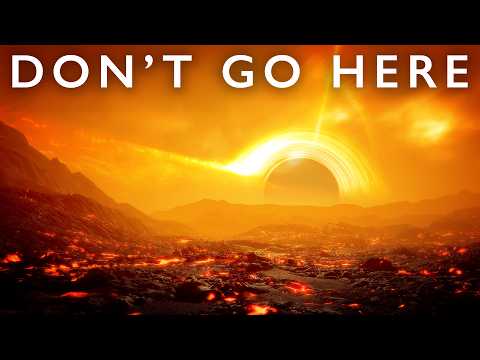
A permanent orange sky: Because the dusty torus is packed with thick dust, there would be no pitch-black night sky or visible central sun. Instead, radiation from the distant accretion disk would scatter through the dust, bathing the entire sky in a hazy, warm orange glow resembling a foggy street lit by a faded street lamp.
-
Unchanging seasons: At tens of light-years from the central black hole, a single orbit takes roughly one million Earth years, meaning seasonal shifts and changes in the sky would unfold imperceptibly across countless generations.
-
Freezing outside, molten within: The surrounding space in the outer torus is extraordinarily cold—around -173°C near a billion-solar-mass black hole—for three reasons: it lies thousands of times farther out than the hot inner disk; most AGN radiation escapes along the black hole's poles rather than horizontally through the disk; and dense layers of dust and gas absorb most remaining radiation, blocking even X-rays. Yet beneath the surface, Mishra estimates these silicate-rich "dust giants" are heated internally by the decay of short-lived radioactive isotopes, melting their interiors into global magma oceans under outgassed atmospheres—making them look like colossal lava balls warmed from within rather than from above.
-
Vast isolation: Even with millions of planets sharing the same dusty torus, the colossal scale of the disk means neighboring worlds would be separated by several light-years, requiring near-light-speed travel to visit another planet in the same system.
Why None Have Been Detected Yet
Across hundreds of billions of galaxies in the observable universe—if roughly one in ten hosts an active nucleus with millions of worlds—there could be around 10 quadrillion ($10^{16}$) black hole planets. Several factors explain why none have been confirmed:
-
Migration and stellar growth: Over time, some planets may migrate outward off the edge of the disk and drift away as nearly undetectable rogue planets, while others may accrete enough material to turn into stars.
-
Limitations of standard detection methods: Techniques like the transit method (watching a star's light dim as a planet crosses it) and the radial velocity method (measuring a star's gravitational wobble) depend on a bright, stable host star. A black hole is dark, and its surrounding accretion disk is so overwhelmingly luminous that a Jupiter-sized planet cannot be seen against its glare.
-
Extreme distance: Current exoplanet surveys reach about 30,000 light-years, whereas the nearest active galactic nucleus, Centaurus A, lies 11 million light-years away—three orders of magnitude beyond current survey limits.
Astrophysicists have proposed two potential ways to detect them in the future: searching for planetary transits in radio wavelengths rather than visible light (which astrophysicist Pavel Kakhala notes is theoretically possible, though technically difficult), or using gravitational lensing and X-ray eclipses to spot the collective signature of an entire swarm of solid bodies passing in front of the small, bright X-ray-emitting core of an AGN. Both approaches would require observing the right AGN at precisely the right angle and moment, leaving black hole planets for now as a captivating theoretical frontier.
Full Transcript
00:00This is no ordinary planet.
00:03It doesn't exist in a solar system like
00:05our own.
00:06Yes, it's in orbit around something that
00:08radiates heat and light, just like our
00:10sun, but it's not a star.
00:13This is the accretion disk of the
00:16supermassive black hole at the center of
00:18a galaxy.
00:20And this is a black hole planet.
00:24It's not a rogue planet flung out from
00:26its home system. It wasn't dragged here
00:28by the gravity of the great central
00:30black hole. Instead, scientists believe
00:33it might have formed right here in one
00:35of the most hostile environments in the
00:38cosmos.
00:39And it's not alone. Scientists now think
00:42there could be millions of them around a
00:44single active black hole, which would
00:46make them the largest population of
00:48planets in the universe.
00:51So, if that is really the case, how come
00:55we've never found one?
00:58I'm Alex McColgan, and you're watching
01:00Astro. Join me today as we venture to a
01:02totally new type of world to understand
01:05how they might form,
01:07what makes them different from the
01:09planets in our own solar system, and
01:11what [music] it would take for us to
01:13finally detect one.
01:19Most large galaxies have a supermassive
01:21black hole at their center that can be
01:23millions, if not billions of times the
01:25mass of our sun.
01:26And the scorching, violent conditions
01:29[music] that come with it aren't exactly
01:31what you imagine as being ideal for a
01:33planetary nursery.
01:35If there is a lot of matter nearby, the
01:38supermassive black hole goes into a
01:40feeding frenzy.
01:42As gas and dust get caught in its
01:44gravity, the supermassive black hole
01:46starts accumulating a swirling, growing
01:49belt of debris around [music] its
01:51midsection, an accretion disk. This
01:53active accretion can make the galactic
01:55center extremely luminous, turning it
01:58into what is known [music] as an active
02:00galactic nucleus.
02:02This disc is gigantic. It can span
02:05trillions of kilometers across,
02:07thousands of times the distance from the
02:09Sun to Neptune, and its innermost
02:11regions move incredibly fast, almost at
02:15the speed of light.
02:17Active galactic nuclei, or AGNs, are
02:20some of the hottest and brightest
02:22persistent objects in the known
02:24universe. They emit radiation across the
02:26entire electromagnetic spectrum and are
02:29usually brighter than all the stars in
02:31their galaxy combined.
02:34That makes for a pretty extreme
02:35environment. The inner disc boasts
02:37insane radiation, brightness, heat, and
02:41tons of debris blitzing past you near
02:43the speed of light over distances that
02:46will make our solar system look like a
02:48rounding error.
02:50But this all raises a rather obvious
02:52problem for the existence of black hole
02:54planets. Because according to everything
02:56we know about planet formation, it
02:58simply doesn't happen in violent places
03:00like this.
03:02So, what exactly is going on? Why do we
03:05think planets could exist here?
03:09When we think of planets, we usually
03:11think of them orbiting a star. After
03:14all, that's what we see within our own
03:16solar system, the Sun surrounded by a
03:18family of eight spectacular planets.
03:21They are worlds we've covered a lot over
03:23the years. But if you ever wish that you
03:25could dive even deeper into some of the
03:27solar system's wonders, then you need a
03:29copy of my book, Incredible Universe.
03:32With stunning imagery and thoughtful
03:34explanations that are accessible to all,
03:36I wrote this book to take you on a trip
03:38through the solar system and all its
03:40wonders, and it's gone better than I
03:42expected. We are really close to selling
03:44out. In fact, now we only have copies
03:47left in the USA. So, if you want one,
03:49now is your chance to get a copy before
03:51they are gone completely. Click the link
03:53below to get yours.
03:55I really enjoyed writing this, so I hope
03:58you enjoy reading it, too.
03:59For now though, let's go back to planets
04:01that we know a lot less about, most of
04:04which we do think of having their own
04:06suns.
04:07In fact, our entire method of hunting
04:09for exoplanets relies on them
04:11interacting with their host star.
04:13It is worth mentioning that rogue
04:15planets do exist, which hurtle through
04:18interstellar space without being
04:19attached to a star.
04:21Some of them form by dust collapsing
04:22into a mass, but others likely form
04:25around stars before eventually being
04:27ejected from their orbit by nearby
04:29interactions.
04:31But these black hole planets are not
04:33rogues. They do belong to a host, just
04:36not a star.
04:38Planets like the ones in our solar
04:40system come from [music] the
04:41protoplanetary disk, a flat ring-shaped
04:44structure of gas and dust debris
04:46orbiting around a young star, which
04:48contains all the key raw materials to
04:51form planets.
04:52But hang on a minute. This sounds
04:55suspiciously similar to the AGNs we were
04:57talking about. Perhaps at first glance?
05:00Yes.
05:01But on closer inspection, AGNs are
05:03actually quite different in a few key
05:06ways.
05:07Firstly, AGNs are much hotter. The
05:09friction within the accretion disk can
05:11create temperatures as high as 10
05:13million degrees Celsius. To form rocky
05:15worlds, you need temperatures of around
05:17a few hundred to a few thousand degrees
05:20Celsius. And for gas giants, you're
05:22looking [music] at sub-zero
05:24temperatures.
05:25With this much heat, collisions between
05:27particles in the AGN knock electrons
05:29loose and leave the gas ionized. This
05:33ionized gas leads to much more magnetic
05:35turbulence and instability in AGNs than
05:37in protoplanetary disks, which does not
05:40lend itself to clumping material
05:42together. Let me explain.
05:45When a magnetic field runs through cold,
05:47neutral gas, nothing happens.
05:49But run the same magnetic field through
05:51ionized gas, like the ones we find
05:54around an AGN, and it's a wildly
05:56different story.
05:58Thanks to what's known as the Lorentz
06:00force. When a magnetic field is applied
06:02to charged particles like ionized gas, a
06:05force is exerted on those charged
06:07particles, and here there are loads of
06:10them.
06:11This Lorentz force pushes in a direction
06:13perpendicular to the particles'
06:15velocity, which stops particles from
06:17being able to travel freely across
06:19magnetic field lines, and bends their
06:21sideways motion into a circle. But,
06:24here's where it gets interesting.
06:26These moving particles are themselves
06:28moving currents, which means they also
06:31generate their own magnetic field. In
06:33other words, the ionized gas drags the
06:35magnetic field with it, and just as much
06:38as the field constrains the gas. The two
06:40eventually become locked together in a
06:42condition known [music] as flux
06:44freezing.
06:46I know this is complicated, so let's
06:48break it down even more.
06:50Think of two parcels of gas orbiting at
06:52slightly different distances from a
06:53black hole
06:54>> [music]
06:54>> as two tennis balls joined by an elastic
06:57band, which represents a magnetic
06:59[music] field line.
07:00The tennis ball close to the black hole
07:02orbits faster, so it runs ahead and
07:04stretches the elastic band toward. And,
07:07this is where my analogy works really
07:09well, because the stretched field line
07:11behaves exactly [music]
07:12like an elastic. It drags backward on
07:15the ball that's racing ahead, and tugs
07:17forward on the one that's lagging
07:18behind. The inner tennis ball slows down
07:21and sinks further inward towards the
07:23black hole. The outer ball speeds up and
07:26moves further out. This stretches the
07:28band, or in reality the magnetic field,
07:31even further, which pulls harder on each
07:33ball, which separates them more in a
07:36runaway cycle.
07:38But, this can't go on forever.
07:40Eventually, the magnetic field line is
07:42stretched past its limit and snaps. At
07:45that moment, the tennis balls [music]
07:47decouple, the tension releases, and the
07:50whole system goes from orderly orbital
07:52motion to chaotic, turbulent accretion
07:55[music]
07:56soup.
07:57This phenomenon is known as
07:58magnetorotational instability, and it's
08:01happening everywhere in [music] the
08:02accretion disk all at once.
08:05And, that kind of turbulence is exactly
08:07what you want to avoid if you're trying
08:09to make a planet because it makes
08:11particle collisions too violent. At high
08:14speeds, particles fragment and splinter
08:17instead of sticking together and growing
08:19slowly into a larger body.
08:21Protoplanetary disks on the other hand
08:23don't suffer from this problem. They're
08:25too cool to become very ionized so
08:27remain relatively pretty stable and more
08:31amenable to the delicate process of
08:33planet formation.
08:35You see, to start with, dust particles
08:38around the protoplanetary disk are tiny,
08:40smaller than a micron. That's about the
08:43width of a single bacterium of E. coli.
08:46They'll randomly bump into each other
08:48every now and then. Without ice, the
08:51silicate dust grains are more likely to
08:53shatter if they collide too hard,
08:55but some models show that if they're
08:57coated in ice, they'll fuse rather than
08:59fragment. This is because ice has a
09:02higher surface energy than bare silicate
09:04grains, which means more energy is
09:06needed to pull the particles apart once
09:08they touch.
09:09This makes the impact of ice on ice
09:12stickier, letting the grains cushion and
09:15fuse on impact instead of shattering.
09:17Since AGNs are so much hotter and
09:20brighter than protoplanetary disks, ice
09:22can't form within the inner whirling
09:24disk, which poses a problem for [music]
09:26the early stages of planet formation.
09:29In a protoplanetary disk, the gas is
09:31also partly held up by its own internal
09:33pressure so it can afford to orbit a
09:35little slower than a solid body would
09:37without getting sucked in by the star's
09:39gravity. That leaves the pebbles
09:42battling a constant headwind, slowing
09:44them down. And as they slow down, they
09:47start to spiral inward toward the star.
09:50But all it takes is for one clump of
09:52pebbles to form and the tables turn
09:55completely.
09:57As you know, every action has an equal
09:59and opposite reaction. So as the gas
10:02exerts a headwind, [music] the particles
10:04also push back by the same amount. When
10:06enough pebbles cluster together, they
10:09exert enough frictional force on the gas
10:11to accelerate it closer to their own
10:13speed. This weakens the headwind on the
10:15pebbles and slows their drift towards
10:18the star.
10:19This makes [music] it easier to catch
10:21incoming solitary pebbles that are still
10:23falling inward at regular speed, adding
10:26them to the cosmic pileup of soon-to-be
10:28planet debris. This phenomenon [music]
10:30is called streaming instability, and it
10:33results in long, dense filaments of
10:36material.
10:37How do concentrated trails of tiny rocks
10:40turn into full-blown planets?
10:43Well, that's thanks to a little game of
10:45tug-of-war with gravity.
10:48These filaments' own gravity is trying
10:50to pull them together, while the star's
10:52gravity is trying to force them apart.
10:55If the filament grows dense enough, its
10:57self-gravity wins out over the star's
10:59tidal forces, and the filament
11:01collapses. But, it doesn't collapse into
11:04one giant object. Instead, it breaks up
11:07into many planetesimals, the way a
11:10stream of water splits into several
11:12droplets. Each filament yields a whole
11:15population of bodies.
11:18But, what about the pebbles that never
11:19joined a filament? Well, now there are
11:22several solid bodies in their path, so
11:24it's only a matter of time before they
11:26get trapped in their gravity.
11:28The planetesimals grow by collecting
11:29these orphan pebbles, but only up to a
11:32point. Once a planet is massive enough,
11:35its gravity clears a low-pressure groove
11:37in the disk around its orbit. [music]
11:39This pushes the displaced gas just
11:41outside the planet's orbit, so the gas
11:44pressure peaks there. And since pebbles
11:46always drift towards high-pressure
11:48zones, they accumulate at that outer
11:51edge instead of [music] crossing the
11:52pressure gap to reach the planet. In
11:54other words, it becomes physically
11:56impossible for more pebbles to get close
11:58enough to the new planet to become
12:00[music] part of it, so it stops growing
12:02via pebble accretion.
12:04As I'm sure you can see from all of
12:06this, planet formation is a delicate,
12:09time-consuming process that requires
12:11[music] three key ingredients: cold, so
12:15dust and ice survive instead of
12:16vaporizing, calm, so grains [music]
12:19drift into each other gently enough to
12:21stick rather than shatter, and time. It
12:25needs millions of years of undisturbed
12:27settling so that microscopic specs of
12:29dust [music] have time to grow step by
12:32painstaking step into new worlds.
12:35An AGN is the opposite on every count.
12:38It's hot enough to vaporize ice and
12:41ionized gas. That ionization gives rise
12:43to immense magnetic turbulence across
12:45the whole system,
12:47>> [music]
12:47>> and it's all happening in the tidal grip
12:49of something a million to a billion
12:51times the sun's mass, which rips apart
12:55anything trying to clump together.
12:57And yet, a 2026 study now claims
13:01>> [music]
13:01>> there might be millions of black hole
13:04planets orbiting around AGNs.
13:07So, what did the team find? And how is
13:10this even possible?
13:14Let me start by tempering your
13:16expectations. As mentioned earlier, and
13:19as much as I wish we had, we haven't
13:21seen one of these black hole planets
13:23yet.
13:24Instead, a team of researchers led by
13:26Bhupendra Mishra from the Polish Academy
13:29of Sciences created a computer model of
13:32a supermassive black hole and its
13:33accretion [music] disk. They then added
13:36several parameters and data points to
13:38investigate how dust might clump
13:40together under different conditions
13:42>> [music]
13:42>> in different parts of the accretion
13:43disk.
13:44And they found something remarkable.
13:46[music]
13:47It seems that the outermost edges of
13:50these colossal glowing disks possess the
13:53perfect temperature and dust density to
13:56mimic stellar nurseries.
13:58"We've discovered millions of
14:00Jupiter-mass planets could form at
14:03distances of tens of parsecs from
14:05supermassive black holes, which are also
14:08AGNs," Mishra says.
14:11And what's more, they believe the very
14:12same streaming instability mechanism we
14:15expect around protoplanetary disks is
14:17behind it.
14:19The outer regions of the accretion disk
14:21are known as the [music] dusty torus.
14:24Here, anywhere between 3 to 32
14:27light-years away from the supermassive
14:28black hole, lies a cooler, dust-rich,
14:31and radiation-shielded region where dust
14:34grains may be able to grow and aggregate
14:36in a way that's analogous to planet
14:39formation around a star.
14:42In Mishra's model, the team watched how
14:44material in the outskirts of an AGN
14:46behaved and found that dust grains in
14:48these regions can grow through simple
14:50collisions and sticking, just as they do
14:53around ordinary stars.
14:55Once the grains reach a certain size,
14:57millimeters to a few centimeters in the
15:00outer disk, streaming instability kicks
15:02in, causing the dust to clump into
15:05enormous, dense filaments, which
15:07collapse into millions of planetary
15:09building blocks within a single AGN
15:11torus, spanning a huge range of sizes,
15:15from objects roughly Earth's mass all
15:18the way up to giants several times
15:20Jupiter's mass.
15:22However, this wouldn't be a video about
15:25black holes if things didn't get weird.
15:28As Mishra and his team kept their
15:30simulations running, they revealed
15:32something mind-bending.
15:34The distinction between planet and star,
15:36as we know it, might break [music] down
15:39completely.
15:40Now, a planet orbiting around a star
15:43grows until it has consumed all the
15:45material available to it in its orbit.
15:48But in an AGN torus, the reservoir of
15:51material is so vast that new planets
15:54just don't have that same ceiling
15:56imposed on them.
15:58In theory, they could keep growing and
16:00growing until they've accumulated enough
16:03mass to trigger nuclear fusion and
16:05become stars.
16:07So, have we actually ever caught this
16:09star formation happening around a black
16:11hole?
16:12Well,
16:13not directly.
16:15The glare of an active black hole is so
16:17overwhelming that spotting a single
16:19newborn star, or a planet for that
16:21matter, against [music]
16:22it is impossible.
16:24But, we don't need to catch this star
16:26formation in action to predict it's
16:28happening, because it seems to have left
16:30behind two sets of fingerprints. And the
16:32first set is hiding [music] in our own
16:35galaxy.
16:36Orbiting our supermassive black hole,
16:39Sagittarius A* is a cluster of young,
16:42massive stars sitting where we least
16:45expect them.
16:47Gravity should have torn their gases
16:48apart long before they could collapse
16:51and form stars, unless, of course, they
16:54were born from a disk that has since
16:55drained away into a black hole, which is
16:58what some scientists think happened to
17:00Sagittarius A* over billions of years.
17:03The second clue that stars might form in
17:05AGNs comes from the gas around them.
17:08Turns out, it's strangely rich in
17:11heavier elements, [music]
17:12the kind you'd expect if generations of
17:14stars had lived and died right there
17:17[music] in the disk.
17:19On their own, neither signal is proof,
17:22but together, they [music] point to the
17:23possibility that stars could be forming
17:26in black hole accretion disks.
17:29And if that's the case, then the idea of
17:31planets also forming in this way isn't
17:34so ridiculous after all.
17:36The model also predicts another strange
17:39object with no known equivalent in the
17:41universe.
17:43Objects with [music] stellar masses that
17:45are made completely of solid dust, not
17:49gas.
17:50Unlike regular stars, these wouldn't
17:52burn any hydrogen, yet they would be far
17:55too massive to be considered a planet.
17:57This hypothetical object has been dubbed
17:59a totally [music]
18:00metal star. Metal, of course, meaning
18:03anything heavier than helium to an
18:05astronomer.
18:07So, to recap,
18:08>> [music]
18:08>> about 10 parsecs, or 32 light-years away
18:12from the black hole, conditions in the
18:14AGN torus are analogous enough to
18:17protoplanetary disks that planet
18:19formation via pebble accretion might
18:21actually be possible.
18:23From this, millions of black hole
18:26planets of all sizes could emerge, which
18:29could possibly continue accreting matter
18:32until they reach stellar masses or even
18:35turn into stars.
18:37Now, this concept of black hole planets
18:40forming isn't exactly new.
18:42A 2020 paper led by Keiichi Wada first
18:46coined the term planet or black hole
18:49planet. They used a different approach
18:51than Mishra, but came to the same
18:52conclusion
18:53>> [music]
18:54>> that the outskirts of the AGN torus
18:56could, in theory, birth planets.
18:59The key constraint Wada and his team
19:01highlight though is [music] the balance
19:02between the rate of collision of
19:04particles and the lifetime of the AGN
19:07itself, which he estimates to be 100
19:09million years.
19:11If the planets can't form within that
19:12time frame, their existence obviously
19:14wouldn't be viable.
19:16But let's assume they can. After all,
19:18some studies suggest it took as little
19:20as 10 million years for our own Earth to
19:22take shape. And if the center of the
19:24galaxy is filled with countless [music]
19:26new worlds, I want to know what would
19:29standing on the surface of one be like?
19:32What would you see in the sky? Would
19:34being on one of these worlds be even
19:37remotely like our planetary experience?
19:42Looking up from the surface of a planet,
19:44the first thing you'd notice is the sky.
19:47It looks like a dark street on a foggy
19:50day illuminated by the hazy orangey glow
19:54of a faded street lamp.
19:56Since the outer edges of the AGN torus
19:58contain a lot of dust, you wouldn't see
20:00an inky black sky like we do on Earth.
20:03Instead, the radiation from the
20:04accretion disk would [music] be
20:06scattered across the whole sky in a
20:08warm-toned glow.
20:11And no matter how long of a time lapse
20:12you filmed, [music]
20:13the sky would appear unchanged.
20:16When you're this far out, a full orbit
20:19around your black hole would take a
20:21million Earth years.
20:23And its seasonal changes would unfold
20:25incredibly slowly. You could live for
20:28generations without noticing a
20:29difference.
20:31On Earth, our biology is wired to be
20:33calibrated to a central star. But here,
20:36there's nothing to calibrate to but the
20:38glowing sky.
20:40Look down and you'll see you're standing
20:41on a world of pure dust.
20:44Mishra speculates planets would be made
20:46of silicates all the way through. And
20:49that the radioactive decay of
20:50short-lived isotopes heats them
20:52internally enough to melt through the
20:54silicates themselves, giving our planet
20:56a magma ocean under an outgassed
20:59atmosphere.
21:00In his own words, [music] Mishra
21:02describes them as dust giants exceeding
21:05Jupiter's mass.
21:06They will look like lava balls.
21:09And yet, [music] their surroundings
21:11would be surprisingly cold.
21:13Temperatures out here drop significantly
21:15for three main reasons.
21:17Firstly, this region is thousands of
21:19times further out than the blazing hot
21:21inner disk where all the energy is
21:23generated.
21:24Secondly, the majority of that radiation
21:26is released in the orientation of the
21:28poles of the black hole, not [music]
21:29horizontally through the disk. And
21:32finally, any radiation that does head
21:34this way has to fight through everything
21:36in between. Layer after layer [music] of
21:39dust and gas absorbs it on the way out.
21:42Many of these dusty tori [music] are so
21:44thick that even x-rays struggle to get
21:46through.
21:47So, by the time any of that heat reaches
21:50us, most of it has already been
21:52absorbed. For a central black hole with
21:54the mass of a billion suns, the
21:57temperature in the area surrounding our
21:58planet would be a bone-chilling -173°C.
22:01[music]
22:05So, a world in an environment around
22:07173° [music] below zero, but molten
22:11underneath, can only mean one thing. The
22:14heat comes from inside, not above.
22:17This is fundamentally different from any
22:20terrestrial planet in our solar system,
22:22where the vast majority of the heat
22:24comes from the outside, from our sun.
22:27And what if we wanted to explore the
22:29neighboring planets in our planetary
22:31system? Well, we'd need to invent some
22:34kind of [music] near light speed travel
22:36because the nearest other planet would
22:38likely be several light-years away.
22:41Planets would circle their black hole at
22:43vastly greater distances than planets
22:45orbit their stars with individual worlds
22:48separated by enormous stretches of space
22:51and lying several light-years from the
22:53center.
22:54Beautifully ironic when there are
22:56possibly millions [music]
22:57of them in the same torus, isn't it?
23:00The same kind of irony taunts us here on
23:02Earth, too.
23:03If there are hundreds of billions of
23:06galaxies in the observable universe and
23:08perhaps one in 10 is active at a given
23:11time, hosting millions of planets, there
23:15are about 10 quadrillion planets out
23:18there.
23:19That's a one with 16 zeros behind
23:22[music] it.
23:23So, why haven't we found any?
23:26Well, the most obvious answer is they
23:29might not stay put forever.
23:31The model suggests that over time some
23:34of these worlds might migrate outward,
23:36drifting away from the black hole and
23:38off the edge of the disk that made them,
23:41turning them into rogue planets which
23:43are almost impossible to spot.
23:45We have found hundreds of rogue planets
23:47over the years through gravitational
23:49microlensing or directly observing
23:51infrared signals from newly formed
23:53planets,
23:54but we don't think any of them formed
23:56around a black hole.
23:58Then there's the argument that our
24:00planet may only be a planet for part of
24:03its life.
24:04As we saw, in an environment this rich,
24:06there's a little to stop a new world
24:08from growing into something else
24:10entirely, like a star.
24:12But even if every last planet stayed
24:14exactly where it formed and remained a
24:16planet, we'd still be hard-pressed to
24:19see them because our main methods of
24:21finding exoplanets depend on something
24:23these worlds don't have, a star.
24:27In the transit method, researchers stare
24:29at a star and wait for its light to dip,
24:31a signal a planet might have crossed in
24:33front of it. In the radial velocity
24:35method, researchers watch a star wobble,
24:38tugged by the gravity of something
24:39orbiting it.
24:41Both techniques share the same
24:42assumption. There's a bright, stable,
24:45well-behaved point of light in the
24:46middle, and the exoplanet reveals itself
24:49by disturbing it.
24:51But, around a black hole, that simply
24:53doesn't work.
24:55A planet passing in front of it can't
24:56make it because it's already dark.
25:00Around that, there might be an accretion
25:01disk, so luminous it can outshine the
25:03entire galaxy.
25:05Good luck finding a Jupiter-sized world
25:07against that.
25:09Then, there's the distance.
25:11Our current exoplanet surveys can only
25:13reach about 30,000 light-years. The
25:16nearest active galactic nucleus,
25:18Centaurus A, is 11 million light-years
25:22away.
25:23We are off by three orders of magnitude.
25:26And yet, researchers aren't ready to
25:28label planet hunting as impossible just
25:31yet.
25:32One suggestion is to look for transits,
25:35>> [music]
25:35>> not in visible light, but in radio.
25:38Astrophysicist Pavel Kakhala said that
25:41technically it isn't easy, but it is
25:44theoretically possible.
25:46Another approach is gravitational
25:48lensing.
25:49Rather than trying to detect a single
25:51world, researchers can look for the
25:53fingerprint of entire population of
25:55solid bodies passing in front of the
25:57small, bright, X-ray emitting region at
26:00the AGN's core. But in this instance,
26:02you'd find a swarm rather than an
26:04individual planet.
26:06But of course, there's a catch. For this
26:08to work, we need to be looking at the
26:10right AGN, at the right angle, at the
26:12right moment, which mostly means we'd
26:15need to get extremely lucky.
26:18For now, there are no planet hunting
26:20missions on the horizon. Planets remain
26:23a theoretical and mystical population
26:25that isn't beyond the realm of
26:27possibility, but one that's relegated to
26:30our scientific
26:32which leaves us free to wonder what they
26:34might be like. Could anything live in
26:37that permanent orange twilight?
26:39What would they think about our
26:40star-based systems?
26:42I bet we'd seem pretty bizarre to them,
26:45too.
26:48I'm happy to announce we have a weekly
26:50newsletter to keep up with all the
26:52discoveries in our cosmos, and our
26:54designer Peter has made the most
26:56beautiful email you'll ever receive.
26:59Sign up with the link down below.
27:01It's the best way to stay connected
27:02between videos. Short, focused updates
27:05on what's new and fascinating in space
27:07each week. No spam, no filler, just the
27:11good stuff.
27:12You'll get the latest news, visuals, and
27:14insights delivered straight into your
27:16inbox.
27:17If you enjoy Astrum videos, you'll love
27:19this. Join the newsletter and stay
27:21curious with us.
Description
Scientists are searching for missing planets in the most unlikely place.
Astrum books are still available in the US! If you’re fascinated by the cosmos, want to learn more about our Solar System, or just love stunning space images, get
At the edge of a supermassive black hole lies one of the most violent, hostile environments in the cosmos. It's the last place anyone expected to find a planet, but scientists now believe missing worlds could be lurking here. How do these black hole planets form? What are their surfaces like? And how do we actually find them?