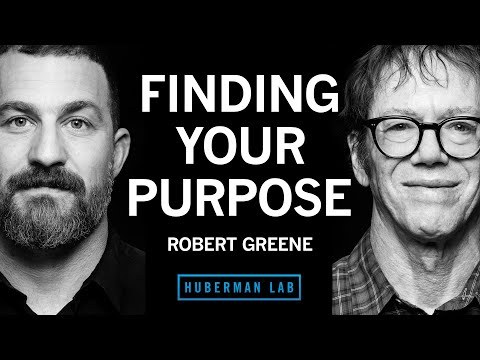
Andrew Huberman
AI Summary
Finding Your Life's Task, Early Inclinations, and Purpose
Author Robert Greene and Stanford neurobiology professor Andrew Huberman explore how people discover and pursue their life's task or sense of purpose—noting how Huberman has long recommended Greene's Mastery (alongside books like Longitude and Principles of Neural Science) for navigating life transitions. Unlike animals with narrower instinctual niches, human beings arrive without a built-in script and can easily feel adrift amid outside expectations, school pressures, or chasing money without emotional resonance.
Greene points to early childhood "impulse voices" (referencing ideas connected to Abraham Maslow) and diverse ways intelligence or inclination shows up (referencing Howard Gardner's frames of mind), noting how early sparks—such as Greene's own fascination with words, anagrams, palindromes, and human origins/ancestry, or Huberman's childhood fascination with flora, fauna, aquatic life, and organizing knowledge—can act as an internal compass. When people are emotionally engaged and aligned with what genuinely draws them, learning and discipline come much faster, even if finding that direction takes time or happens later in adulthood rather than on a rigid schedule.
The Real vs. False Sublime, Time, and Anxiety in Creative Work
Discussing his book project on the sublime (and "love sublime"), Greene contrasts experiences that transcend ordinary ego boundaries and connect us to something larger or more alive with false substitutes—such as chasing fleeting hits, substances, endless scrolling, or outrage—that offer temporary distraction or relief without lasting depth. Both speakers also reflect on how time feels—whether stretched and heavy during low or disconnected stretches, "murdered" or numbed through distraction, or flowing effortlessly when deeply absorbed—as well as the role of anxiety in creative work and problem-solving.
Rather than treating creative writing or deep thinking as an effortless trance, Greene describes his own process as heavily demanding—often involving rough early drafts, frustration, and pushing past self-doubt over weeks and months before a piece clicks—arguing that leaning through the discomfort of not knowing yet helps produce genuine, "alive" ideas rather than settling for superficial answers.
Power, Vulnerability, Relationships, and Nonverbal Cues
Framing power not merely as domination or villainy, but as a fundamental human need to influence one's environment, defend against manipulation, and act effectively in social life, Greene and Huberman discuss how both overt and unspoken dynamics shape workplaces, friendships, and romantic partnerships. While Greene notes that opening yourself up—letting ideas, stories, or another person in—requires a degree of vulnerability, attachment patterns and fear of hurt or loss of control can make people overly guarded or cause them to pull back when real closeness or imperfection surfaces.
In romantic and long-term relationships, Greene emphasizes looking past surface polish or idealized fantasies toward deeper convergence in core values, character, humor, and how someone treats others across settings—pointing to examples like Franklin and Eleanor Roosevelt and sharing how his relationship with his wife was grounded in shared sensibilities (including a love for animals/cats). Both also note that modern digital/app communication can flatten nuance compared with real-world, in-person interaction where subtle cues—such as genuine smiles versus forced ones, eye/gaze cues (including Huberman's neurobiological notes on vision and arousal), posture, foot direction, and vocal tone—can be observed directly, drawing on figures like Milton Erickson and ideas around reading behavior without relying solely on words.
Mentorship, AI, Stroke Recovery, and "Death Ground"
On mentorship and growth, Greene and Huberman highlight learning by studying and emulating admired role models—and taking the social courage to engage directly rather than passively clicking or consuming—while digesting ideas into your own thinking rather than merely mimicking them. Discussing artificial intelligence, Greene expresses concern that relying on tools like ChatGPT as a shortcut for hard cognitive struggle can dull people's mental "muscles" (echoing Douglas Hofstadter's analogy of taking a helicopter up Mount Everest versus climbing it), while Huberman warns against flattening rich human experience and nuance into simplified labels or digital avatars while celebrating the brain's ongoing neuroplasticity across the lifespan (citing Renoir and Jeffrey Schwartz).
Finally, Greene recounts his August 17, 2018 stroke—triggered by a blood clot affecting blood flow to his brain—describing the medical emergency (including his shirt being cut away, as seen in its stitched repair), disorienting perceptions of time and self during and after the crisis, and physical limitations (such as difficulty with fine tasks, walking/swimming limits, and riding a recumbent bike) alongside a deeper gratitude for being alive and noticing everyday beauty. Connecting that urgency to death ground (drawing on Sun Tzu and 33 Strategies of War), Greene argues that recognizing life's fragility and real stakes—when paired with enough inner resilience rather than self-destruction—can awaken focus and purpose instead of letting time slip away by default.
Full Transcript
00:00welcome to the huberman Lab podcast
00:02where we discuss science and
00:03science-based tools for everyday
00:05[Music]
00:08life I'm Andrew huberman and I'm a
00:10professor of neurobiology and
00:12Opthalmology at Stanford School of
00:14Medicine my guest today is Robert Green
00:17Robert Green is an author who has
00:18written more than five bestselling books
00:21including the 48 Laws of Power the laws
00:24of human nature and Mastery he did his
00:26bachelor's training at the University of
00:28California Berkeley and the University
00:30of Wisconsin at Madison Robert Green's
00:33books are both unique and important for
00:35several reasons not the least of which
00:37is that they explore the interaction
00:39between the psychology of self
00:41self-exploration and the psychology of
00:43human interaction all rooted in history
00:46and modern culture and at the same time
00:48in a way that pertains to everybody I
00:50first learned about Robert's work from
00:52reading the book Mastery which to my
00:54mind is a brilliant exploration and a
00:56practical tool for how to think about
00:58and pursue one's purpose purp whenever
01:00I'm asked for book suggestions I always
01:02include Mastery in my top three
01:04recommendations during today's
01:06discussion we cover a wide range of
01:07topics including how to find and pursue
01:10and Achieve one's purpose we talk about
01:13the selection of a life partner as well
01:15as romantic and other types of
01:16relationships we also discussed the
01:18topics of motivation and urgency and
01:20this concept of death ground which arose
01:23during our discussion of Robert's recent
01:25stroke Robert stroke rendered him
01:27certain limitations but also has allowed
01:30him to explore how to write how to
01:32exercise indeed how to interface with
01:35life in general in new ways that allow
01:37him to continue to expand his sense of
01:39purpose I'm certain that by the end of
01:41today's episode you will have gleaned
01:43tremendous amounts of new knowledge that
01:45will allow you to navigate forward along
01:48the path to your purpose perhaps find
01:49your purpose if you feel you haven't
01:51done that yet as well as to greatly
01:53enhance your relationship with yourself
01:55with others and indeed to the world
01:57around you before we begin I'd like to
01:59emphas ize that this podcast is separate
02:01from my teaching and research roles at
02:02Stanford it is however part of my desire
02:05and effort to bring zero cost to
02:07Consumer information about science and
02:08science related tools to the general
02:10public in keeping with that theme I'd
02:12like to thank the sponsors of today's
02:14podcast our first sponsor is Roa Roa
02:17makes eyeglasses and sunglasses that are
02:19of the absolute highest quality I've
02:21spent a lifetime working on the biology
02:23the visual system I can tell you that
02:25your visual system has to contend with
02:26an enormous number of challenges in
02:28order for you to be able to see clearly
02:30Roa understands those challenges and has
02:32designed their eyeglasses and sunglasses
02:34accordingly so that you always see with
02:36Crystal Clarity Roa eyeglasses and
02:38sunglasses are designed with a new
02:39technology called float fit which allows
02:42them to fit perfectly and not move
02:44around even when you're active in fact
02:46whenever I'm wearing my Roa eyeglasses
02:47or sunglasses I usually forget that I'm
02:49wearing them I happen to wear Roa
02:51eyeglasses at night when I drive or if
02:52I'm reading at night and I wear Roa
02:54sunglasses during the daytime if it's
02:56very bright especially if I'm driving
02:58into sunlight if you'd like to try Roa
03:00eyeglasses or sunglasses you can go to
03:02roka.com that's
03:03r.com and enter the code huberman for
03:0620% off your first order again that's
03:09r.com and enter the code huberman at
03:12checkout today's episode is also brought
03:14To Us by Helix sleep Helix sleep makes
03:16mattresses and pillows that are tailored
03:18to your unique sleep needs now sleep is
03:21the foundation of mental health physical
03:23health and performance when we are
03:25sleeping well and enough mental health
03:27physical health and performance all
03:28stand to be at their best one of the key
03:30things to getting a great night's sleep
03:31is to make sure that your mattress is
03:33tailored to your unique sleep needs
03:35Helix sleep has a brief two-minute quiz
03:37that if you go to their website you take
03:39that quiz and answer questions such as
03:41do you tend to sleep on your back your
03:42side or your stomach do you tend to run
03:44hot or cold in the middle of the night
03:46maybe you don't know the answers to
03:47those questions and that's fine at the
03:49end of that two-minute quiz they will
03:51match you to a mattress that's ideal for
03:53your sleep needs I sleep on the dusk DUS
03:55us mattress and when I started sleeping
03:57on a dusk mattress about two years ago
03:59my sleep immediately improved so if
04:01you're interested in upgrading your
04:02mattress go to helixsleep.com
04:04huberman take their two-minute sleep
04:06quiz and they'll match you to a
04:07customized mattress for you and you'll
04:09get up to $350 off any mattress order
04:12and two free pillows again if interested
04:14go to Helix sleep.com huberman for up to
04:17$350 off and two free pillows today's
04:20episode is also brought To Us by waking
04:22up waking up is a meditation app that
04:25includes hundreds of meditation programs
04:27mindfulness trainings yoga NRA sessions
04:29and nsdr non-sleep deep rest protocols I
04:32started using the waking up app a few
04:34years ago because even though I've been
04:36doing regular meditation since my teens
04:39and I started doing Yoga Nidra about a
04:41decade ago my dad mentioned to me that
04:43he had found an app turned out to be the
04:45waking up app which could teach you
04:47meditations of different durations and
04:50that had a lot of different types of
04:51meditations to place the brain and body
04:53into different states and that he liked
04:55it very much so I gave the waking up app
04:57a try and I too found it to be extremely
05:00useful because sometimes I only have a
05:02few minutes to meditate other times I
05:04have longer to meditate and indeed I
05:06love the fact that I can explore
05:07different types of meditation to bring
05:09about different levels of understanding
05:11about Consciousness but also to place my
05:13brain and body into lots of different
05:14kinds of States depending on which
05:16meditation I do I also love that the
05:18waking up app has lots of different
05:19types of Yoga Nidra sessions for those
05:22of you who don't know Yoga Nidra is a
05:24process of lying very still but keeping
05:25an active mind it's very different than
05:27most meditations and there's excellent
05:30scientific data to show that yoganidra
05:32and something similar to it called
05:33non-sleep deep rest or nsdr can greatly
05:37restore levels of cognitive and physical
05:39energy even with just a short 10-minute
05:41session if you'd like to try the waking
05:42up app you can go to waking up.com
05:46huberman and access a free 30-day trial
05:48again that's waking up.com huberman to
05:51access a free 30-day trial and now for
05:54my discussion with Robert Green Robert
05:57I'm so happy you're here I'm reallyy
05:59happy to be here Andrew thank you so
06:01much for inviting me a short
06:04story in 2015 I was teaching a course to
06:08undergraduates this was a big course 450
06:11students where was this this was when I
06:13was a professor at University of
06:14California San Diego I was about to move
06:17back to Stanford um but the course was
06:21entitled neural circuits in health and
06:22disease but there was a final lecture
06:25where I would do a lot of Q&A with the
06:27students about science about careers
06:30about career paths and what I found was
06:32that many of the students had questions
06:35about not just science but about how to
06:37learn and forage for information yeah
06:39and I recommended three books at the end
06:42of the course every year that I taught
06:44it I taught it for four years and one of
06:47the books was the book longitude which
06:49is a wonderful story about discovery of
06:51timekeeping devices at c um one book
06:55I'll leave as a mystery um not to be not
06:57to be mysterious but because it's not
06:59it's it's a science book I'll just tell
07:01you what it is it's um uh principles of
07:03Neuroscience so I thought that I don't
07:05know that one yeah it's a big it makes a
07:07better a door stop uh for most than than
07:09a book but it's it's a wonderful
07:11resource um if you want to learn about
07:13neuroscience and your book Mastery W and
07:16the reason I recommended Mastery is
07:17because these students were soon going
07:18to go into the great Jungle of yeah you
07:22know post uh undergraduate education and
07:25and for me I found Mastery to be an
07:27absolutely transformative book in that
07:30it taught me so much about how to learn
07:33from others how to expect certain types
07:36of um interactions when one kind of
07:39assigns themselves to a mentor um and
07:43vice versa and it talked about some
07:46things that we'll get into in more depth
07:47today but not the least of which is
07:49about identifying that um unique seed
07:52that exists within all of us that can
07:55guide our best decisions in terms of
07:57finding our purpose and it and so I will
08:00usually end with a great debt of
08:01gratitude and I'll probably do that
08:03again at the end but I want to start
08:06with a great debt of gratitude uh
08:07Mastery transformed my entire life and
08:10and in many ways this podcast probably
08:12wouldn't exist were it not for Mastery
08:16because um it really embedded in me this
08:19idea that we all have uh a deeper
08:22purpose and it explains how to go about
08:24finding that purpose so I tell you that
08:27and I also will use that as a segue for
08:30um asking you now since I'm sure
08:32people's ears are picked up to this you
08:34know how do you find your purpose um
08:37could you share with us what what it is
08:39to find one's purpose and how early life
08:42events perhaps can cue us to what that
08:45purpose is for each of us well thank you
08:48for that that marvelous introduction I'm
08:51almost blushing that's that's fantastic
08:52story um well you know being a human
08:56being is not easy as opposed to an
08:58animal because we're born and nobody
09:00gives us like a direction our parents
09:02might be a little bit our college
09:04teachers Etc mentors but generally we're
09:07on our own and it's a very very
09:10difficult process you wake up in the
09:12morning and you don't really know what
09:13you're what you can do you could choose
09:1612 different paths it can be very
09:17confusing and very overwhelming when you
09:20find that sense of purpose when you find
09:22what I call your life's task everything
09:24has a direction everything has a purpose
09:27your energy is concentrated it's it's
09:29not like you're just going down a single
09:31narrow pathway it's not like life
09:33becomes boring and it's just about
09:35discipline and solving problems it's
09:37actually the most exciting thing that
09:38can ever happen to you because you never
09:40have that lost feeling you wake up in
09:42the morning you go yeah this is what I
09:44need to accomplish people come at you
09:46with all kinds of distractions and
09:48boring and irritating things you're able
09:51to cut it out it's just the most
09:52marvelous piece of internal radar that
09:55you can have so I genuinely wish that
09:57everybody can find that kind of internal
10:00radar and so it's not easy and I
10:04understand that there's no like instant
10:06formula because we're all about instant
10:08formulas it's difficult and I want you
10:10to know that so it's not like Robert can
10:12give me the answer in three minutes no I
10:14can't but there's a process involved
10:17it's not it's not you know a mystery you
10:20can follow a very singular process and
10:23the idea is you're talking about
10:25childhood the way I like to frame it is
10:28when you were were born you are a
10:31phenomenon you are unique your DNA has
10:34never occurred in the history of the
10:36universe going back billions of years it
10:38will never occur in the future your life
10:41experience with your parents and
10:43everything that you experienc in your
10:44early years going on up is unique it's
10:47yours you're are one of a kind right so
10:51that is your source of power to waste
10:53that is just the worst thing you can do
10:55in your life and what what the power is
10:58is find finding that uniqueness what
11:01makes you you and how you can M that and
11:04how you can go deep into it and use that
11:06to create a career path right and so I
11:10tell people when you're a child when
11:11you're four or five or even younger you
11:15have what the great psychologist maslo
11:17called impulse voices there Little
11:20voices in your head that say I love this
11:23I hate that I like this food I don't
11:26like when Mommy moves this way I like
11:28when Daddy comes from here here you're
11:30very queued into who you are and what
11:31you like and what you don't like and
11:33these voices kind of direct you in
11:35certain ways
11:37right and when you're very young they
11:39direct you towards intellectual mental
11:42Pursuits as well and there's a book I
11:44recommend for everybody uh it's Howard
11:47Gardner's five frames of mind it's
11:49helped me immensely the idea is he talks
11:53about five forms of
11:55intelligence our problem is we think of
11:57intelligence as mostly intellectual but
12:00there are many forms of intelligence
12:02there's the intelligence that has to do
12:03with words there's abstract intelligence
12:06that has to do with patterns and
12:07Mathematics there's kinetic intelligence
12:09it has to do with the body there's
12:11social intelligence he has five of them
12:14and the idea is your brain naturally
12:18veers towards one of them it can Veer
12:20towards two of them that happens but
12:21generally one of them kind of dominates
12:24right and it's like a grain in your
12:26brain that's going in a certain
12:28direction you want to go with that grain
12:31and because that's where your power will
12:32lie so when you're young if you go back
12:36and think about when you were four or
12:37five you you can maybe get a picture of
12:39some kind of direction or voice inside
12:42of you that was impelling you towards
12:44this I know for me it was
12:48words from I can remember when I was six
12:50years old I was just obsessed with words
12:52just the letters in Words almost like in
12:55almost slightly schizophrenic way I
12:57would spell words backwards I would take
12:59them apart I would do anagrams I love
13:01paland drums right so I had a thing
13:04about words and language it's very
13:06Primal some people you know Albert
13:09Einstein when he was four years old his
13:11father gave him a birthday gift of a
13:13compass and he was just mesmerized by
13:16this Compass the idea that there are
13:18invisible forces out there in the cosmos
13:21moving this needle and he's obsessed
13:23with the idea of invisible forces Steve
13:26Jobs when he was like seven or eight or
13:28maybe younger in Berling game California
13:30his father they passed by a store with
13:33de technological devices in the window
13:36and he was just hypnotized by the design
13:38of those devices and the glass tubes and
13:40everything so he wanted to go in that
13:42direction you know Tiger Woods saw his
13:45father hitting golf balls in the garage
13:48and he was just like screaming with joy
13:49he had to he had to do that right you
13:52know I can give you a million different
13:53examples of this of course these are
13:55people who are famous obviously we can
13:58go back and find that it's easier but
14:01what happens to you and please cut me
14:03off if I'm going on too long no please
14:05continue please what happens to you is
14:08you're seven now you're getting older
14:10and you're starting to not hear that
14:12voice anymore you're hearing the voice
14:14of your teachers telling you you're not
14:16good at this field you need to get
14:17better at math you know you shouldn't be
14:20interested in these sports or anything
14:21you should be going this dire your
14:23parents are starting to tell you this is
14:25the career they want for or the
14:26direction they want you to go in right
14:29you start hearing that more than your
14:30own voice and as you get older it gets
14:33worse and worse and worse then when
14:35you're a teenager it's all about what
14:37other people are doing your peers what's
14:39cool what's not cool you know and that
14:42kind of is more so all of these noise
14:45enters your brain and you can't hear
14:47that anymore you don't know who you are
14:50and so you go to
14:51college you kind of maybe choose a a
14:55major that seems practical that your
14:57parents want you to go in into maybe you
15:00kind of wander around you're not sure
15:02and then you enter the work world
15:04without that inner radar that I'm
15:05talking about and you brother you're
15:07lost right where should I go well I need
15:11to make money right and so you make a
15:13choice based on the need to make a lot
15:15of money some not everyone but some
15:17people do that and I understand that
15:20need we all need to make a living but
15:23that can set you off on a very bad path
15:25because you're not connected emotionally
15:28the thing is when you figure out that
15:30Primal inclination that grain that's
15:32inside of you then you have the the
15:36energy to to do to be disciplined to go
15:39through boring tasks to learn you learn
15:41at a faster rate because you're
15:43emotionally engaged when you're
15:45emotionally engaged in a subject the
15:48brain learns twice three times four
15:50times as fast as when you're not I
15:53always give the example in college I
15:55studied foreign languages which was kind
15:57of a passion of mine
15:59for three or four years I studied French
16:02and then I went to Paris and I couldn't
16:05speak a word it was it was useless
16:07because it didn't teach me anything
16:09practical right I was totally confused
16:11and then but I was in Paris and I and I
16:13loved it and I wanted to live there
16:15right and I had a girlfriend and I
16:17needed to speak French to her and I can
16:19tell you in one month I learned more
16:21than those four years of University
16:23because I wanted to because I was
16:25engaged my emotions were there it was
16:27like I had to survive survive to learn
16:29French whereas so most of us we don't
16:32have a need really to learn this subject
16:35We're Half we're paying half attention
16:37but when you find that thing that really
16:39connects to you you're paying deep
16:41attention your emotions are engaged
16:43you're learning at a much faster rate
16:46okay and so the thing is how do you find
16:49that when you're older when you're 21 I
16:52I I give people a lot of help and it's
16:54usually not so difficult we can go
16:56through that process it gets harder when
16:58you're 30 and you've been wandering
17:00around but it's not impossible I didn't
17:03really start find my exact path until I
17:06was 38 39 to be honest so there's hope
17:10when you get 40 and you get 50 gets more
17:12and more difficult right and it's very
17:14sad if you wasted that seed of
17:16uniqueness that I'm talking about and I
17:19tell people there are ways of going back
17:21and we go through a process like
17:22archaeology we have to dig and dig and
17:24dig and find those bones from your
17:26childhood that indicated what you were
17:28meant to do
17:29but when you find your life's task
17:31everything opens up it doesn't mean you
17:33figured out okay I've got to aim for
17:35this particular job when I'm 28 that's
17:37not how it works it gives you a sense of
17:40direction you can try different things
17:42you can experiment you can have fun when
17:44you're in your 20s you're going to learn
17:45you're going to learn skills but it
17:47gives you an overall framework instead
17:49of whoa all this confusion this chaos
17:51social media the internet I could go
17:53here here here you're lost at C it gives
17:56you a very important sense of direction
17:58a compass
18:00as you described this I I have this
18:02image of um you know you mentioned
18:04animals um that presumably don't have a
18:08lot of flexibility in terms of the
18:09niches they can exist in but the way I
18:11imagine this process is that as a human
18:14we're plopped into a environment and
18:17here I'm using analogy where um we don't
18:20really know if we are an aquatic animal
18:23a terrestrial animal or a or an Aven
18:26right or an amphibian or an amphibian
18:27for that matter um and to make the wrong
18:30choice right to be an amphibian who's
18:32trying to fly although I'm sure they're
18:34out there um in the animal kingdom uh it
18:38it's not just a waste of time it's
18:40probably deadly um and not to overd
18:43dramatize the the failure of finding
18:45one's purpose but I see it that way
18:47whereas um perhaps we could just say
18:50that the process of finding one's
18:52purpose is to to realize like ah you
18:54know um I'm an amphibian I can go in and
18:57out of water whereas a bunch of other
18:59creatures around me stop at the water's
19:00edge right right and this is really cool
19:03and a bunch of these other things like
19:05these flying things that they can't
19:06actually even go in the water some of
19:07them might you know be on the surface or
19:09dive into it but they they can't do what
19:10I can do so the process of
19:12self-discovery it sounds like it's about
19:14um restricting one's choices to a a a
19:18sort of wedge within the full landscape
19:20of of options and um you know for me I
19:23can certainly recall after reading
19:25Mastery it helped me recall some early
19:28seed emotions that I experienced as a
19:31very distinct sensation in my body can
19:33you describe that yeah um without making
19:36it too um specific to my my unique taste
19:40you know as a kid I loved um flora and
19:42fauna I loved learning about biology
19:44sure yeah no surprise there um but
19:46animals and how they move in particular
19:48and fish and going to a a proper
19:51aquarium store for the first time for me
19:53and going snorkeling for the first time
19:54was like Wow and even as I describe it
19:57it's almost like my body fls I feel it
19:59in my left arm of all things and it
20:01feels like there's something to do about
20:03it it's not just that I'm in observation
20:05of things that Delight me right it's
20:07like there's something there's an
20:08activation State created within me like
20:10I got to do something with this and
20:12typically it's tell everybody about it
20:14until they won't listen anymore um but
20:17oftentimes it's to also draw those
20:18things to think about them and I just
20:20Delight in them it's a constant source
20:22of delight and so seeds such as those
20:24and there are a few other things in that
20:25in that landscape of Flora and Fauna and
20:29learning about animals and biology
20:32including the human animal and then
20:34organizing information feels so
20:36satisfying to me it's like a drug that
20:38um and so it just felt feels like this
20:41you know Eternal spring of of life right
20:45and so for me that's what it was and to
20:47and in 2015 when I was teaching that
20:49course the course I loved but I was
20:51feeling a little bit astray in my
20:52scientific career and then I read
20:54Mastery and I realized yes I love
20:57running a laboratory I love teaching but
20:59there's something else for me and it has
21:01to do not with a podcast I didn't even
21:03know what a podcast I probably I knew
21:05what a podcast was I was listening to
21:06podcast at that time but um but I wasn't
21:09on social media I had no thoughts of
21:11having a podcast but what I wanted was
21:13that feeling in
21:15its total number of forms that's the
21:17goal get that feeling in as many forms
21:19as possible right is that is that about
21:21that's a that's that's absolutely
21:23perfect because the connection to what
21:26I'm talking about it's not an
21:28intellectual thing it's it's visceral
21:30it's emotional it's physical right and
21:33you feel it in your body and when you're
21:34doing it it's like it's at your level
21:37it's like you're swimming with the
21:38current you feel it things are easy
21:41everything clicks together there's a
21:42delight not everything is going to be
21:45delightful there's going to be tedium
21:46involved there's going to be moments of
21:48boredom but you're able to withstand the
21:50moments of boredom because you feel the
21:53Deep overall connection so yes that's
21:56precisely what I'm talking about I mean
21:58it's for me it's a little bit similar
22:01thing is I said about words but the
22:03other thing that I was obsessed with
22:05when I was a kid was early human
22:08ancestors don't ask me why I just was so
22:12obsessed with our ancestors millions of
22:14years ago and how it's possible to be
22:16living here in the 60s or 70s with cars
22:19and everything but to come to where we
22:21are now and I wrote a a short story when
22:26I was eight years old about a vulture It
22:29Was Written from the point of view of a
22:31vulture watching the first humans kind
22:33of emerge on the planet I'm sure it was
22:35absolutely awful Dreadful but the weird
22:38thing is I'm writing a new book and all
22:41I'm doing in that book is going into ear
22:42into early humans and I feel like a kid
22:45again I'm so excited I'm so happy so I
22:47can very much relate to your
22:49story you mentioned these five different
22:51forms of intelligence or frame frames of
22:54Mind as you refer to them um and I'm
22:58certainly aware that you know I lean
23:00towards a more intellectual interests
23:03although as you pointed out the the
23:05excitement the Delight is visceral yeah
23:07and the actions are actions they're of
23:08the body ultimately right um one has to
23:11draw speak write books Etc um to to
23:14transmute that excitement into something
23:17real for people that are not as
23:21intellectually tuned but maybe are
23:22kinesthetically tuned for instance um I
23:26can only wonder what that's like uh I'm
23:28not completely uncoordinated but I don't
23:29think I have a kinesthetic Attunement uh
23:32or frame of mind but I for instance um
23:35had a podcast listener mention that they
23:40think in feels that they literally
23:44experience thought as a Ser as sort of a
23:46patchwork of bodily Sensations right and
23:50that thought for them is not of the
23:52stuff from the neck up but only from the
23:55neck down which to me was really
23:57intriguing and so I only raise this
24:00because um there have to be a as you
24:02point out there's an infinite number of
24:03different sort of um orientations based
24:06on our unique DNA and experience but
24:09what do you
24:10think explains why these particular
24:13seeds or uh as you point out like the
24:15the the direction that the grain runs in
24:17the brain I mean it's it's partially
24:19going to be nature it's going to be DNA
24:21um but we we're talking about this as if
24:24there's some exciting or a inspiring or
24:27delightful
24:29thing that captures us can it be the
24:31other way too can it be um you know one
24:35has a bad experience as a child in an
24:37intellectual environment and then
24:39decides you know I'm I'm going in the D
24:42things of the body feel good things of
24:44the mind of intellect feels bad and does
24:47it matter whether or not we are drawn to
24:49our Purpose By recognizing what we love
24:52or what we hate um or are both useful oh
24:56they're both very very useful um you
24:59know a lot of intelligence is is not is
25:03non-verbal we think in terms of images
25:06we're we're very much infected by the
25:08emotions of other people so I know for
25:11instance uh my mother is very very
25:14interested in history she's obsessed
25:15with history and I probably absorbed her
25:18interest in history I don't think
25:20there's a genetic a gene for that
25:22interest you know so you're you're going
25:24to absorb things from your parents as
25:26well so it's not all just genetic but
25:29yeah what you hate will pay a big will
25:32have a big thing but the problem with
25:33doing that is if you go into a direction
25:37in you're in you're in elementary school
25:39Etc and they force you to learn math and
25:41you hate it what it tends to do is it
25:44turns you off from learning in general
25:46you think I don't want to I don't want
25:48to I don't want to be disciplined I
25:50don't want to go through anything
25:51because it's painful doesn't lead
25:52anywhere it's not me frustration it
25:55turns you off from learning in general
25:57so it's really really important for a
25:59child to have the love experience as
26:02early as possible so that they can know
26:04what they hate and why they hate it
26:06right and then they can Rebel and they
26:08can go into that field as opposed to I
26:11hate learning I hate discipline I hate
26:13studying I hate trying things over and
26:14over again if you're kinesthetically
26:17oriented and you know a part of me I
26:19understand that because I love sports is
26:22you have to you have to practice it's
26:24going to take a lot of it's not you're
26:25not going to instantly be good at
26:27something right and that's going to
26:29require a love of it right but if your
26:32math experience I hate learning
26:35you're not you're it's going to transfer
26:36to sports you're going to hate
26:38discipline in general so it's very
26:40important for parents to let that child
26:42have at least glimmers of that love
26:45moment I know for me when I um finished
26:49college and I entered the work world I
26:52had to get a job I got worked in
26:53journalism I hated it I hated working
26:57for other people I hated hated office
26:59politics I hated all the egos I hated
27:01the smarminess I hated the lack of
27:04quality it was all just about you know
27:06making money and getting things out
27:08there and then I worked in Hollywood I
27:10hated Hollywood I hated working in
27:12Hollywood that formed me very much maybe
27:15go in the direction that I went in but
27:17only from the basis of I knew that I
27:19wanted to be a writer so you know that's
27:22very important that it's not just hate
27:24it can form you but there also has to be
27:27that posit of deep emotional love of
27:29something that also is grounded in you
27:32in some way what you just said really
27:34highlights the fact that energy and
27:37motivation can come from either either
27:39pressure you know desire for something
27:42or desire to get away from something and
27:45um earlier when you were talking about
27:48um how we are so much more engaged and
27:51driven toward things that stir us
27:54emotionally and and actually we know
27:57based on the neuroscience you know too
27:59I'm sure that um only by the release of
28:02certain neurochemicals in the brain and
28:03body would our brain have any reason to
28:05change right if you don't feel agitation
28:08and you can do everything that you're
28:09trying to do of course your brain
28:10wouldn't change like why would it right
28:12that agitation is a is a signature of
28:14the neurochemicals that are saying hey
28:16something's different now right right
28:18you might need to do something different
28:19including rewire yourself right um and
28:22that can come from positive or negative
28:25experiences I'm obsessed with this idea
28:27of energy I mean we all want to have
28:28more energy and focus and normally we
28:30hear about the concept of energy in the
28:32context of caloric energy like what
28:34should we eat and when and how much and
28:36we need to get sleep but what you're
28:38really referring to is neural energy
28:41like the the engagement of ourselves
28:44that's you know uh sitting there ready
28:46to be engaged but it requires the right
28:49experiential macronutrients right the
28:51experiential micronutrients as opposed
28:54to of course we need good nutrition but
28:56that's not sufficient it's necessary but
28:57not sufficient so uh would you say that
29:00when um we are let let's say since a
29:03good number of our listeners are in
29:04adulthood um you know from our 20s on
29:08that the things that excite us as adults
29:11that really generate some feeling of
29:13Readiness or or grab our attention um
29:17are still informative toward guiding our
29:19decisions about best life and life
29:22purpose well um what do you what exactly
29:25do you mean by that I mean like because
29:28there are things that excite you in in a
29:31kind of a quick way like you know where
29:33you have to relieve some tension and you
29:36there's entertainment and there's things
29:37that kind of give you pretty immediate
29:39gratification and there's the larger P
29:42picture of something that will give you
29:44fulfillment over years to come so you
29:47can feel that when you're older and you
29:49can pay attention to it but a lot of the
29:51time is we we're paying too much
29:53attention to the immediate pleasures of
29:55life to what gives us instant
29:57gratification and that's what we're
29:58grabbing for so this is a much more kind
30:01of deeper process that involves that
30:04digging that I was saying it it's it's
30:06deeper than just kind of I like this I
30:09don't like that you know kind of thing
30:11it's it's more it's more something macro
30:14than than just just that and so when
30:17you're in your 20s or in your 30s or
30:20your 40s you want to be paying attention
30:22to yourself and the problem with people
30:24in the world today is you're not paying
30:26attention to yourself not inside your
30:28own head you don't hear those voices you
30:31don't hear what you love what you like
30:32anymore because as I said there's so
30:34many of these other distractions going
30:37on and so you're always like attuned to
30:40what other people like right because
30:42you're in social media this is what
30:44people are following this is what
30:45they're interested in as opposed to
30:47disengaging backing off from that and
30:50and looking at yourself and going
30:52through the process of that's not me
30:55actually I don't really like that you
30:57know and so what you're talking about is
30:59I think very profound is levels of
31:02frustration or anxiety are definite
31:05signals that you must pay attention to
31:08that they're telling you this isn't a
31:10good direction for you this is a waste
31:11of time for you and in general I tell
31:14people selfawareness being able to hear
31:17those voices to understand that your
31:19frustration is telling you something and
31:22sometimes you you just act on it without
31:25understanding it but understanding why
31:27why you're frustrated why you don't like
31:29your career why you're not happy about
31:31where you're going is the key to
31:33everything it will open up it will
31:35actually be able even in your 30s to
31:37return you to that childhood inclination
31:40but if you can't listen to where those
31:42emotions come from then they're useless
31:45they're not teaching you
31:46anything as we all know quality
31:48nutrition influences of course our
31:50physical health but also our mental
31:52health and our cognitive functioning our
31:54memory our ability to learn new things
31:56and to focus and we know that one of the
31:58most important features of highquality
32:00nutrition is making sure that we get
32:01enough vitamins and minerals from high
32:03quality unprocessed or minimally
32:05processed sources as well as enough
32:07probiotics and prebiotics and fiber to
32:10support basically all the cellular
32:12functions in our body including the gut
32:14microbiome now I like most everybody try
32:17to get optimal nutrition from Whole
32:19Foods ideally mostly from minimally
32:22processed or nonprocessed Foods however
32:24one of the challenges that I and so many
32:26other people face is getting enough
32:28servings of high quality fruits and
32:29vegetables per day as well as fiber and
32:31probiotics that often accompany those
32:33fruits and vegetables that's why way
32:35back in 2012 long before I ever had a
32:37podcast I started drinking ag1 and so
32:40I'm delighted that ag1 is sponsoring the
32:42huberman Lab podcast the reason I
32:44started taking ag1 and the reason I
32:46still drink ag1 once or twice a day is
32:49that it provides all of my foundational
32:51nutritional needs that is it provides
32:53insurance that I get the proper amounts
32:55of those vitamins minerals probiotics
32:57and F fiber to ensure optimal mental
33:00health physical health and performance
33:02if you'd like to try ag1 you can go to
33:04drink a1.com huberman to claim a special
33:08offer they're giving away five free
33:09travel packs plus a year supply of
33:11vitamin D3 K2 again that's drink a1.com
33:15huberman to claim that special offer so
33:19it sounds like one of the goals is to
33:22engage in what I'll just call for the
33:25moment unadulterated self-referencing
33:28you know unadulterated uh in the the all
33:30senses of the word because um as a child
33:35as you point out um at stages of life
33:37that are before puberty they're
33:39literally prex um which I think is
33:42important right because um puberty to me
33:45as a neurobiologist who started off as a
33:48developmental
33:49neurobiologist I can tell you that
33:51puberty is the most profound
33:52transformation that the brain undergoes
33:55for in the entire lifespan there's just
33:57absolutely no question about it
33:58everything is different after puberty
34:00because of all of the new relational
34:03dynamics that become apparent and our
34:05potential involvement in them yeah it's
34:07just it's you know it's not talked about
34:09enough how dramatically puberty changes
34:12the brain sure I mean we are different
34:14people before and after puberty hormones
34:15that are suddenly raging the hormones
34:17are there and it's not just changes in
34:20how we view the world but changes in how
34:22the World Views us and not just through
34:24the lens of sexuality but also
34:28expectation of what we are capable of
34:30what we are responsible for or not
34:31responsible for our learning capacity I
34:34mean puberty is like this you know it's
34:37also the most rapid stage of Aging in
34:39our entire lifespan those kids that go
34:41home for summer and then come back like
34:43shaving you know I was sort of a late I
34:46wasn't a late bloomer but I had a long
34:47protracted puberty but I remember those
34:49kids I'm sure we we all remember those
34:50kids um everything changes and so I
34:53think prior to puberty these seeds as
34:55you've described them of of delight or
34:58of resistance to things think they are
35:01unadulterated they're not contaminated
35:04by the voices and expectations of others
35:06and so I can see the challenge of
35:07reaching back to those as an adult um I
35:10wonder if this relates to um something
35:13that I've heard you talk about before
35:16although perhaps not as much as some of
35:17the other topics you've discussed
35:19publicly which is um the real versus the
35:22false Sublime oh um could you perhaps
35:26just Define for us what Sublime really
35:30is what a Sublime experience is and and
35:32the distinction between real and false
35:34Sublime experiences because I I feel
35:36like this relates to finding that seed
35:39right it's it's about finding authentic
35:41seeds of within us as opposed to when
35:44emotions can be distracting and
35:45misleading wow I never thought I never
35:48made that connection and it's the book
35:49that I'm writing right now so thank you
35:51for that I have to think about that I'm
35:53actually I'm writing a book on the
35:56sublime and um I have several ways of
35:59kind of illustrating I generally like to
36:01use a metaphor and the metaphor is that
36:04being a human being being a social human
36:06being living in a particular culture
36:08means that you live inside of a circle
36:11and that Circle of that time are the
36:14conventions of thinking of ideas that
36:16are acceptable of behavior that is
36:18acceptable this is where you where you
36:20can go mentally where you can go
36:22physically you know all the codes and
36:25conventions so that's Circle for ancient
36:28Egypt and for 21st century America
36:31they're obviously very different but
36:33it's the same Circle it's the same
36:34limiting factor you're not supposed to
36:36go outside of it these are thoughts
36:39experiences Behavior you're not supposed
36:41to do the sublime is what lies just
36:45outside that Circle um the word sublime
36:48comes from on the threshold of it's like
36:52here's a door and the sublime is
36:55literally at the threshold of the door
36:57you're looking out into something else
36:59right and the quintessential Sublime
37:03experience is a near-death experience
37:05you're standing on the on the doorway
37:07the threshold of death itself right and
37:11so in my book I'm illustrating the
37:13different kinds of sublime experiences
37:15that you can have in relation to the
37:18cosmos in relation to thinking about
37:20being alive just being alive is the
37:22strangest sensation you can possibly
37:24have I have I know that very personally
37:27after my stroke I go into childhood
37:29chapter on childhood and how Sublime
37:31your own childhood was I go into animals
37:34relation to animals I go have a chapter
37:36about the brain chapter about love I'm
37:38working right now on a chapter about
37:40history okay but what I'm trying to say
37:43is the human brain is wired for these
37:46experiences is wired for transcendental
37:48experiences that take us out of the
37:50narrow little realm that we live in
37:53because we're aware of our death as the
37:55only animal truly conscious of it own
37:57mortality and it frightens the hell out
38:00of us and the idea that we can see
38:02something larger than than just the the
38:06the banal parts of our life is a doorway
38:08that open allows us to kind of transcend
38:11the moment to feel connected to
38:13something larger to feel connected to
38:15some power in the cosmos to Evolution
38:17itself right and so we're wired for that
38:21and I'm writing a chapter now about
38:2340,000 years ago at the moment where I
38:26think the sublime was born is a story
38:28that I'm trying to illustrate right now
38:31with our upper Paleolithic
38:33ancestors so it's deep inside of us we
38:35need it we have to have it in the 21st
38:38century we have very few avenues for it
38:41any real Avenues religion used to be the
38:44main kind of way of of accessing this
38:47and so because it's so deep we reach for
38:50false forms of the sublime that give us
38:53the sense that we're we're transcending
38:55but it's not at all because
38:58Sublime has to come from within it's an
39:01experience that you have that you're
39:03generating in your own mind in your own
39:05experience the false Sublime comes from
39:07outside it comes from drugs it comes
39:11from alcohol it comes from shopping it
39:14comes from online rage it comes from
39:17joining a cause and just getting out all
39:19your aggression and violence right it
39:22comes from causes it comes from
39:24addictions okay it gives you a sense it
39:27calms you down and makes you feel like
39:30there's something else going on in life
39:31besides your job that you're you're sick
39:33of but it's not real it's not lasting
39:36it's false it's an illusion it's not
39:37based on anything real it's not
39:39connecting to that deep part of human
39:42nature that's wired for these
39:44experiences so what happens is you have
39:47to have more and more and more and more
39:49of it you have to have you know more of
39:51this rush you need more of the drug you
39:53need more of the alcohol you need more
39:55of the sex you need more of the porn
39:56it's never going to satisfy you but the
39:59real Sublime you don't have that feeling
40:01it's like it's transformative once you
40:03feel it it lasts for you for the rest of
40:05your life it's what maslo again called a
40:08peak experience so that's the difference
40:10between the false and the real Sublime I
40:14haven't quite connected it to what you
40:16were saying but if I think about it I
40:17think you're on something very
40:18interesting I mean maybe the connection
40:20I was trying to draw was uh doesn't hold
40:23but yeah for me
40:25um those early experiences of seeing
40:28things that just delighted me in a way
40:30that felt like that not only is well the
40:34the the thought process was a long time
40:36ago when something like oh my goodness I
40:39can't believe this exists this is so
40:42cool this is the coolest thing and so
40:45clearly create an activation state
40:46within me but then there was also a
40:49thought and a feeling of again a lot of
40:52this is sort of pre preverb it's not
40:54truly preverbal I could speak at that
40:56age but it was
40:58um that's of me and I'm of it right
41:01there's a connection there and then it
41:03was there's something to do about this
41:05the activation State created in the body
41:07was you know I I need to learn more
41:09about this I need to tell people about
41:11this I need to think about this I need
41:13more examples of this and see whether or
41:15not they're all like this you know etc
41:17etc um so certainly it meets some of the
41:22criteria of a Sublime experience
41:24definitely and I knew again when I was
41:27in graduate school and again when I was
41:29this young Professor about to transition
41:31to tenure that I knew it was going going
41:32to do something different it was as if I
41:34was on the threshold of something but I
41:36didn't know what that next thing was but
41:38I could trust it because of that early
41:40experience of knowing that's the threat
41:43like like I'm an amphibian this is my
41:45environment and you're an amphibian too
41:48right and we're different amphibians but
41:49you know we're going to be amphibians
41:51together right and then and there's a
41:53permanence to it that it does seem to
41:54transcend time I'm obsessed with time
41:57perception so I have to be careful not
41:58to go off on a tangent about that but
42:00the human brain's ability to F slice or
42:02macro slice time is incredible and and
42:04it's been set of um not just addictions
42:07but also interactions with toxic people
42:11that they murder time that that humans
42:14have a I think it was young I I'll look
42:17it up but um one of the great
42:19psychologists said something to the
42:21extent that um addictive behaviors
42:25thought patterns substances are humans
42:28attempts to murder time so that they
42:31don't have to address their mortality
42:35yeah and that's always made a lot of
42:36sense to me yeah we say kill time is our
42:39expression kill time through passive
42:42engagement but also kill time through um
42:44trying to get overwhelmed or overtaken
42:46by an experience or a substance as
42:48opposed to when you're truly connected
42:51you have that sense of
42:53flow and 3 hours can pass by and you're
42:56not even aware Ware of it so time is a
42:58totally subjective experience it can be
43:01extremely slow and tedious and you feel
43:03very depressed or it can pass by but
43:07that passes by without you even noticing
43:09it and it's a wondrous experience you
43:11know when I'm deep in my writing I'm not
43:14aware of the time passing I'm so
43:16involved I'm so immersed it's a deeply
43:18deeply pleasurable experience of time it
43:21is Sublime and yeah so I agree with you
43:24I think your distinction is very
43:25interesting you I'm eager awaiting your
43:28your next book but we won't rush you
43:30well I I I'm I'm so immersed in it that
43:32I could I could talk for hours because I
43:34also have a chapter in there about what
43:36I call the
43:37dayon which is like that voice inside of
43:41you that speaks to you and I'm writing a
43:43whole chapter about how Sublime that is
43:45when you connect to that voice so you
43:47are spoton there is something very much
43:50connected to master in this book but
43:52it's the next chapter that I'm writing
43:54fantastic I can't wait I can't wait I'd
43:57like to shift slightly to a topic that
43:59you've written extensively about which
44:01is power um and not just power but also
44:06seduction which you've written
44:07extensively about and of course you've
44:10written about finding one's purpose so
44:12tell me if the framework that I've just
44:15given myself Liberty to create is an
44:17accurate one and if it's not I I'm
44:19hoping that um it's not in perhaps some
44:22interesting ways so to me you talk about
44:26and we will talk about power as as a
44:28resource it's it's something that um
44:32it's there as a resource it could be
44:33used or not used um and I think of
44:36Seduction as one form of exchange
44:38between an individuals so there's a verb
44:40associated with seduction power I'm
44:43thinking of more as a noun in this
44:44context you're the word guy um and then
44:48you know purpose is uh is really about
44:50finding like to what end or ends one is
44:52going to um devote power seduction and
44:55the other forces that allow human beings
44:58to interact with each other in the world
45:01um but power as a resource that can be
45:04expressed in different ways and accessed
45:06in different ways maybe we could just
45:08explore that a little bit because you
45:10know when we hear the word power I think
45:12a lot of people kind of brace themselves
45:14like here we go someone's going to try
45:16and have power over me this is about
45:18manipulation and so on and so forth but
45:22I learned pretty early on that every
45:26every career Endeavor there there are
45:28power dynamics there's Mentor mentee
45:30they teachers and their students and
45:31both have power um in inter in romantic
45:35relationship there's a power exchange
45:37there are yeses and their NOS there are
45:39Mayes there are um uh covert and overt
45:45contracts yeah I'll do this because I
45:47want to right you'll do this because you
45:49want to great sounds great overt
45:51contractor they're also covert contracts
45:53well I don't feel safe doing that so
45:54what I'll do is I'll take something on
45:57through from the interaction that you're
45:58not aware of so that I can sort of um
46:01ease my sense of danger and make give
46:04myself the illusion of feeling safe and
46:06all sorts of kind of complicated human
46:08dynamics that have to do with us having
46:09this forbrain thing that can do all of
46:11that gymnastics so maybe we could start
46:14very simply by just saying you know how
46:16would you define power in terms of its
46:20uh functional definition like in in in
46:22interpersonal relations and then why do
46:25you think power is so essential to all
46:29relationships that's really what I'd
46:30like to get to why is it so essential
46:33why couldn't it be something else well
46:36the way I Define Powers I try and take
46:38it away from that kind of negative
46:40context that most people have and that
46:41you that you brought up and I bring it
46:44to something very primitive and very
46:46Primal the way the human being is wired
46:49the feeling that we have no control over
46:52our environment and in the earliest
46:54period it was literally over our
46:56environment and wild animals and nature
46:58and and climate Etc but now the sense
47:01that you have no control over your
47:04career over your children over your
47:07parents is deeply deeply am miserating
47:10and it compels us to act in certain ways
47:13either attempts to find positive ways of
47:16power or doing what you call covert ways
47:18of getting power you know passive
47:20aggressive traditionally passive
47:22aggressive means so it's deeply wired in
47:25us to want a degree of control over the
47:28immediate environment and immediate
47:30events we can never have complete
47:33control and the idea of having complete
47:34control is nonsense and it would
47:36actually be very ugly because you want a
47:38degree of Letting Go and letting
47:40circumstances come to you etc
47:42etc so the sense of you you you want to
47:46feel like with other people and
47:49relationships that you can influence
47:51them that you can move them in a certain
47:53direction either to get you to love you
47:56and treat treat you better or either to
47:58stop annoying irritating behaviors or
48:01either to you know wake up and and find
48:03and and and do productive activity if
48:05it's your children Etc you want to have
48:08the ability to influence people to move
48:11them in a certain direction either in
48:13your interest or in their interest right
48:16and once you have that need and every
48:20single human being ever who's ever lived
48:22has that need and we often don't
48:25recognize it because we're in
48:26embarrassed by it we're embarrassed by
48:28our desire for power for our need to
48:30control every human being has it right
48:33and it's not easy because human beings
48:36are
48:37complicated they don't if you say do
48:40this and you're talking to your son
48:42he'll do the opposite or he'll do
48:43something else you can't just force
48:46people in a direction right by being
48:48overt and telling them this is what you
48:49need to do you create resentment you
48:51create an enemy they may they may say
48:54yes yes daddy yes husband I'll do what
48:56you say say but they're you they're
48:58they're going to resist you deep down
49:00inside right so people are tricky they
49:04wear masks they pretend to say one thing
49:06and they do another they have their egos
49:09and you inadvertently wound their egos
49:11or trip them in some way and they react
49:13in a way that you don't expect and so
49:16power is this kind of invisible realm
49:18that envelops Society where people are
49:22continually battling each other and
49:24struggling in it but no one is like
49:26talking about it no one's being overt
49:28about it no one's saying this is exactly
49:30what I'm trying to do and so when you
49:32enter the social world and the career
49:34world you're not expecting these battles
49:37you don't know no one's taught you no
49:38one's trained you your parents don't
49:40train you nobody trains you and you make
49:43mistakes and you realize how political
49:45people are if you're a Sharky character
49:47and there's a certain percentage of them
49:50you realize wow I can deceive people I
49:53can manipulate them I can get what I
49:54want I can pretend to love them and they
49:57they'll fall for me and I can do all
49:58this other stuff but for most of us the
50:0095% of us who aren't sharks and I'm I'm
50:03including myself in that category it's
50:07it's it's very very disturbing to
50:09suddenly enter that world and see all of
50:11that invisible power games on that's no
50:13one's given you any advice for helped
50:15you and so take it out of the realm of
50:19it's just about trying to dominate the
50:22world and manipulate and exploit and and
50:25abuse it's something inside of you you
50:28have this need and your suppression of
50:30it will only make you come out in
50:33passive ways and you won't be able to
50:35control certain things if you want to
50:39move people if you want them to follow
50:41your ideas if you want them to be more
50:45aligned with your politics or your ideas
50:48you have to be subtle you have to learn
50:50psychology you have to learn certain
50:53aspects of how to almost move people
50:55without them realizing against in
50:57certain directions which is like The Art
50:59of Seduction and if you're not
51:02interested in that if you're just going
51:03to tell people what you think of what
51:05you're going to do that means you're not
51:06interested in Practical action you're
51:08not interested in results you're just
51:09interested in venting your own
51:11frustrations or your own anger so
51:13learning the subtle little dynamics of
51:16power is extremely essential because
51:19we're a social animal it doesn't mean
51:21that you're going to get dirty that
51:23you're going to suddenly go out there
51:24and manipulate the hell out of people
51:26most of the 48 Laws of Power is about
51:29defense but how to defend yourself from
51:31the Sharks about there how to defend
51:33yourself from making classic mistakes
51:36like outshining the master like talking
51:38too much like arguing with people
51:40instead of demonstrating your ideas on
51:42and on and on it's not an ugly thing it
51:45actually makes you a better social
51:48individual so that's how I I like to
51:50frame it it's very interesting I I
51:53think as a young guy growing up it was
51:57so important to me um to know where I
51:59fit in with my friend group um and I
52:02didn't think of it so much as a
52:04hierarchy um nor when I was in my
52:07academic studies did I think of it as a
52:10hierarchy even though it was clearly was
52:12right um so much as it the goal was to
52:16figure out where was my unique slot that
52:20I could um do the most good for myself
52:24and others you know kind of finding my
52:26spot um I don't want to say on a shelf
52:27because that gives an image of something
52:29vertical but you know in the let's make
52:31it lateral a lateral arrangement of
52:33different people with different
52:34strengths different life purposes trying
52:36to figure them out you know where where
52:39should I be in order to express that and
52:41also feel connected to others and um and
52:44in order to do that I did have to I
52:47realize now based on your answer I did
52:50have to figure out um you know who's
52:52trying to have power over who's
52:54pretending that they don't want Power
52:56but is actually exerting power um you
53:00know these sorts of things and there's
53:03an incredible piece that comes from
53:04knowing that one is in the correct Place
53:07both profession interpersonally in
53:09relation to oneself but also in the
53:11context of one's peer peer group it's
53:14kind of yeah this is where I belong
53:16because trying to gain power when one is
53:18trying to move to a position that isn't
53:20right for them or in a way that isn't
53:21right for them just seems so
53:23energetically costly seems like a waste
53:26of a life frankly right right you know
53:28trying to gather resources simply to to
53:30have them to give the illusion of power
53:32but then being afraid of losing them
53:34just sounds like a recipe for for misery
53:36as you pointed out you know whereas
53:38figuring out where am I most powerful in
53:41the benevolent sense of the word that
53:43that that seems like a good a good
53:45Pursuit well it's connecting up to to
53:48Mastery again and finding your life's
53:50purpose you know I I I knew when I was
53:53young that I couldn't exert physical
53:55power because I was a skinny little runt
53:58and I was I wasn't bullied but people
54:00would kind of pick on me etc etc so I
54:04veered towards intellectual Pursuits
54:06where I could have power and in the end
54:09you know you might have been a jock and
54:10you might have done well in high school
54:12but haha Look at me now I'm not saying
54:14that it's a beautiful thing that that's
54:16but that's part of human nature the
54:17desire to actually you know prove
54:20yourself and find that Niche that you
54:22that you belong to so you don't have
54:24that kind of hum that sense of
54:27inferiority which Alfred Adler the
54:29psychologist describes very eloquently
54:32so a lot of it is kind of compensating
54:35when you're a child for things that are
54:37your weaknesses and finding what you're
54:39so good at that you do have that power
54:42and people can't bully you right and you
54:44you're you're like now a famous
54:46neuroscientist whereas they're like who
54:48knows what they're doing kind of thing
54:50so power definitely is connected in some
54:53way to that inner sense of what you were
54:55meant to do and you feel it with the
54:58with the ease and the connection that
54:59comes from it right so I can honestly
55:04say that my dislike of working for other
55:07people and office politics and egos I
55:10now have a of an existence where I don't
55:12have to deal with any of that and I'm so
55:14blessed and I wake up every morning and
55:16I pray to God thank God I I found this
55:19because it's it's the perfect lifestyle
55:21for me and you're are can be accurately
55:24described as an intellectual be Beast so
55:27it's um and which is like a compliment
55:30right um we hear the word beast and we
55:32think uh you know a Ferocious Beast
55:33trying to harm others but I'm happy
55:35being a beast yeah you know so I think
55:37finding where we can be a beast you know
55:39and and for some people that's painting
55:41or or yeah gardening or whatever it
55:43might be um I think is again ties back
55:46to the these issues of or this quest of
55:49for
55:50Mastery seduction is also a very loaded
55:53word right it's even more uglier than
55:55power
55:57because seduction right seduction kind
55:59of drips with uh the idea that somebody
56:03is
56:04tricking someone else into doing
56:06something that they otherwise would not
56:08want to do but seduction is both our
56:12propensity to do it and to have it done
56:14to us is hardwired into our nervous
56:17system and has a lot to do with the
56:19hypothalamus and a bunch of other areas
56:20that I won't Bor us with the
56:21nomenclature but um seduction to me
56:26implies some sort of exchange I suppose
56:28we could seduce ourselves through denial
56:30or convincing ourselves that of of
56:32something but more often than not when
56:35we talk about seduction we're talking
56:36about an interaction between two or more
56:38people so um what are some of the core
56:41principles of Seduction and and if you
56:44care to play um Anthropologist a bit um
56:48and a neuroscientist I I would invite
56:50that why do you think we have neural
56:53circuits in our brain that allow us to
56:55seduce and be
56:57seduced well um I don't know how if if
57:00I'm if I'm being kind of an armchair
57:03intellectual here but my my theory is
57:06some of it has to go back to social um
57:09events long in our prehistory which have
57:12to do with
57:13taboos and Society was initially kind of
57:17organized by a series of tabos right
57:21most notably the taboo on incest and
57:24what happened this is just not my theory
57:25it's the theory of the malanowski
57:28malanowski is I pronounce it um that the
57:31moment a taboo enters the human brain
57:34like you're not supposed to sleep with
57:36this woman the desire arises inside of
57:39you to actually sleep with that woman
57:41the the the sense of no the sense that
57:44this is prohibited stirs the desire
57:46stirs the contrary impulses in humans
57:49and we can be very um what's the word
57:53perverse creatures right so if you've
57:56ever tried to suppress a thought you
57:59realize that it keeps coming up keeps
58:01coming up you can't suppress it don't
58:03think of an elephant Andrew whatever you
58:05do don't think of an elephant you're
58:07thinking of it because you can't help it
58:09right the idea that you're not supposed
58:11to desire this person stirs that actual
58:14desire so I believe the sense of
58:17something being taboo and transgressive
58:19is the ultimate kind of origin of our
58:22desire for seduction but seduction in
58:26involves
58:27vulnerability it involves somebody gets
58:30inside somebody gets under our skin
58:33right and to do that we have to let them
58:35in so the person being seduced is in
58:38some ways to a degree complicit because
58:41if you just put up a wall and you said
58:44no I I'm not going to be seduced nothing
58:46will happen but you have a vulnerability
58:49you're letting that person into your
58:51psyche Into Your Inner Space the
58:54Paradigm for that Early Childhood so
58:59Freud talks a lot about this I don't
59:01know if people still believe in Freud
59:02anymore but I certainly do okay
59:04absolutely a genius of both Psychology
59:07and Physiology wrong about a lot of
59:09things did a lot of things he shouldn't
59:11have done I let's acknowledge that I
59:13think everyone would agree that sleeping
59:14with your patients and being a cocaine
59:16addict bad ideas but at the same time he
59:20had an absolute like near Supernatural
59:22levels of insight and Brilliance into
59:24human nature sleep with patience I
59:26believe he did um but if I just if I
59:29just threw that on him without him doing
59:31it then you know uh forgive me he
59:32certainly had emotional attachments to
59:34his patients that he shouldn't have had
59:37I don't know if he slept with them he
59:38very well might have but his idea was
59:42that the child is seduced by the parent
59:45you're in extremely vulnerable position
59:48right your life depends on them and
59:50they're seducing you with their energy
59:52you're letting them in right and that
59:55kind of creates a pattern pattern for
59:56the rest of your life and so for
01:00:00instance the feeling of being carried by
01:00:03your father and just being taken around
01:00:06physically is a form of Seduction
01:00:08because you don't know what he's going
01:00:10to do to you you're very excited you
01:00:13want that surprise right and to me it's
01:00:16related to the seduction of a story
01:00:18stories are very seducing to us we don't
01:00:21know where they're taking us we don't
01:00:22know what the next chapter is what's
01:00:24going to happen to this character or not
01:00:26the surprise lowers our resistance and
01:00:29opens our mind up to what's going to
01:00:32happen next is a form of Seduction fairy
01:00:35tales the stories you were reading as a
01:00:37child your interactions with your
01:00:39parents they're deeply deeply ingrained
01:00:41in you you cannot be seduced unless you
01:00:44are vulnerable right and so I like to
01:00:48switch it around and get out of the
01:00:50negative connotations being vulnerable
01:00:53is actually a positive trait
01:00:56I think a lot of people now in the world
01:00:58today because things are so harsh and
01:01:00invasive that people have become too
01:01:03invulnerable they don't want to let
01:01:05anything in right and this now infects
01:01:08their relationships with other people
01:01:10they don't want to be influenced they
01:01:12they want to be strong inside of
01:01:14themselves they're afraid of giving in
01:01:16to the other person of surrendering to
01:01:18their influence but it's actually a
01:01:21delightful feeling to surrender to the
01:01:23power of another person and then reverse
01:01:26that charge and have them surrender to
01:01:27your power so when I'm reading a writer
01:01:32and sometimes uh they completely seduce
01:01:35me like friederick nid is one of my
01:01:37favorite writers I let go of everything
01:01:40I let him enter my brain and I'm
01:01:42completely seduced I let him lead me
01:01:44along but then I encounter writers that
01:01:47I don't like at all I I'll mention one
01:01:50you know probably not a good thing but
01:01:52Steven Pinker I don't like Steven Pinker
01:01:55I find him really annoying okay um but I
01:01:59forc myself to try and find a way to be
01:02:01seduced by him to let him into my brain
01:02:03to see where he's coming from to open
01:02:05myself to the possibility that he could
01:02:08be correct so vulnerability letting
01:02:11people into your mental space is a form
01:02:13of intelligence it's a it's kind of an
01:02:15emotional and an intellectual
01:02:17intelligence and forgive me for
01:02:18interrupting but I think it also implies
01:02:20a level of confidence because empathy or
01:02:23allowing oneself to be vulnerable to the
01:02:25point where you're seduced by something
01:02:28um by
01:02:29definition if you're choosing to do it
01:02:32uh implies that you also have the
01:02:34confidence that you can get back to
01:02:36yourself afterward right that you're not
01:02:37going to get lost in the circumstances
01:02:40you're not going to be hijacked to the
01:02:41point of no return right or in some way
01:02:43that's detrimental to you so it it's um
01:02:47it I'm sounding really nerdy here it's a
01:02:49it's cinear with with confidence in many
01:02:52ways sure like take my mind and take it
01:02:55where you will because I know I can come
01:02:57back at any time right right and the
01:02:59same thing in a physical seduction in a
01:03:01romantic sense right you're opening
01:03:03yourself up to the charm to the energy
01:03:05of the other person but if they start
01:03:08displaying dark energy and you see that
01:03:11they're abusive or something is wrong
01:03:13you have the ability to retreat ah well
01:03:15there it gets tricky because very tricky
01:03:17well because the attachment systems
01:03:18which are also rooted in childhood um
01:03:22oftentimes can overwhelm one's ability
01:03:24to recover oneself like to I mean so I
01:03:26mean how many if I had a dollar for
01:03:28every time someone in that I knew in my
01:03:30life saying like you know I know they're
01:03:32bad for me but I just can't like we just
01:03:34can't seem to disengage like that you
01:03:37hear about that all the time I mean you
01:03:38see court cases about this that are
01:03:40public and you know you just go why
01:03:41didn't they just walk away from one
01:03:42another well because once those
01:03:44attachment systems are locked in it
01:03:46almost becomes in a and here
01:03:48metaphorically speaking like a parent
01:03:50child relationship like you can't
01:03:51suddenly decide your parents weren't
01:03:52your parents simply because you know
01:03:54better now right you are forever
01:03:56stricken with the reality that they were
01:03:59and they had an influence and I think
01:04:00that that attachment system is um is a
01:04:04is a force that tugs pretty hard yeah
01:04:06and um a lot of women have written to me
01:04:10since the Art of Seduction sort of
01:04:12saying that their boyfriend or husband
01:04:14was applying some of these tactics on
01:04:17them and it was very painful and they
01:04:19were kind of a little bit angry at me
01:04:21for for it but then they kind of
01:04:23realized that they it wasn't they didn't
01:04:25learn it really from my book it was
01:04:26already kind of wired in them but that
01:04:29reading about these tactics and these
01:04:31strategies actually helped them to
01:04:33recognize what their husband or
01:04:35boyfriend was doing to them the
01:04:37manipulation and the games that were
01:04:38being played do men write to you and
01:04:40talk about the seductive adornments that
01:04:42women have used to to um bring them into
01:04:45relationship as well or are you
01:04:47typically hearing from women I mostly
01:04:49hear from women complaining about men
01:04:51and and and how they've abused them and
01:04:53how they used I see some of these
01:04:56some of the strategies I I don't deny
01:04:58have a slightly nefarious Edge to them
01:05:01because I didn't want to write a book
01:05:03about Seduction That doesn't have that
01:05:04taboo element because I say seduction
01:05:06involves the taboo and I didn't want to
01:05:09I didn't want to censor myself but
01:05:11female toale seduction clearly also
01:05:13exists less of I acknowledge that it's
01:05:16um less often is it physically abusive
01:05:19um but right I mean from an early age
01:05:22both boys and girls men and women are
01:05:24coached by Society on the sorts of uh
01:05:28seductive tactics and and adornments
01:05:31right I mean everything from makeup
01:05:32perfume hairstyles cars watches jewelry
01:05:35um expression power displays of any kind
01:05:38um I mean that stuff the world's filled
01:05:40with that stuff yeah but men are
01:05:41generally kind of happy when a woman
01:05:43seduces them right they're unless
01:05:45they're after their money or something
01:05:47like that which happens but generally
01:05:49the sense you know I talk about this in
01:05:52in the first chapter about Sirens which
01:05:54I say is the quintessence essential
01:05:56archetype of the female
01:05:57seductress the the kind of half human
01:06:00half bird creature on a rock singing so
01:06:03beautifully that you have to jump in the
01:06:04water and then they kill you and so the
01:06:06idea is that men want to let go because
01:06:10men have to be so in control so powerful
01:06:13they have to project this image they
01:06:15have a secret desire to let go and be
01:06:17almost dominated by a very powerful
01:06:19woman a lot of men have that and I talk
01:06:22about some of the most powerful men in
01:06:24in history jul jius Caesar Mark Anthony
01:06:28um Joe dagio who all these men very
01:06:32masculine men who fallen for very
01:06:34feminine siren-like women and been
01:06:37completely dominated by them and they
01:06:39actually kind of enjoy the process
01:06:41because it's like a sense of I can let
01:06:43go I can enter this totally s sensual
01:06:46physical world and it it's extremely
01:06:49pleasing it's like another realm outside
01:06:52of my kind of cold masculine world you
01:06:55know so I don't really get men
01:06:57complaining too much about women who've
01:06:59seduced them honestly it's usually the
01:07:01other way
01:07:02around I'd like to take a quick break
01:07:04and thank our sponsor insid tracker
01:07:07insid tracker is a personalized
01:07:08nutrition platform that analyzes data
01:07:10from your blood and DNA to help you
01:07:12better understand your body and help you
01:07:14reach your health goals now I've long
01:07:16been a believer in getting regular blood
01:07:18work done for the simple reason that
01:07:19many of the factors that impact your
01:07:21immediate and long-term Health can only
01:07:23be analyzed from a quality blood test a
01:07:25major problem with a lot of blood tests
01:07:27out there however is that you get
01:07:29information back about metabolic factors
01:07:31lipids and hormones and so forth but you
01:07:33don't know what to do with that
01:07:34information with inside tracker they
01:07:36make it very easy because they have a
01:07:37personalized platform that allows you to
01:07:40see the levels of all those things
01:07:41metabolic factors lipids hormones Etc
01:07:44but it gives you specific directives
01:07:46that you can follow that relate to
01:07:47nutrition behavioral modification
01:07:49supplements Etc that can help you bring
01:07:51those numbers into the ranges that are
01:07:53optimal for you if you'd like to try
01:07:55inside TR TR ER you can go to insid
01:07:57tracker.com huberman to get 20% off any
01:08:00of insid tracker's plans again that's
01:08:02insid
01:08:03tracker.com huberman I've heard before
01:08:06um and I promise this is not an original
01:08:08idea that I'm pretending to have heard
01:08:10elsewhere that my friend asked me to ask
01:08:12sort of question that in all sexual
01:08:15exchanges there's a power exchange
01:08:17definitely um maybe you could elaborate
01:08:19on that um because as you were
01:08:21describing some of the seductive power
01:08:23dynamics that exist uh a phrase that
01:08:25I've heard before uh came to mind um
01:08:27that at first made me chuckle but then
01:08:29made me think um quite deeply about this
01:08:31issue of the relationship between sexual
01:08:33and power dynamics which is this notion
01:08:35of topping from the bottom you know if
01:08:37one is giving someone else the
01:08:40impression that they are more powerful
01:08:43by virtue of the word giving they
01:08:44actually hold some power right power is
01:08:47can be given or taken but um often times
01:08:51uh seductive exchanges and sexual
01:08:53exchanges and romantic exchanges in
01:08:56particular are about both people
01:09:01uh buying into a ute a temporary
01:09:05illusion let's pretend that you're in
01:09:07charge when actually I'm in charge okay
01:09:10but I know that you think that you're in
01:09:12charge okay let's just pretend none of
01:09:14that exists and just do X right and I
01:09:16think this is another example of covert
01:09:19contracts and it's one that actually can
01:09:21potentially create a lot of problems
01:09:23post Hawk right um but I think the
01:09:27relationship between sex romance and
01:09:30power is an important area to explore in
01:09:32the context of this well I wrote The Art
01:09:35of Seduction with the idea that it was
01:09:37an art invented by women it was invented
01:09:40by women who had no power essentially
01:09:44socially politically in any sense of the
01:09:46word in in in domestically right and but
01:09:50the one power that they could that they
01:09:51could wield over a man was through sex
01:09:54some physical attraction and so they
01:09:57develop this art of kind of luring a man
01:09:59into their world through various
01:10:01theatrical effects Cleopatra being kind
01:10:05of the archetype of this and then luring
01:10:09the the powerful man into this world he
01:10:12has the illusion that he's the one
01:10:14pursuing her but in fact she is the one
01:10:17controlling the dynamic so often times
01:10:20the person who appears to be the weaker
01:10:23one in the relationship who's not not
01:10:25doing the pursuing is actually inviting
01:10:28the pursuing is actually leading the
01:10:30other person on so there's a lot of kind
01:10:32of appearance games going on and you can
01:10:35never really figure out who exactly is
01:10:37in control of the dynamic because one
01:10:40person is
01:10:41like allowing the other person to lead
01:10:44them on but the fact that you're
01:10:46allowing them is a degree of power is a
01:10:49degree of control right so it's very
01:10:51hard to figure out and sex and power and
01:10:55romantic relationships are very much
01:10:57intertwined in US physically emotionally
01:11:01neurologically you can't avoid it right
01:11:04and so I think it's kind of dishonest to
01:11:06say that that none of that exists that
01:11:09it's like that there's some egalitarian
01:11:12Paradise out of there when it it's
01:11:14really not wired in us for that kind of
01:11:17relationship there's a recent scientific
01:11:20publication SL factoid that I want to
01:11:23share with you in this context because
01:11:24I'd like your thoughts on it uh David
01:11:26Anderson who's a phenomenal
01:11:28neurobiologist he's been a guest on this
01:11:30podcast before he's a professor at
01:11:32Caltech studies um basically the
01:11:34functions of the hypothalamus so okay
01:11:36things like uh aggression mating and and
01:11:39things of that sort um and does it so it
01:11:42in with great detail he's a virtuoso of
01:11:44the hypothalamus and he published a
01:11:47paper two years ago showing that indeed
01:11:51there are neural circuits in the brain
01:11:53of animals and presum presumably in
01:11:56humans as well that control sexual
01:11:57mounting Behavior but that there is
01:12:00actually a separate circuit for
01:12:03purely nonsexual mounting and physical
01:12:06power over that's expressed in animals
01:12:09and anyone that's ever owned a dog and
01:12:10gone to the dog park we'll see same-sex
01:12:13mounting between dogs or mounting
01:12:16between dogs that has apparently um no
01:12:19sexual end point yeah and in exploring
01:12:23this literature and some talking to dve
01:12:25about it it's very clear that there are
01:12:26neural circuits um that have everything
01:12:29to do with essentially one animal of a
01:12:31species getting on top of the other
01:12:33animal usually from behind often times
01:12:36scruffing or biting the back of the neck
01:12:38and saying I control you it's a it's
01:12:40often done in a playful context
01:12:42especially between animals not always
01:12:44aggressive but there's a certain element
01:12:45of aggressive to it but it essentially
01:12:47says I decide whether or not you are
01:12:50mobile or not for this moment and that
01:12:52it and this is very important I want to
01:12:54emphasize this this is a circuit that is
01:12:56entirely separate from all of the
01:12:58reflexes associated with sexual behavior
01:13:00in males and females I find this to be
01:13:03fascinating um and because we hear about
01:13:05power over right and we hear about power
01:13:08and we think about physical power over
01:13:10but the idea that something as primitive
01:13:12as mounting just like something as
01:13:14primitive as biting or as
01:13:17striking has its own unique set of
01:13:19circuits in the brain I think
01:13:22substantiates every everything that you
01:13:24put in uh
01:13:25in your books about power and maybe even
01:13:27seduction as well so as I just kind of
01:13:30toss that out there for consideration I
01:13:32I I wonder um if you have any
01:13:34Reflections on it if not um feel free to
01:13:36just say I don't but of course but to me
01:13:40this was a really important Discovery
01:13:41because I think everyone looks at
01:13:42mounting behavior and says oh that has
01:13:45to be sexual and sometimes it's oh I see
01:13:48what you mean but but it's not that
01:13:50there's a there seem to be a host of
01:13:51neural circuits in the brain that are
01:13:53are really about finding who's on top
01:13:57literally that has nothing to do with
01:14:00sex yeah I'm sure that's true I've never
01:14:02I've never I've never um read anything
01:14:04about that but I can say that um I wrote
01:14:08a chapter in in my new book about love
01:14:12and that's a different thing than than
01:14:14seduction and I was trying to come up
01:14:16with an idea of love that does have an
01:14:19element of equality that doesn't have
01:14:22this power Dynamic going on in it of
01:14:25that and um you know kind of like the
01:14:27antithesis of my Art of Seduction where
01:14:29I'm almost contradicting myself and I
01:14:32was going into the into the biology of
01:14:36it and even into the physics of it so
01:14:39there is a famous uh French biologist
01:14:41whose Name Escapes me I'm sorry I can't
01:14:43remember from the 20s and 30s um and he
01:14:48was studying
01:14:49parium and he found he was studying them
01:14:51you know they there in these ponds Etc
01:14:54and he said that there was these moments
01:14:56where these single celled organisms were
01:14:59suddenly coupling they were all joining
01:15:01together just one to one and they were
01:15:04absorbing the membrane of one inside the
01:15:06other and then they would like go then
01:15:08once one couple did that all the parami
01:15:11started joining up together then they
01:15:12would sink to the bottom of the
01:15:15pond and parium don't reproduce through
01:15:18sex they reproduce through dividing
01:15:21themselves right self-
01:15:23reproduction and so he was saying that
01:15:26the desire to couple to to to connect to
01:15:31someone so deeply where you absorb one
01:15:32is absorbed in the other is biologically
01:15:35wired into US goes back millions and
01:15:38millions and millions of years and it's
01:15:41a desire essentially a biological desire
01:15:44for love right and it's an energy that
01:15:48permeates all all the it's it's not just
01:15:51about power and hierarchies and that he
01:15:54was showing other creatures that had
01:15:55something similar going on and you know
01:15:59in physics we talk about
01:16:02entanglement and we also talk about um
01:16:06you know matter if matter isn't absor
01:16:08isn't um opposed by a lot of ktic energy
01:16:11it joins together I mean particles join
01:16:13together to form matter etc etc so
01:16:16there's something in the universe that's
01:16:17trying to connect things to each other
01:16:20so there's this this kind of energy that
01:16:22exists in the world where we have have a
01:16:25deep need to connect to
01:16:27somebody with outside of those power
01:16:30dynamics right where there's a degree of
01:16:32equality where we're drawn to each other
01:16:36and we let go of the ego games we let go
01:16:38of the playing we kind of surmount our
01:16:42own physiology our own
01:16:44hypothalamus and we engage in this I
01:16:47call it love Sublime and it involves the
01:16:50physical part the sexual part is the
01:16:52trigger for it because when you have sex
01:16:55with someone your body is suddenly
01:16:57permeable to their energy in a way that
01:17:00you cannot control it releases all kinds
01:17:02of of chemicals in the brain that are
01:17:04very powerful and often times that sense
01:17:08is too powerful and you react and and
01:17:11you're afraid of it and you pull back
01:17:13but if you don't react and you go
01:17:15further then the mind also becomes
01:17:17permeable to the other person and their
01:17:20energy and their desire and so then it
01:17:24kind of creates a SP spiring effect
01:17:25where the physical and the mental
01:17:27connection reaches the state that I call
01:17:29love Sublime now it's an ideal it
01:17:32doesn't really exists that much out
01:17:34there in the world today but there are
01:17:36stories in history that illustrate it
01:17:38and I believe that is a biological
01:17:41necessity for us to feel a deep deep
01:17:44sense of connection we normally ascribe
01:17:46that to religion to God Etc but I
01:17:50maintain the essence of love the model
01:17:53for for love is between to human beings
01:17:56straight or homosexual doesn't matter
01:17:59and that feeling of surmounting our own
01:18:03neurology our own system and and
01:18:05entering this zone is deeply deeply
01:18:08satisfying we all want it and it has to
01:18:11involve letting go of the power dynamics
01:18:14letting and everything being equal it's
01:18:17not that the other person is exactly
01:18:19like you you recognize their difference
01:18:22but but as far as being worthy of
01:18:24attention
01:18:25being worthy and
01:18:26respected you leave all that other stuff
01:18:29outside so there is a Zone that's
01:18:31possible that's outside this power
01:18:33dyamic that we're talking about I'm
01:18:36excited that you're writing about this
01:18:37uh so this is for your next book yeah
01:18:40I'm very excited I couldn't help but
01:18:43think of some of the parallels between
01:18:44what you describe and what we're
01:18:46observing nowadays in the landscape of
01:18:48politics and social dynamics where
01:18:51clearly um there is no setting aside of
01:18:55egos people feel both sides feel
01:18:57attacked everyone in between feels
01:18:59confused like why do I have to pick a
01:19:01side um and there seems to be no hint of
01:19:05a future where people are setting down
01:19:08their swords it which means if we were
01:19:10to go with your earlier definition which
01:19:12I like a lot that um nobody feels safe
01:19:15enough to be
01:19:17vulnerable enough to um to allow the
01:19:21union of of people to occur which is
01:19:24just a way a way of rewarding you know a
01:19:27bunch of other things um and not nearly
01:19:29as eloquently as as you described it but
01:19:32if setting aside of power dynamics and
01:19:34making oneself vulnerable is is the key
01:19:36to accessing love in the Romantic
01:19:39context surely but also in the um
01:19:41societal context I mean what are the
01:19:44channels for that I mean I suppose there
01:19:46is the argument not mine that everyone
01:19:48should just take a boatload of
01:19:49psychedelics and see the
01:19:50interconnectedness of things but that
01:19:52seems like an unrealistic route I I just
01:19:54don't see that being you know um you
01:19:57know 12th grade graduation um curriculum
01:20:01um nor do I think it would be healthy I
01:20:03to be clear I think that you we'd end up
01:20:05with a lot of expression of of problems
01:20:07there um but short of a magic substance
01:20:10that could increase feelings of uh
01:20:12connectedness among everyone
01:20:14simultaneously um how are you going to
01:20:16save Humanity Robert well um CU I'm I'm
01:20:20concerned about young people in
01:20:21particular with hookup culture with
01:20:23pornography Etc Etc it's kind of
01:20:26rewiring the human brain and we're
01:20:28losing what I was just describing and I
01:20:31see a particularly a lot of young people
01:20:33and I don't blame them because they've
01:20:34grown up in a world that's very chaotic
01:20:37and very hostile could could I say I
01:20:39think it's um and not to be nitpicky
01:20:41here but I I love what you just said I
01:20:43think in my mind it's hi things like
01:20:45that are hijacking the hardwiring of the
01:20:48brain okay um and I'm just again forgive
01:20:51me my the audience is probably going
01:20:53can't really rewire brain like that well
01:20:55I think we can expand and rewire Upon
01:20:57Our hard wirring but so much of what you
01:20:59you talk about in your books is about
01:21:01finding one's Essence but then also what
01:21:04I love about your book so much among
01:21:05many other things is that it's about
01:21:07that dance between the hard wirring and
01:21:09and the possible of through effort so
01:21:11anyway forgive me for for being it's
01:21:14very accurate um so yeah what how do you
01:21:17get us out of this well you're putting a
01:21:19big burden on me I am but I think you're
01:21:21up to it you know um well I try to do it
01:21:23in this chapter because I wanted to
01:21:26seduce the reader into the idea that
01:21:29this is something extremely pleasurable
01:21:32and extremely healthy and the feeling of
01:21:35being vulnerable is a very positive
01:21:38attribute that will infect not just your
01:21:41romantic relationships but will infect
01:21:43you mentally so creative people are
01:21:47extremely vulnerable they're extremely
01:21:49vulnerable to ideas they're extremely
01:21:51vulnerable to the environment and
01:21:54closing yourself off into your own ego
01:21:57into yourself so the chapter is called
01:21:59Escape the Prison of the ego and you're
01:22:01you're kind of trapped inside of
01:22:03yourself and your own thoughts and your
01:22:05own desires and it's like a prison it's
01:22:07enclosing you and you want to escape
01:22:09somehow and you escape through drugs you
01:22:11escape through porn but it doesn't lead
01:22:13to actually escaping you want to be able
01:22:15to let go of the self and get out of
01:22:17this this prison that you're in right
01:22:20and so it's a desire that that we all
01:22:23have and so I wanted to frame it as this
01:22:26incredibly positive Dynamic that you can
01:22:29engage in and the ability to be
01:22:31vulnerable to other people to open
01:22:34yourself up and to say that yeah they
01:22:38might hurt me but I'm strong enough to
01:22:40take it and if they hurt me I'll learn
01:22:42from it and I'll rebound and I know
01:22:44that's a bit naive on my part but I want
01:22:47you to at least have that feeling
01:22:48because a lot of young people write to
01:22:50me and they say I I can't fall in love
01:22:53anymore I can't don't like that feeling
01:22:55I it makes the loss of control is too
01:22:57much you know and and a lot of that
01:23:00their behavior patterns are in creating
01:23:02this sense of control which you can have
01:23:05when you're locked inside of yourself uh
01:23:07hence over indulgence in pornography
01:23:11yeah and masturbation
01:23:13Etc as a way to avoid the you know the
01:23:17understandable fear about inter
01:23:18relational Dynamics yeah yeah so you
01:23:22know when you're young you're you're
01:23:23idealistic at least a lot of young
01:23:25people are and you have these dreams and
01:23:28these hopes and to let go of this
01:23:30possibility which is deeply pleasurable
01:23:33and deeply therapeutic to the human
01:23:36animal as a social animal it's like the
01:23:38highest form of interaction that we can
01:23:41have so my strategy in that chapter was
01:23:44to paint such a wonderful portrayal of
01:23:47the pleasures that are awaiting You by
01:23:50letting go of your defenses of letting
01:23:53go of all of your natural or resistance
01:23:55factors and opening yourself up to other
01:23:58people is is a key to not just a
01:24:02romantic relationship but to Career
01:24:04Success to mental energy to creativity
01:24:08to being open in general right and
01:24:11so I don't think I could have a a wide
01:24:16you know a huge impact but we'll see
01:24:17when the when the book comes out but I'm
01:24:20advocating that sense of opening
01:24:22yourself up to the universe to the
01:24:24Cosmos itself as an energy that
01:24:27permeates the world and so that you
01:24:31don't want to the feeling of being
01:24:33closed inside of your ego inside of your
01:24:35yourself I want to make it so you feel
01:24:38the pain of that because you don't
01:24:41really feel the pain of it you feel like
01:24:43it's comfortable for you but I want to
01:24:45make it clear to you that it's not
01:24:47comfortable it's deeply deeply painful
01:24:50and it's disconnecting you from some of
01:24:52the best experiences you can have in
01:24:54life
01:24:54so I have that strategy the only other
01:24:57hope I have is in the human Spirit
01:25:00itself so a lot of this is being caused
01:25:02by social media I believe right um and
01:25:08uh and the instant and the the kind of
01:25:10immediate gratification we can get in so
01:25:12many ways and my hope is that young
01:25:16people get fed up and get dis disgusted
01:25:20with all this disconnection and
01:25:22alienation in their life and that they
01:25:24hunger from actually something more
01:25:26communal more interactive more real as
01:25:29opposed to Virtual and so that the human
01:25:32Spirit can't be completely squashed by
01:25:35technology Etc so I have that hope
01:25:39because we've gone through these Cycles
01:25:40before in history where people have
01:25:43become very invulnerable and very locked
01:25:46and closed and suddenly there's an
01:25:47explosion a creative explosion like in
01:25:50the 1960s like in the 1920s like in 18th
01:25:54century Europe with the Casanova and the
01:25:56where seduction reached its kind of
01:25:58apigy Etc so it has kind of swung back
01:26:01and forth between these moments where
01:26:03humans get incredibly closed and bitter
01:26:05and partisan and everything's conflict
01:26:08and everyone's divisive Etc and suddenly
01:26:10goes in the opposite
01:26:13direction I I have hope in that
01:26:15possibility and I structured my chapter
01:26:18to perhaps sweep that a little bit along
01:26:21that tie and see if I can have any
01:26:23effect well I I think what you just
01:26:25described in conversations like it and
01:26:27that stem from it are likely to have a
01:26:30tremendous effect I think it's exactly
01:26:31what's needed now and um certainly I'll
01:26:35be uh to amplify that message I I agree
01:26:38with everything you said and not just
01:26:39because you're sitting here as a guest
01:26:41uh on this podcast but because um it's
01:26:44clear to me that while power dynamics
01:26:46and seduction are um wired into our
01:26:49human relations since the beginning of
01:26:51time that we have reached a a a very
01:26:54challenging period in our history um
01:26:57it's somewhat of a relief to me to know
01:26:59that it's happened before but in a very
01:27:01different context uh we hear a lot about
01:27:03The Swinging back and forth of the
01:27:05pendulum uh someone in fact uh Peter AA
01:27:09online Physician's brother actually said
01:27:11I um so we'll credit him he said no it's
01:27:13not a it's not a pendulum that swings
01:27:15back and forth unfortunately now it's
01:27:16become a wrecking ball so it's swinging
01:27:18back and forth and doing damage as it as
01:27:20it reaches its um you know its extremes
01:27:23and I think that
01:27:24um I also look forward to a time where
01:27:27people
01:27:29um acknowledge that the injustices
01:27:32around them and and that have been done
01:27:33to them and others and um but somehow
01:27:35are able to transcend that and the word
01:27:37that I'd like to pick up on there is the
01:27:40word justice um it was pointed out to me
01:27:43uh by someone I respect very much that
01:27:45you know having a sense of justice is a
01:27:47is a wonderful and important thing and
01:27:48as humans it's important to how we
01:27:50structure Society but I do think that a
01:27:52lot of the negative things that we see
01:27:53out there nowadays are have something to
01:27:55do with the availability of uh ready
01:27:58availability of pornography high density
01:28:02calorie food Etc a bunch of things like
01:28:04that but that one of the issues with
01:28:06social media because it does have its
01:28:08positive aspects but one of the negative
01:28:10issues in my mind is that it's a steady
01:28:12flow of um examples of Injustice so all
01:28:16day long you're just seeing things like
01:28:18that that piss you off and that piss
01:28:19other people off and for different
01:28:20reasons but but what was pointed out to
01:28:23me is that one of the key things about a
01:28:24sense of Injustice is to be able to
01:28:26determine whether or not there's
01:28:27anything that you should do about it and
01:28:30I think that everyone now feels a bit
01:28:32hijacked by all the injustices we see
01:28:35because we feel like well we're supposed
01:28:36to do something about it but it may be
01:28:40that while we can't let every Injustice
01:28:42pass that being bombarded all day long
01:28:45with things that upset us is hijacking
01:28:47our creativity it's distracting us from
01:28:50our deeper purpose it's preventing a
01:28:51sense of vulnerability that would lead
01:28:53to a sense of deep love
01:28:54and and on so I don't think it's just
01:28:56about the The Lure the tantalizing lures
01:28:59of of sex food and um and looking at you
01:29:02know bodies and hearing voices on social
01:29:04media I think there is some validity to
01:29:06that but that it's also that you know
01:29:08there's just ample opportunity to go
01:29:11down the gravitational pole forces of
01:29:14Injustice like H that's so frustrating
01:29:16why are they doing that I mean I catch
01:29:17myself doing that talking to co-workers
01:29:19when I walk in about did you see this
01:29:21thing this is crazy what's going on with
01:29:23the their crazy when you know as opposed
01:29:26to thinking about anything else in that
01:29:27moment and I try and yank myself out of
01:29:29that but I I think that um you're not
01:29:33going to do it alone but I think you
01:29:34will play a major role in saving us from
01:29:36this because people I do I think because
01:29:38people just need to see themselves
01:29:40through a different lens and realize
01:29:42this is distracting me from who I'm
01:29:43supposed to be well a lot of what what
01:29:46modern life should involve is the
01:29:48ability to ignore certain things so for
01:29:51instance I don't know if you know that
01:29:53app next door oh right I used to have it
01:29:57but then I'd see all the the packages
01:29:59being stolen off my neighbor's porches
01:30:00in Oakland and then I started enjoying
01:30:03living in Oakland less and I love the
01:30:05city of Oakland it's got its problems it
01:30:07definely has its problems but as an East
01:30:08Bay kid you know and went to school out
01:30:11there and you know like I have deep love
01:30:12for the East Bay and it it's always had
01:30:15those problems but when you see stuff
01:30:16being stolen on your phone in the middle
01:30:17of the night when you wake up it creates
01:30:20a sense that like they're out to get my
01:30:23stuff right terrible right and so uh I
01:30:26have it in my spam filter but I look at
01:30:28it and and every headline is people
01:30:31stealing somebody broke into somebody's
01:30:33house this P dog bit me this's this
01:30:36rapid dog going around there's this
01:30:38homeless person that's yelling and
01:30:39attacking people on and on and on I feel
01:30:42like I'm living in this neighborhood
01:30:43it's like Beirut or something in the
01:30:451980s I can't even walk out my door I
01:30:48just got I don't look at next door
01:30:50anymore I just ignore it I don't open it
01:30:52ever because because I know that that
01:30:55they're designed algorithmically to put
01:30:57that in front of you every single time
01:30:59so that you click on it because that's
01:31:01we respond to that kind of stuff
01:31:03naturally we can't help it so you have
01:31:05to be able to shut that stuff up and
01:31:08look at what you can actually control in
01:31:10your life so I have this visceral
01:31:14dislike of what's going on in Ukraine
01:31:17because I was in Ukraine recently and I
01:31:19feel I've identified very strongly with
01:31:21their struggle right and and it just I
01:31:25can't that outrage feeling it just every
01:31:27time I read an article about it it just
01:31:28drives me crazy so the only thing is I
01:31:31stop reading as much as I can I read
01:31:33things that are kind of rational and
01:31:35intelligent and I send them money and I
01:31:38you know I donate as much as I can and I
01:31:40help them practically but I don't allow
01:31:43myself to get that kind of outraged
01:31:45feeling all of the time
01:31:47so somebody has to write a book somebody
01:31:50has to instruct Us in what to ignore and
01:31:53what to act pay attention to so there
01:31:56are things that you can control
01:31:59injustices that are out there that you
01:32:01could control by voting by certain by
01:32:04amassing a movement by you know dealing
01:32:07with climate change not by trying to
01:32:10recycle every little thing in your house
01:32:12but actually doing something really much
01:32:15more macro in the world you know joining
01:32:17a cause there are things you can do and
01:32:19that's positive and that's a way of
01:32:21channeling that kind of dark energy in
01:32:24you for a positive purpose but it's
01:32:26totally disruptive and it totally
01:32:28distracts you and weakens you and drains
01:32:31you of energy to fall into those rabbit
01:32:33holes and let them and let yourself fall
01:32:35into them so you have to learn the art
01:32:38of what to ignore and what not to pay
01:32:40attention to and understand that you're
01:32:42wired to see those kind of red alert
01:32:46buttons on Facebook or on next door
01:32:48wherever they are and it it's just it's
01:32:51it's negative it's like a candy rush you
01:32:53have to avoid it and it's taking us away
01:32:56from our purpose which we each have I
01:32:58mean I think to me that's the the most
01:33:00um delerious aspect unless unless your
01:33:03purpose is to organize and be an
01:33:05activist people ask me I wrote a lot
01:33:07about in my human nature book about the
01:33:10shadow side of human nature right and we
01:33:13all have it we all have a dark side we
01:33:15all have hidden aggression we all have
01:33:17feelings of Envy we all have feelings of
01:33:19grandiosity we all have aggressive
01:33:21impulses how do you deal with it
01:33:24and I say the way to deal is to channel
01:33:26it into something positive and
01:33:28pro-social and that could be putting it
01:33:30in your artwork venting that anger and
01:33:32that outrage and something that people
01:33:34kind of can identify with or it can be
01:33:36in organizing something that could be
01:33:39your purpose in life and actually doing
01:33:41something positive so that's the only
01:33:44way that you could actually use that
01:33:45energy for some kind of actual life's
01:33:48task or purpose you've been discussing
01:33:51lately a bit on some of your channels
01:33:54about masculine and feminine um let's
01:33:59say
01:34:00roles um and crisis of the masculine
01:34:04feminine dance as well as the crisis of
01:34:07masculinity per se crisis of femininity
01:34:10per se um do you care to expand on that
01:34:14a bit I think um we could probably take
01:34:17three four hours to explore all this in
01:34:19full um but I was struck by some of the
01:34:23things that you said um because I agree
01:34:25completely that um just as we are not
01:34:27given a road map When we arrive in the
01:34:29world as to how to find our purpose I
01:34:31think there's also a very conflicted
01:34:33road map that's thrown in front of us
01:34:35and indeed conflicting multiple road
01:34:37maps about what it means to be masculine
01:34:41or feminine or some combination of both
01:34:43which of course everybody is some
01:34:45combination of both just to varying
01:34:47degrees well um yeah so men have a
01:34:50feminine side to them which if you try
01:34:52to repress will come out in other ways
01:34:56and women have a masculine side of them
01:34:58I think Yung described this very well
01:35:00with the anima and the animous which I
01:35:02think is is extremely
01:35:04real um it's very very confusing times
01:35:08for both men and for women right now we
01:35:11don't know the roles that there there're
01:35:14everything is just so fluid and it's
01:35:16very very difficult particularly if
01:35:18you're young so young women are getting
01:35:20this idea that everything should be
01:35:23equal and that women should have and of
01:35:26course it's right should have be paid
01:35:27the same and should have the same career
01:35:29opportunities there should be no
01:35:31Prejudice or harassment or anything but
01:35:33at the same time on social media it's
01:35:35all about looking perfect and looks are
01:35:38are incredibly important and if you're
01:35:40not hot you're in terrible trouble and a
01:35:42lot of young girls are extremely
01:35:44confused by this they're getting mixed
01:35:46signals right and boys are even in
01:35:49perhaps even worse circumstance where
01:35:52being masculine is SE is something
01:35:54negative so we don't have any ideals out
01:35:58there anymore of what what constitutes a
01:36:01good positive form of femininity and a
01:36:04good positive form of masculinity in
01:36:07fact we even think that there shouldn't
01:36:09be anything like that there's no such
01:36:10thing as being masculine or feminine
01:36:12whatever it's very very confusing and so
01:36:17you know I I think of of of masculine
01:36:20traits that I think are very positive
01:36:23that should be out there to kind of
01:36:24counteract the sort of Andrew Tate
01:36:28seduction that a lot of young men are
01:36:29falling for and it's a kind of an inner
01:36:33strength where you're sort of in control
01:36:36of your emotions you're not invulnerable
01:36:38etc etc but um you can take
01:36:42criticism you can take PE you know you
01:36:45can have moments of failure and you'll
01:36:47bounce back but you have a kind of res
01:36:49inner resilience and a kind of inner
01:36:52strength a kind of a quiet calm that I
01:36:55think used to be exemplified in movie
01:36:58icons like a Gary Cooper type thing
01:37:00right and that kind of sense of inner
01:37:03calmness where you're not hysterical
01:37:05you're not getting upset about
01:37:07everything that happens where you have a
01:37:09kind of an inner strength and a
01:37:11confidence and you can withstand kind of
01:37:13what Ryan holiday talks about a lot
01:37:15about with stoicism you can withstand
01:37:18all of the hardships in life but you
01:37:19have that Citadel within you is a very
01:37:22very powerful form of masculinity as
01:37:25opposed to it's all about sleeping with
01:37:28a lot of women having really fast cars
01:37:31you know being abusive and being a bully
01:37:33etc etc these are signs of weakness of
01:37:37insecurity and to be masculine should be
01:37:40a sense of security and inner confidence
01:37:42and Inner Strength right and that's what
01:37:45we should venerate in our culture and we
01:37:47should have icons like that okay um it
01:37:51doesn't mean that that there's no role
01:37:53for men who are not masculine or have
01:37:55more of the feminine virtues that's also
01:37:58there's definitely a role for that and
01:38:00you know we see a lot of that in all
01:38:02sorts of Arenas of life and then there
01:38:05should be a positive model for women you
01:38:08know where instead of their appearances
01:38:11being judged by their appearances and
01:38:13having to conform to the ideals of
01:38:15what's hot or not it's about being
01:38:19incredibly powerful and competent and
01:38:21and have expertise and being really
01:38:24successful in your career and and as
01:38:27opposed to being continually judged by
01:38:29your appearances which is very damaging
01:38:33so these are terrible times I mean I I
01:38:37feel fortunate that I grew up in a time
01:38:38where there were these kind of models
01:38:41for me to go by and I think of my father
01:38:45who who was a very quiet man and he was
01:38:49he was just a middle class salesman is
01:38:51basically what he was he just sold for
01:38:54all his whole life he sold chemical
01:38:56supplies for one company um but he was
01:38:59very dignified he treated people well he
01:39:02was very calm and very quiet but he also
01:39:04was very empathetic that was my role
01:39:07model for what I think is a good
01:39:09masculine energy and I think a lot of
01:39:12people just don't have that and they're
01:39:14very lost and so I don't know what the
01:39:16answer is that I can't really produce
01:39:18that out of thin air but I wish I could
01:39:21well certainly nowaday is there many
01:39:24more um let's say examples and options
01:39:27of masculine and feminine qualities out
01:39:31there for observation because of social
01:39:33media and because of the internet uh and
01:39:36as you pointed out before a key feature
01:39:39to becoming a functional human being
01:39:41especially nowadays is learning what to
01:39:42ignore I mean there's an interesting
01:39:45idea in the circles around a nutrition
01:39:48and health that you know never before in
01:39:50human history have human beings been
01:39:52able to access such a wide variety of
01:39:54foods that are differ from what their
01:39:56ancestors ate and I don't even mean
01:39:59ancient ancestors I mean if you grew up
01:40:02in the Bay Area as I did in the 1970s
01:40:05and 80s there were a few ethnic
01:40:08restaurants but we ate the same you know
01:40:1115 or 20 Foods over and over again right
01:40:13and then eventually that exploded into
01:40:16dozens of options and more and fusion
01:40:19foods and all sorts of things and so
01:40:20there is this idea in the nutrition
01:40:22communities that we are not hardwired to
01:40:25um think about and discern so many
01:40:27different food options that you know
01:40:28that's um and to taste so many distinct
01:40:31flavors whereas before people one
01:40:33portion of the planet or country ate
01:40:35generally one way in a given season if
01:40:37there's seasonality etc etc in a similar
01:40:39vein um we are now and children too are
01:40:44now um overwhelmed with a number of
01:40:46different options of how to express
01:40:48oneself both masculinity and femininity
01:40:50but generally speaking and so question
01:40:53is then how does one choose right how
01:40:55does one decide what's what's functional
01:40:58what works what's best what's me right
01:41:01everyone asking themselves who am I
01:41:03right I think all teenagers I find this
01:41:05fascinating ask themselves who am I
01:41:07adults don't tend to ask themselves that
01:41:08question but who am I I still ask myself
01:41:10question okay well that's good maybe I
01:41:12should ask myself that more often but um
01:41:15I think
01:41:17that we clearly have gone over a cliff
01:41:20with this stuff I don't think we're
01:41:21still at the point where we're kind of
01:41:23veering towards the edge of of confusion
01:41:26I think young people are really confused
01:41:28because the moment one assumes uh one
01:41:32clear and let's say balanced Mas set of
01:41:34masculine feminine attributes or maybe
01:41:36ver is a bit more masculine or a bit
01:41:37more feminine it's like um there are a
01:41:40million examples telling you that that's
01:41:41wrong I know and then sometimes has the
01:41:44tendency to Anchor to well no no I'm
01:41:46right because this is this is who I am
01:41:47and then all of a sudden you're you're
01:41:48in a larger battle so uh you know Gary
01:41:52Cooper's great love his movies um but
01:41:54we're like we now have a million
01:41:57variations on Gary Cooper um that don't
01:42:00look anything like the Gary Cooper you
01:42:02and I are talking about and a lot of
01:42:03people won't even know who we're talking
01:42:04about but I
01:42:05they I'm a dinosaur but perhaps it
01:42:07illustrates the point no i' not that
01:42:09you're a dinosaur but that um there is
01:42:11no single or even um set of masculine or
01:42:14feminine ideals so picking Role Models
01:42:19is something that I really truly
01:42:21internalize from your book mastery yeah
01:42:23you know there were a lot of lonely
01:42:24years for me and I won't get into the
01:42:26stories of just wondering like my what
01:42:28am I going to do you know I'm 13 my home
01:42:31was completely broken no semblance of
01:42:34the reality it was before you know who
01:42:36are the the males in my life I'm going
01:42:37to orient to and fortunately for me I
01:42:39assigned mentors to me whether or not
01:42:41they knew it or not that really helped
01:42:43me along and I changed them up as you
01:42:44recommend there wasn't one um I
01:42:47understood there was a breaking up
01:42:48process an integration process combining
01:42:50and threading together different things
01:42:52I think I truly believe that that's
01:42:54what's required then um it doesn't have
01:42:56to be 100% Gary Cooper it can be 10%
01:43:00Robert Green 10% someone else you know
01:43:045% this and creating a pie chart of
01:43:06sorts of you know who one wishes to be
01:43:08in a given context but that takes work
01:43:11it takes a bit of work and
01:43:12discernment but gosh that's powerful um
01:43:16and really credit goes to you because I
01:43:19you know you were a mentor of mine you
01:43:20didn't even realize it in the way that
01:43:22you forge and organiz information and
01:43:24there were others and but Mastery is
01:43:26where I learned to do that and this is
01:43:29not a podcast it's a sales pitch for
01:43:31Mastery but gosh it really taught me
01:43:34okay I have a graduate adviser she was
01:43:36wonderful and Brilliant but she didn't
01:43:39know how to explain a lot of things to
01:43:40me so I'd find someone else for that
01:43:42right and someone else for the other
01:43:43thing and someone else for the other
01:43:44thing and together create a patchwork of
01:43:46of really excellent mentors that made a
01:43:48lot of sense to me yeah yeah so I I
01:43:51think there's a a role for
01:43:53that process that you spell out in
01:43:55Mastery in the larger context of like
01:43:56could have become as a person and that
01:43:58includes masculine and feminine ideals
01:44:00yeah and and it's an ongoing process
01:44:02throughout your life so who you glommed
01:44:05on to when you were 14 or 15 will change
01:44:07when you're 19 I had a series of people
01:44:10like you're talking about my high school
01:44:13English teacher who had an enormous
01:44:15impact on me who taught me basically how
01:44:17to write I internalized his voice when I
01:44:20went to Berkeley I had a professor that
01:44:23who became my kind of surrogate father
01:44:25at Berkeley who I deeply admired for his
01:44:28level of scholarship so he became kind
01:44:30of an intellectual role model later in
01:44:33life when I finally wrote my first book
01:44:35I met a man y steers who was a book
01:44:37packager who understood the business Etc
01:44:40he kind of saved me he was sort of my
01:44:43mentor for the next phase in my life so
01:44:45on and on and on I found people but they
01:44:47have positive qualities qualities they
01:44:50admire they're not perfect everyone is
01:44:52flawed
01:44:53and so at some point maybe you see too
01:44:55many of the flaws you go on I need
01:44:57somebody new in my life but there's
01:44:59nothing wrong with that it's not like
01:45:01you're you're you're violating any codes
01:45:03or hurting them you move on to somebody
01:45:05else but the sense of finding people
01:45:08whose qualities you admire we don't
01:45:11learn from people just by following
01:45:14their ideas we pick up their energy
01:45:17their Spirit now you didn't necessarily
01:45:20pick up my energy or Spirit from Reading
01:45:22Master although Maybe you did I don't
01:45:23know but when you're interacting with
01:45:26that professor at Stanford or whatever
01:45:29it's not just verbally there's kind of a
01:45:31non-verbal communication going on you're
01:45:34internalizing some of the positive
01:45:35qualities that you saw in them and
01:45:38finding these series of mentors because
01:45:41I call it surrogate
01:45:43parents you can't choose your father and
01:45:46mother but you can choose these ideals
01:45:48for you can choose these mentors in your
01:45:51life you can kind of rewrite
01:45:53your family history and find that Father
01:45:55Figure You Never Had by glomming onto
01:45:58this person but it has to be the right
01:46:00fit it has to be someone that you
01:46:02connect to emotionally and
01:46:04intellectually and that has the positive
01:46:06qualities you wish for yourself well
01:46:08I'll embarrass you perhaps by saying
01:46:10that um since I was a freshman in
01:46:12college which is really when I turned my
01:46:15academic life around and really my life
01:46:16around I've maintained the same notebook
01:46:18with a list of names of people that I
01:46:21admire and who I'm um you know trying to
01:46:24emulate in some way not in every way
01:46:26certainly and the certain names have
01:46:27been crossed off but um most of them
01:46:29have survived and and certainly after
01:46:31reading Mastery your name made that list
01:46:34and um and I hope I'm not being crossed
01:46:36off at some point no not at all not not
01:46:38at all and through Reading Mastery there
01:46:40were there were additional names um you
01:46:43know I had the great the great
01:46:44Misfortune of having all three of my
01:46:46academic advisors die suicide cancer
01:46:48cancer which sounds tragic the joke in
01:46:50my field is you don't want me to work
01:46:52for you that's what that's what everyone
01:46:53says but by being essentially
01:46:55scientifically orphaned because there's
01:46:57a strong Mentor mentee relationship in
01:46:58science and progression through the
01:47:00career uh track it forced me to go out
01:47:03and find other people and also to learn
01:47:05how to quote unquote mother and father
01:47:07myself in the context of profession and
01:47:09I got a lot of help but um I I can't
01:47:12emphasize enough how valuable that
01:47:14practice is and so when one looks out on
01:47:15the landscape of social media options I
01:47:18mean these are literally just options of
01:47:20people to you know we call it following
01:47:23but um you know it probably should be
01:47:25called something else uh because
01:47:27following you know it fall short of
01:47:29emulating or attempting to emulate but I
01:47:31think that in the context of masculine
01:47:33and feminine ideals this is so critical
01:47:35but it's like the buffet of food is so
01:47:37enormous now right I mean you've got
01:47:39every cuisine on the table so speak
01:47:42we're we're not wired for that no and I
01:47:44know personally I I get very agitated
01:47:47and upset if I go to the market and I
01:47:50have to choose between 30 items and I
01:47:52have no idea what I want it makes me
01:47:54really cranky and upset whereas if I
01:47:56know okay I can have this food I can't
01:47:59have that I'm only looking for this okay
01:48:01it's easy it doesn't take two hours and
01:48:04waste my time too much choice is very
01:48:07detrimental to the human being I think
01:48:09and that's why going back to what I
01:48:10originally said when you have that sense
01:48:13of purpose about your life about what's
01:48:16important it does just infect your
01:48:18career but it infects everything you do
01:48:21so you know eating this food is going to
01:48:24drain me of my energy that I need to
01:48:27create this thing that means so much to
01:48:29me and energy and feeling my my brain
01:48:32active and alive is incredibly important
01:48:35value all right I'm not going to eat all
01:48:36that Sugar because it's bad for me right
01:48:39it means I'm not going to get outraged
01:48:41by these things on the internet because
01:48:42it's a waste of time I can't do anything
01:48:44about it it's just feeding on my you
01:48:47know on my I forget the part of the
01:48:49brain that's that's like the amydala or
01:48:51whatever right so no I don't want to go
01:48:54there right and on and on and on all
01:48:56these things in social media some of
01:48:58it's good some of it's interesting I can
01:49:00follow Andrew huberman's podcast and I
01:49:03enjoy that and I learn a lot from it but
01:49:05a lot of these podcasts are useless
01:49:07they're they're not helping me in any
01:49:08way so it gives you this kind of filter
01:49:12and this radar to cut out those hundred
01:49:16different choices that drive us
01:49:17absolutely crazy and I know maybe I'm
01:49:21partially I maybe maybe I'm a little bit
01:49:23I don't know I hate to say that maybe
01:49:24I'm partially on the Spectrum or
01:49:26something but I can't trans can't stand
01:49:29too many choices it completely drives me
01:49:31nuts so I always have to kind of funnel
01:49:34my energy into something to things that
01:49:36are productive and having a sense of
01:49:39your purpose whenever you discovered in
01:49:40your 20s hopefully gives you that
01:49:43ability to say these are the positive
01:49:45role models I want in my life these are
01:49:47the mentors and the thing about
01:49:50following people on social media is it's
01:49:52so easy it's just a click it doesn't
01:49:54mean anything a mentor relationship
01:49:57takes work it takes courage because you
01:50:00have to actually go up to somebody and
01:50:02physically ask for their help and a lot
01:50:05of people write to me say I'm afraid of
01:50:07asking this important powerful person to
01:50:10be their mentee right so it involves a
01:50:13sense of social courage where you have
01:50:14to literally engage with another human
01:50:17being who you admire and who you think
01:50:18is powerful so it's building your social
01:50:21skills Etc but it's a skill you develop
01:50:24you can't just follow someone you can't
01:50:26just watch their lectures you have to
01:50:28engage with them and you have to get
01:50:29over some of your fears and your
01:50:31anxieties in the process yeah and I
01:50:34might add to it uh I think everything
01:50:36you said is absolutely true and I think
01:50:38um engaging in the the various um tools
01:50:42that they recommend is immensely helpful
01:50:44like I think hear hearing about a book
01:50:46is great reading a book is even better
01:50:48um thinking about a book is even that
01:50:50you read is even better than that and
01:50:52and then uh writing down your own ideas
01:50:54and writing a book well that's that's
01:50:57the big win right and that's what the
01:50:58world I believe that's what the universe
01:51:01wants from us not necessarily to write a
01:51:03book but you know translate what I just
01:51:04said to any number of different
01:51:05Endeavors yeah you want to be able to
01:51:08think for yourself right so you're not
01:51:11just absorbing ideas from other people
01:51:14and kind of mimicking them and kind of
01:51:16just learning the exteriors of their
01:51:19ideas you want to kind of digest them
01:51:22and then have them slowly become your
01:51:24own ideas by interacting with them by
01:51:27Crea then putting them through your own
01:51:29lens so someday it's it's a book
01:51:33stirring in me is the art of thinking
01:51:36and how to use that kind of process and
01:51:39go deeper into it and I talked a lot
01:51:41about it in one of my podcasts which
01:51:43might be the seed of a book but it's
01:51:47it's the the difference between dead
01:51:49thinking and Alive thinking ideas can be
01:51:52either alive or they can be dead and an
01:51:55alive idea is something that enters your
01:51:58brain from an external Source a
01:52:00philosopher an article somebody you
01:52:02admire somebody you hate and then you
01:52:05absorb it and you think about it and you
01:52:08decide I'm going to turn it around into
01:52:10this and I'm going to make it alive and
01:52:12it's going to make it something that's
01:52:14part of me another part of an alive idea
01:52:17is um you have an idea that comes to you
01:52:20about a book or a project or something
01:52:23about the world and you go maybe that's
01:52:26not actually true maybe the opposite is
01:52:28true and you go through a process and
01:52:30you cycle through it on and on and you
01:52:32reflect on it and you refine this idea
01:52:34and maybe it turns into its opposite and
01:52:36through the process of reflecting and
01:52:39correcting and revising it you turn it
01:52:41into something living something alive
01:52:43within you right on and on and on and
01:52:47what prevents people from going through
01:52:48that process which would be the subject
01:52:50of my book is basically anxiety because
01:52:54I think how you handle anxiety is the
01:52:57most important kind of quality in life
01:52:59it'll determine whether you will be
01:53:01successful whether you will find your
01:53:03career path or whether you won't be able
01:53:06to I don't know if you can follow that
01:53:08idea at all but um anxiety is a signal
01:53:11to you that you don't understand
01:53:13something that that there's a problem
01:53:14out there that that you can't
01:53:16resolve and so what happens to most
01:53:20people if you're insecure is you glom
01:53:23onto something instant and easy to get
01:53:25rid of your feeling of anxiety I don't
01:53:28understand this problem oh it must be a
01:53:30must a must be the answer because this
01:53:32person said that right and so you don't
01:53:34develop the the ability to think you
01:53:36don't develop the ability to go to the
01:53:38next level but if you take that anxiety
01:53:41and you go all right maybe a is an
01:53:45answer and then you start going through
01:53:47a and then you go no maybe a isn't the
01:53:49answer maybe B is the answer you're able
01:53:51to surmount your anxiety and go past it
01:53:54further and further and further you
01:53:55don't rush for the first available
01:53:58answer that's out there right you're
01:54:00able to go through a process of refining
01:54:02things and so in your
01:54:04career if you're anxious for Success if
01:54:07you're anxious for money you're going to
01:54:09make the wrong choices but if you're
01:54:11able to deal with that anxiety and say
01:54:15maybe I'm I have to think more deeply
01:54:17about where I'm going I have to come up
01:54:18with other Alternatives then you're
01:54:20going to make a much better choice on
01:54:22and on and on so how if you're deal if
01:54:25you're a creative person it's very very
01:54:28challenging to have that blank piece of
01:54:30paper before you that book that you
01:54:32haven't written that film or whatever
01:54:34you're filled with a lot of anxiety and
01:54:36you have to deal with it and if you're
01:54:38able to turn into something creative and
01:54:40productive then great things will happen
01:54:42you'll create a masterpiece so the
01:54:45ability to deal with anxiety and to not
01:54:47give into the most instant gratification
01:54:49that you can get is to me a marker of
01:54:52somebody who will be creative and will
01:54:54invent something as opposed to people
01:54:55who just recycle old and dead
01:54:58ideas Amen to that I uh was once told
01:55:03that you know anxiety makes children of
01:55:05us all and not in the positive sense of
01:55:08being childlike you know it it regresses
01:55:11us to a mode where we feel a complete
01:55:13lack of control and I completely agree
01:55:16that being able to manage anxiety and
01:55:18and work dance with it since we can't
01:55:20rid ourselves of it no no perhaps nor
01:55:22should we right because it's a signal as
01:55:24you point out that we don't understand
01:55:26something that there's there's something
01:55:27to get curious about right a process or
01:55:30something out there or both I think uh
01:55:33that really resonates yeah and I think a
01:55:35lot of people will benefit from from
01:55:36hearing that because I think we hear the
01:55:38word flow and we just all imagine I even
01:55:42catch myself imagining that you know
01:55:43when Robert Green sits down to right
01:55:45it's like there's a blank sheet and then
01:55:47he just kind of meditates and then boom
01:55:49out come these books um but I you know
01:55:52if I get realistic for a second I'm sure
01:55:54that there's a lot of inner turmoil and
01:55:56anxiety oh my God you have no idea so um
01:55:59my process is is 95% pain and maybe 2
01:56:03and a half% ecstasy and I don't know
01:56:06what the other 2 and a half% would be
01:56:09but um so I write a story because all in
01:56:12my new book in most of my books I always
01:56:14begin with a story from history
01:56:17Etc and it is so bad it I just I can't
01:56:22believe how bad how flat it is how it
01:56:24sucks I'm so embarrassed I hate myself
01:56:28then I go and I go dig into and I start
01:56:29changing the words in it I start making
01:56:31it a little bit better the second
01:56:33version It's kind of palatable but it
01:56:36still sucks it's if I let it out into
01:56:38the world be very embarrassing I work I
01:56:41it's an anxious you know and my wife can
01:56:44tell you I'm a miserable being when that
01:56:46happens everything looks black to me at
01:56:48that point and I push through it so if I
01:56:51gave in to my anxiety and this happens
01:56:54with a lot of books and writers I would
01:56:56just put out that second version which
01:56:58isn't very good it isn't very strong it
01:57:00isn't thought through because my ideas
01:57:04when I look at them the first time I go
01:57:06that's not real that's not the actual
01:57:08thing that's going on here Robert you've
01:57:09missed the mark you want to hit what's
01:57:11actually real in that story so you have
01:57:14to go deeper and deeper and harder and
01:57:16harder and harder so I don't just give
01:57:18up and go here's the chapter I go it's
01:57:21got to be better it's got to be better
01:57:23until
01:57:24finally after two months of
01:57:27struggling it seems like it's it's gone
01:57:29to the place that I wanted to be in
01:57:32right but I I use that anxiety to keep
01:57:35improving and making it better and then
01:57:36when I reach that point in the story is
01:57:38good enough and I can let my wife read
01:57:41it and then my editor I feel great I
01:57:43have that 2% moment of Joy but it came
01:57:47through all of that anxiety but I can
01:57:49tell you the feeling of f fillment when
01:57:52I finish a chapter is pretty damn great
01:57:56when I finish a
01:57:57book it's better than any kind of drug
01:58:00experience anyone could ever have it's
01:58:01such a wonderful feeling of
01:58:03accomplishment and pushing past all the
01:58:06barriers you know so my process involves
01:58:10a lot of anxiety and dealing with that's
01:58:12why I'm talking about it why I want to
01:58:13write a book about it thank you for
01:58:16sharing that um I'm attempting to write
01:58:18a book and have been for several years
01:58:19and now I feel a little bit better but
01:58:21clearly I need to ratchet down harder um
01:58:24but in other domains of life I I am
01:58:28familiar with the experience of tons of
01:58:30anxiety and just okay I'm going to just
01:58:32get to this one Milestone and then I'll
01:58:34figure out the next Milestone but even
01:58:36that process of saying okay I'm going to
01:58:37break this down into Milestones itself
01:58:38is anxiety provoking it's just that but
01:58:41at some point it generates enough
01:58:42inertia that you just that you just sort
01:58:44of stumble forward into the process and
01:58:46then keep going so try not to bloody
01:58:48oneself that's right too much yeah I
01:58:51think a lot people will benefit from
01:58:52hearing about that in fact I'm certain
01:58:54they will So speaking of anxiety you
01:58:58have a clip on the internet that we will
01:59:01provide a link to in the show note
01:59:02captions which I think is absolutely
01:59:05fabulous about how to find a romantic
01:59:08partner and or get more out of an
01:59:12existing romantic partnership I don't
01:59:14even remember what I said you're going
01:59:15to have to remind oh it's so good
01:59:19um one point in particular yeah that uh
01:59:23I remember um that I think is oh so true
01:59:28is that there needs to be at least one
01:59:31and probably several uh points of like
01:59:34real convergence in terms of one's
01:59:36interests or likes that go beyond like
01:59:40what food somebody likes or uh you know
01:59:43what type of house they want to live in
01:59:45but that actually traces back to these
01:59:48early forms of delight and you mentioned
01:59:51uh that for you and therefore presumably
01:59:55your partner that you know a mutual love
01:59:58and respect for Animals happens to be
02:00:00one of those things within the context
02:00:01of your relationship right that not that
02:00:03A Love For Animals is required for me it
02:00:06sure as hell is right exactly could
02:00:08never go out with a woman who didn't
02:00:09love animals right my sister used to
02:00:11tease me that um if a woman gave me a
02:00:15birthday card or a card that had a
02:00:17drawing of a particular animal which I'm
02:00:19particularly fond of my sister used I
02:00:21have an older sister and she used to say
02:00:22oh no it's over he's gone you know that
02:00:25it would you know um fortunately it's
02:00:27it's not that simple um but uh there's
02:00:30some truth to what she was saying um
02:00:32it's certainly uh it's necessary but not
02:00:34sufficient but maybe you could elaborate
02:00:36a little bit on this notion of um
02:00:38convergent interest and contrast it with
02:00:42a lot of what people tend to hear and
02:00:46say about what's important in
02:00:48Partnership because I think this is
02:00:50something that a lot of people grapple
02:00:52with both in terms of finding a partner
02:00:53and in terms of building
02:00:56partnership well um you have to you know
02:00:59there's you can there's different
02:01:01relationships you can have I mean do you
02:01:03want like a one week a one month
02:01:05relationship are you looking for
02:01:06something longer more satisfying that
02:01:09will entail you know maybe years of
02:01:11being
02:01:12together and um you know uh people can
02:01:16get very boring very quickly right
02:01:19particularly if you can't have a
02:01:21conversation with them about subjects
02:01:23that interest you and so you mention
02:01:26animals animals is a very good example
02:01:29because it's not I'm not saying that you
02:01:31both have to be Democrats or Republicans
02:01:34that's too banal and superficial but the
02:01:36Love of Animals reaches into your
02:01:39character reaches something deep inside
02:01:41of you or your dislike of animals if
02:01:43that happens to be the case but it
02:01:46signals something about it that's so
02:01:47Primal that's so connected to a
02:01:50child that there's going be a deep
02:01:52connection there and it's not like you
02:01:54have to both love cats which is good if
02:01:57that happens to be the case but just
02:01:59animals in general you love their energy
02:02:01you love the fact that they're that
02:02:03they're innocent in their own way you
02:02:05love the fact that they're not playing
02:02:07games with you you love the kind of
02:02:09instant love you can get from them kind
02:02:11of thing and you connect to them on that
02:02:13level is a very very positive sign
02:02:16because it goes beyond just intellectual
02:02:19things into something emotional and
02:02:21visceral
02:02:22so really the emotional connections the
02:02:26values that you have together are very
02:02:28important money is another one that's
02:02:31extremely important so if one of you is
02:02:34incredibly material oriented and it's
02:02:37all about money is is is power and
02:02:39success and comfort and the other isn't
02:02:43really into it it's into spending money
02:02:45Etc a lot of people have endless fights
02:02:48over something like money right where
02:02:51the there's no convergence there and
02:02:54money signals a deeper value about the
02:02:57person so I'm not saying there's
02:02:59anything wrong if money motivates you
02:03:01I'm not moralizing about it because that
02:03:04can signal a value that maybe you grew
02:03:06up without it and that feeling
02:03:08comfortable and feeling like you don't
02:03:09have to worry about something is very
02:03:11very important to you and the not being
02:03:14interested in money reveals something
02:03:16about your character so I'm telling
02:03:18people you want to look at the person's
02:03:20character and see a kind of convergence
02:03:23there and something that can last and I
02:03:25remember I was reading um for one of my
02:03:28books about Franklin Delo Roosevelt and
02:03:30Elanor Roosevelt and the thing of it was
02:03:32Franklin delanor Roosevelt was this
02:03:34incredibly handsome vibrant young man
02:03:37before he got polio very active very
02:03:39athletic very handsome all the women
02:03:42were after him he was like the perfect
02:03:44match he was wealthy and Elanor
02:03:46Roosevelt was like the ugly duckling she
02:03:48wasn't very pretty she was kind of
02:03:50socially awkward
02:03:52but he saw into her character he saw
02:03:55that intellectually she was a match for
02:03:57him he saw that they had kind of similar
02:04:00interests on that level that I'm talking
02:04:02about that go beneath just the
02:04:04surfaces and he chose Elanor and
02:04:07everyone was shocked about it you know
02:04:09nobody was was trying to court Elanor
02:04:12I've wrote her last name at the time I
02:04:15think she might have in being a
02:04:16Roosevelt um so it was very shocking he
02:04:19said I I looked at somebody who I could
02:04:21last with who had some qualities that
02:04:23were much more important to me and ended
02:04:25up being a very satisfying relationship
02:04:27of course later on he had his Dianes so
02:04:29it wasn't perfect but it was a very it
02:04:32was a very positive relationship so
02:04:36seeing your values in life you know when
02:04:40it comes to like money when it comes to
02:04:42like career when it comes to comfort or
02:04:46lack of comfort some people like not
02:04:49being comfortable they like being on the
02:04:51Ed Ed they want challenges they want to
02:04:53move from City to City kind of thing and
02:04:56if you partner with somebody who just
02:04:58wants to live in the same house you're
02:04:59going to have conflict after conflict
02:05:01after conflict the sex might be great
02:05:04and that might be good for a month or
02:05:06two months I have nothing against that
02:05:07I'm not going to judge that either but
02:05:09it won't lead to a longlasting
02:05:11relationship you know Sports and
02:05:13Athletics are another thing is a someone
02:05:15that likes the outdoors or is it someone
02:05:18who's you know like zaha Gabor and has
02:05:20to be in in a Time Square in a penthouse
02:05:23in Manhattan you know kind of thing so
02:05:26values that reach inside of a per
02:05:28character that are deeply ingrained that
02:05:31you can almost not change you can't
02:05:33control and there's a convergence there
02:05:36on several levels is a sign that you can
02:05:39have a deep connection with that person
02:05:41and it's very important and if those
02:05:45connections are good and there's a
02:05:48physical attraction because if without
02:05:50the physical attraction it will kind of
02:05:52fizzle out you've got a recipe for for
02:05:55incredible success for something that
02:05:56can really last and having a lasting
02:05:59relationship as I've
02:06:01had is is such an anchor in your life
02:06:05you know for me for someone who works as
02:06:07hard as I do and hopefully for her as
02:06:09well it just grounds me and it makes
02:06:11life so much simpler and easier and and
02:06:14it's not just simple and easy there's a
02:06:16lot of love and a great deal of of of
02:06:19deeper emotions involved but having a
02:06:22long-term relationship if you can have
02:06:25it is something that pays off in so many
02:06:27dividends so being able to find that
02:06:29kind of convergence you know when I
02:06:32first met my now my wife um I had a cat
02:06:38at the time I'd always been a dog person
02:06:41but this was a cat I had and I love that
02:06:43cat like hell I can't believe he was
02:06:44such a wonderful
02:06:46cat I brought her over to my apartment
02:06:48on the first date I wanted to see her
02:06:51reaction to the cat you know because I
02:06:53generally and I don't know people
02:06:55misjudge that women who don't like cats
02:06:58I I don't I can't get along with right
02:07:01because there's something feline in the
02:07:03feminine nature that I love and she
02:07:06loved my cat boy that was the best sign
02:07:08of all and things just Bloss and she
02:07:10loved me for loving a cat so there was a
02:07:13great convergence right there that we
02:07:14saw right away and there were other
02:07:16things but that was the first
02:07:18one I love that story and everything you
02:07:22just said suggests I believe that in
02:07:25order to find the right partner and to
02:07:29build an existing partnership that
02:07:31hopefully feels at least partially right
02:07:33to people that it requires at least some
02:07:35knowing of self Because unless you know
02:07:38your character one's own character then
02:07:41it's impossible to really determine if
02:07:44somebody else's character is going to
02:07:46mesh well with it or not self-awareness
02:07:49is is actually the most important
02:07:50quality in life for all aspects but yeah
02:07:54I mean if we go by social pressures a
02:07:58man will choose a trophy wife who looks
02:08:00sexy and hot and will impress all of his
02:08:03male friends etc etc you go by the
02:08:05things that culture tells you that these
02:08:07are the right images for you right and
02:08:11then there won't be any connection to
02:08:12you because you're choosing for purposes
02:08:14that don't connect to who you are and so
02:08:17you have to know yourself you have to
02:08:19know what you love you have to know what
02:08:20you hate I think most people know that
02:08:24they love animals or don't love animals
02:08:26I think most people know that they like
02:08:28stability or they like things to be kind
02:08:31of slightly chaotic I don't think you
02:08:33have to go through deep levels of
02:08:36introspection but what you have to do is
02:08:38when you're involved in a relationship
02:08:40you have to think that those things
02:08:42matter that's the problem you tend to
02:08:45think that those things matter you think
02:08:46that sex matters more than anything
02:08:48physical attraction matters or you think
02:08:50that the person having a lot of money
02:08:52matters etc etc you don't think that
02:08:55this other aspect is important if you
02:08:58value what I'm talking about then your
02:09:01self-awareness will kick in because you
02:09:02really basically know these essential
02:09:04basic parts about your own character I
02:09:07think people sometimes get um distracted
02:09:10by admiration of qualities that they
02:09:13might
02:09:14find admirable but that don't mesh with
02:09:18their own character I've seen this many
02:09:20times before where examp well uh where
02:09:22someone will say well there someone will
02:09:24start listing off the positive
02:09:26attributes of the person that they
02:09:27happen to be dating like he does this
02:09:30blank blank and blank she does this you
02:09:32know he volunteers Etc and that's all
02:09:34great I mean volunteering for good
02:09:36causes I'm all in support of that but
02:09:38then what they're overlooking often it
02:09:41seems is whether or not that's a core
02:09:43value for them or whether or not it's
02:09:45just something that they admire I hear a
02:09:47lot of admiration in the early days of
02:09:48relationships that later I hear about
02:09:50failing and what you're talking about is
02:09:52something deeper more uh aligned with
02:09:56one's own sense of self and it almost um
02:10:00leads me to use the word you know sort
02:10:02of a more about energetics it's like
02:10:05merging of people's energies which
02:10:07sounds very new Agy and that's not my
02:10:09intention but but I think it relates to
02:10:12something that we do hear a lot about
02:10:14and I think is valid which is how it
02:10:16feels to be around somebody in different
02:10:18context like do we feel at ease do we
02:10:20feel lightness and ability to express
02:10:22ourselves and to um and do we enjoy and
02:10:25admire them in their expression as
02:10:27opposed to just admiring what they do
02:10:30they've accomplished blank blank and
02:10:31blank I see right they uh manifest these
02:10:34qualities that I wish I had right you
02:10:35hear that and and aspire to have which
02:10:38is very different than a meshing of of
02:10:41energies also there a couple other
02:10:44things you have to understand their
02:10:46character as well and people can be very
02:10:48deceptive and very slippery and can wear
02:10:50masks
02:10:51one telling sign that I've noticed in my
02:10:53own relationships in the
02:10:56past is that the woman would be a
02:10:58certain way with me that I thought was
02:11:00very good and I liked and then the
02:11:01moment we were with other people she
02:11:04acted in a way that was very irritating
02:11:06it's like a different character and I
02:11:08really kind of fell out of love with her
02:11:11when I saw her in social interactions
02:11:13she revealed so with me she was almost
02:11:16wearing a mask and playing a game but
02:11:18the moment she entered a different
02:11:19circumstance I saw other aspect to her
02:11:22character so you also have to be very
02:11:24attentive to their character what lies
02:11:26underneath that they have some of these
02:11:28values that they're not just trying to
02:11:30win you over for whatever and they're
02:11:32playing along with you the other thing
02:11:34that's very
02:11:35important is a sense of mystery so a
02:11:40partner can become boring very very
02:11:42quickly right after a year you know
02:11:44every single thing about them right
02:11:47they're going to say the same things the
02:11:50conversations go around found in circles
02:11:53it's just you've reached an end there's
02:11:54no surprises there's no mystery you want
02:11:57somebody where they have corners that
02:12:00you don't really see at first that they
02:12:03surprise you sometimes suddenly there's
02:12:05a quality that you hadn't suspected
02:12:07before so people who are too obvious who
02:12:10are too familiar who show everything
02:12:12instantly they're going to end up boring
02:12:15you right but people who have a bit of
02:12:18Reserve I I know this is maybe I'm I'm
02:12:21projecting my own values on the world
02:12:23but people who who kind of intrigue you
02:12:26that you don't fully understand that
02:12:28make you want to know more and if they
02:12:30can be like that after two years or
02:12:32three years or five years wow that's
02:12:33fantastic but the sense of I know every
02:12:36single thing about this person they
02:12:38never surprise me anymore is what kind
02:12:40of breaks the the the enchantment and
02:12:43leads to the end of the relationship
02:12:46well the idea of more to learn about
02:12:47somebody um perhaps also suggests that
02:12:50they are continuing to evolve into
02:12:52forage in the landscape of life you know
02:12:54that they're not fully baked right that
02:12:57which I think is um an interesting idea
02:13:00in during the four episode series that
02:13:02we did on Mental Health Paul kti a
02:13:04psychiatrist said that um a matching of
02:13:07generative drives which he defined as
02:13:10the desire to create something in the
02:13:11world of One's Own expression is really
02:13:13critical in relationship and he said you
02:13:16know it matters less whether or not one
02:13:17person likes classical music and the
02:13:19other person rock and roll provid that
02:13:21their relationship to music is similar
02:13:24or something of that sort like that it's
02:13:26about a drive to of a certain sort to
02:13:28engage in the world so one person could
02:13:30love music the other person's not into
02:13:31music but the way that they approach
02:13:34life is one of perhaps Mutual curiosity
02:13:38desire to find out Etc and that this
02:13:40exists on a Continuum uh I'm curious if
02:13:43uh it seems to jive with what you're
02:13:45with what you're saying it does but the
02:13:46only thing I would add is if you love
02:13:49classical music and they love like heavy
02:13:53metal music you're going to be driven
02:13:55crazy pretty quickly it's going to you
02:13:57know it's not going to mesh with you and
02:13:58I know I would have that problem you'll
02:14:00both be in headphones a
02:14:02lot right so the fact that you both have
02:14:05because music is like animals in a way
02:14:09so I agree completely with what you're
02:14:11saying but I would say maybe music isn't
02:14:13the best example because music says
02:14:16something very deep about a person right
02:14:19there and you know I'm not saying one is
02:14:21superior to the other but it reveals
02:14:24something that's nonverbal that that
02:14:26kind of gives you a window into who they
02:14:29are so if they like punk rock like you
02:14:33do and I grew up on punk rock there's a
02:14:35rebellious thing this to there's an
02:14:37anti-authoritarian quality that's very
02:14:39strong you get you get to see that
02:14:41through them if they like modart and
02:14:44soft string quartets there's somebody
02:14:47that kind of values softness and
02:14:49tranquility and peace and you're not
02:14:51like that so the music kind of shows you
02:14:55something a quality about their
02:14:56character that can be very telling can
02:14:58be very eloquent and so it doesn't mean
02:15:00that you both have to love The Clash or
02:15:04the dead kennedies or whatever showing
02:15:06my own Generation Um but that you both
02:15:10have that rebellious streak and that
02:15:13rebellious streak could be you like
02:15:15there's classical music composers who
02:15:17could be pretty damn rebellious and
02:15:19angry you know and I actually kind of
02:15:21like them so that convergence I think is
02:15:23a positive one kind of thing but in
02:15:25general I agree with that I'm curious
02:15:28about the nonverbal communication
02:15:30component of all types of relationships
02:15:33but let's stay in the landscape of
02:15:35romantic relationships for the moment
02:15:37yeah maybe include professional
02:15:38relationships too because what you just
02:15:40described is really about a resonance
02:15:43around the non-verbal stuff I mean it
02:15:45can be articulated with words yeah um I
02:15:48love animals I love this music this is
02:15:49the best song like did you see that like
02:15:51otter are amazing right this kind of
02:15:53thing but language is just an attempt to
02:15:57place you know words on a Feeling in
02:15:58those instances so it it can be
02:16:01classified as non-verbal
02:16:04um with respect to non-verbal
02:16:06communication you've
02:16:08written fairly extensively about the
02:16:11fact that people often communicate with
02:16:14their body and facial
02:16:15expressions um I'm certainly familiar
02:16:18with the somewhat if not not very eerie
02:16:21sensation of somebody um smiling like a
02:16:24toothy smile and then it as they pivot
02:16:29away that smile just dissolving very
02:16:31quickly and um you know you don't have
02:16:33to be a neuroscientist or a psychologist
02:16:35to realize that like there was something
02:16:37quite false about that experience or
02:16:40that this person experiences um emotions
02:16:43like step functions on off on off which
02:16:46is not how most of us experience
02:16:48emotions most of us experience emotions
02:16:49with some pervasiveness like I was happy
02:16:51walking in the door because of something
02:16:53happened before and so I'm going to
02:16:54smile while I'm walking in the door if I
02:16:56see something shocking and dismaying of
02:16:57course I'm going to frown I'm going to
02:16:58wipe away that smile but those are rare
02:17:00instances so um let's talk about the
02:17:04mouth the eyes the face the body in the
02:17:06context of communication what are what
02:17:07are some important things to P attention
02:17:10one that I I I I wanted to go back on as
02:17:11far as convergence is sense of humor is
02:17:14extremely important right so it's not
02:17:17like you both like the same comedians
02:17:19but if one person likes runchy humor and
02:17:21the other person doesn't that's that's a
02:17:23problem and also the fact that the
02:17:25person doesn't have a sense of humor or
02:17:28doesn't make you laugh is a very very
02:17:30bad sign so I wanted to add that one
02:17:32component in there I'm so glad you did
02:17:34uh someone who can make me laugh has uh
02:17:38you know necessary but not sufficient
02:17:40but boy it's uh approaching sufficient
02:17:43yeah I'd say so I'd say so um you know
02:17:46when it comes to the Art of Seduction
02:17:48The Art of Seduction is a nonverbal
02:17:51language that you must Master it's a
02:17:53language of the gifts that you give it's
02:17:55a ma it's a language of of how you smell
02:17:58it's a language that you TR that you
02:18:00communicate through the eyes etc etc and
02:18:03the thing you have to understand about
02:18:05the human being is that we evolved for
02:18:08much longer period of time without words
02:18:11than the small 40 35,000 years that we
02:18:14have symbolic language so during that
02:18:18vast period of Darkness where we did not
02:18:20have words words we were non
02:18:23communicating non-verbally we were
02:18:24picking up signals from people we were
02:18:27watching every little detail of their
02:18:30behavior because we didn't have words to
02:18:32decipher it so it's wired into our
02:18:35brains to have an amazing sensitivity to
02:18:39people's non-verbal Communications we
02:18:41can almost be telepathic that way if we
02:18:44learn that
02:18:45language the problem is we have the
02:18:48capacity but we don't develop it at all
02:18:51because we are so word oriented you're
02:18:53just listening to people if you're even
02:18:56listening to them at all you're just
02:18:57hearing the words and you're so thinking
02:19:00that the words mean something the words
02:19:01are sincere which they're often not at
02:19:04the same time that you're listening so
02:19:05much to words people are shuffling in
02:19:08their chair they're kind of looking away
02:19:10they're looking at other women or other
02:19:11men their voice is kind of trembling
02:19:14when they say something that where it
02:19:15shouldn't tremble their eyes are dead
02:19:18the smile is kind of fake you're not
02:19:19watching any of it so the most important
02:19:22thing in non-verbal communication law
02:19:24number one is pay attention to it
02:19:27continually develop the practice of
02:19:30shutting off the words and watching
02:19:32people almost as if you took the
02:19:34television and muted it right and just
02:19:36watch their behavior it's not easy and
02:19:39it's not natural because it's the words
02:19:41the words the words we want to we want
02:19:42to focus on them right but your ability
02:19:47to turn that television off to mute it
02:19:50will suddenly open up so many things
02:19:53about people they reveal so much things
02:19:55Sigman Freud said people are continually
02:19:57oozing out all of their secrets through
02:19:59their non-verbal Behavior you can read
02:20:02them like an open book if you master
02:20:04this language and I have the laws of
02:20:07human nature I described the story of
02:20:10Milton Ericson I don't know if you're
02:20:11familiar with Milton Ericson perhaps the
02:20:13greatest modern master of non-verbal
02:20:16communication he was a an amazing
02:20:19psychologist he sort of um is the
02:20:23inspiration behind um n what's it called
02:20:27n help me out here neuro linguistic oh
02:20:30the NLP I mean it's kind of a
02:20:33bastardization of his ideas but he's he
02:20:35created hypnotherapy he's the person who
02:20:37created hypnotherapy certainly I uh
02:20:39hypnotherapy is is a valid psychiatric
02:20:41practice I mean it's excellent clinical
02:20:43data to support well Milton Erikson had
02:20:45Polio when he was
02:20:4719 and he was paralyzed his entire body
02:20:50was par paralyzed he couldn't even move
02:20:52his
02:20:53eyeballs right and he sat in bed and he
02:20:56had a very active mind and he was going
02:20:59to just die from sheer boredom and what
02:21:01he did during the two years of being
02:21:03paralyzed like that was just watching
02:21:06People's non-verbal communication and
02:21:08making notes in his brain and learning
02:21:11every single he learned the 20 different
02:21:14forms of yes the hundred different forms
02:21:17of no right every intonation how
02:21:20somebody entered the room how they left
02:21:22the room you know how they looked at him
02:21:24with the pity or empathy or something he
02:21:27mastered it and then when he became a
02:21:30psychiatrist and he treated people they
02:21:32thought he was psychic he could see
02:21:34everything into them it's because for
02:21:37two years that's all he could do was
02:21:39Observe them he couldn't speak he
02:21:40couldn't do anything he couldn't read a
02:21:43book so you have that same power but you
02:21:46don't have polio obviously but you have
02:21:49to first pay attention to it right it's
02:21:53an amazing thing once you do it's a lot
02:21:56of fun actually and I tell people go to
02:21:59a cafe one day in your city wherever you
02:22:01live and just watch people because you
02:22:04can't hear them they're a few tables
02:22:06away watch their non-verbal Behavior as
02:22:08they interact and see if if you pick up
02:22:10cues from them and they're things that
02:22:12are signs of genuine emotions so for
02:22:15instance an exercise you can do is you
02:22:19go up to somebody
02:22:21from an angle where they can't see you
02:22:23coming up to them and you surprise them
02:22:25you go hey hey Mike whatever they turn
02:22:28for that second their expression reveals
02:22:30how they really think about you you'll
02:22:33detect if you can pick up micro
02:22:35expressions and and you can they're only
02:22:37like one 150th of a second but they're
02:22:41there you can express a kind of and they
02:22:43smile you can see the little disdain in
02:22:46their eyes right then the mask comes on
02:22:50right right or you're talking to them
02:22:53they're looking at you but their feet
02:22:55are facing in an opposite direction that
02:22:57means that they're dying to get away
02:22:59from you kind of thing these are signals
02:23:01that you don't necessarily pay attention
02:23:03to their posture will tell you
02:23:06everything about their levels of
02:23:07confidence right on and on and on the
02:23:10fake smile if you can just Master the
02:23:13ability to detect the fake smile it will
02:23:15go wonders for you because you're able
02:23:18to see what you really want to do is to
02:23:20see the person with a genuine smile
02:23:23particularly in romantic
02:23:24relationships someone whose face lights
02:23:27up a real smile lights your whole face
02:23:29up it doesn't light your mouth that
02:23:32these parts of your face go up your eyes
02:23:34get alive there's like there's like a a
02:23:38neuro thing going on in your brain
02:23:40that's changing your whole facial
02:23:42expression and it means that someone
02:23:44genuinely likes you they're genuinely
02:23:46interested in you they're genuinely
02:23:48laughing or connecting to you man and if
02:23:50you can see that it'll help you so much
02:23:53in the Romantic realm and then it'll
02:23:55help you get away from those toxic
02:23:57people that are continually faking
02:24:00interest in you because a narcissist a
02:24:03toxic
02:24:04person thrives by deceiving you with a
02:24:08Charming alluring front that makes you
02:24:11come into their world then they can hurt
02:24:13you then they can do something to you
02:24:14right then they have you in in in their
02:24:17in their you know in their trap right so
02:24:19being able to see that they're not
02:24:21genuinely interested in you that they're
02:24:23faking it will help you avoid very toxic
02:24:26relationships and as I said to you I
02:24:28don't know if we were on air or not but
02:24:30deep narcissists have dead eyes they
02:24:33they almost can't help it they can fake
02:24:35the smile they can fake everything else
02:24:38but the eyes you have to be able to read
02:24:41it because you say well what are dead
02:24:42eyes you'll know it when you see it
02:24:44there's no life in them they're like
02:24:46looking through you they're not looking
02:24:48at you they're looking through you what
02:24:49can I get of you you're what they call a
02:24:52selfobject they're an object for you to
02:24:54use and that's how they're looking at
02:24:56you like they would look at a hammer or
02:24:57something yeah the concept of dead eyes
02:25:01and also alive eyes is so fascinating
02:25:05because um as audience of this podcast
02:25:08will know that because I've said it too
02:25:10much but I'll say it again that the eyes
02:25:12are the only two pieces of your brain
02:25:13that are outside the cranial Vault I
02:25:15mean they're literally two pieces of
02:25:16brain lining the back of your eyes and
02:25:18the Dynamics of the pupils those changes
02:25:21of course reflect how bright or dim it
02:25:23is in the room but they also reflect
02:25:25levels of arousal that are on the
02:25:27millisecond time scale so as one
02:25:29expresses you know words of um of Glee
02:25:32right the pupils constrict a little bit
02:25:34believe it or not or excuse me dilate a
02:25:36little bit I got it backwards there for
02:25:37a moment um and vice versa you know as
02:25:40one feels uh less less excited um sort
02:25:44of moments of Despair expressions of
02:25:46Despair the pupils should get a little
02:25:47bit smaller because arousal is going
02:25:49down and so I think you know we pick up
02:25:52on these things at a unconscious level
02:25:54do um the deadness of the eyes is is
02:25:56kind of the the um the the conclusion
02:26:00that that pops out at us if we're paying
02:26:01attention but the problem is it love it
02:26:04registers unconsciously but we don't
02:26:06give it any value to it we trust our
02:26:09words we trust our rationality as
02:26:11opposed to our intuitions about people
02:26:13so sometimes when you meet a person for
02:26:15the first time signals go up in your
02:26:17mind brain something's wrong about them
02:26:19and then you forget it because you don't
02:26:21trust those initial unconscious signals
02:26:24that your brain is giving you right so
02:26:26you have to you have to first kind of
02:26:28trust that this that these intuitions
02:26:30are very valuable the other thing is pay
02:26:34deep attention to the tone of voice The
02:26:37Voice as actors will tell you is like
02:26:40the hardest thing to fake right it's
02:26:43very hard to fake excitement your voice
02:26:47either has it or it doesn't it's very
02:26:49hard to fake confidence and you can I
02:26:53mean books have been written about that
02:26:54I'm not going to go into all the the
02:26:56details about it but the person will
02:26:59reveal so much of their emotional of the
02:27:02emotions that they're experiencing
02:27:04particularly levels of confidence you
02:27:07know like a trembling Voice or something
02:27:09or a booming confident voice which some
02:27:12people can fake but often it's very
02:27:14difficult you can still see through it
02:27:16and on the level of Seduction
02:27:20women men are very very attuned to the
02:27:23voice of a woman but we're not aware of
02:27:25it because the voice of our mother had
02:27:28an incredible impact on us in early
02:27:30early early childhood her singing her
02:27:33the tone of her voice that was probably
02:27:36the first seduction that we ever went
02:27:37through and a woman's voice has
02:27:40tremendous power over us right and so
02:27:45hearing a voice that kind of grates or
02:27:47irritates you is is something that's
02:27:49that's a bad side and that goes deeper
02:27:51than all the characteristics that we
02:27:52were talking about but a woman's voice
02:27:55that kind of reminds you of that mother
02:27:57that sing song you whatever feeling it
02:27:59was that's that's somebody that's that
02:28:02can very easily seduce you yeah there's
02:28:04a um there's a place for uh naming this
02:28:09of it's like subcortical courtship uh
02:28:11you know you know below the cortex as a
02:28:14the geeky neuroscientists like myself
02:28:16say you know you're getting down below
02:28:17the cortex with all of this stuff you
02:28:19know convergence of of real uh loves and
02:28:22desires I mean we express with words we
02:28:24sense the world using of course our
02:28:26cortex but we're really talking about
02:28:28getting into the the subcortical stuff
02:28:30that is the stuff of our history the
02:28:33stuff of our um hardwiring and our
02:28:35unique our uniqueness I couldn't help
02:28:38but think about the fact that earlier we
02:28:39were talking about the now you know
02:28:41infinitely vast number of choices of
02:28:44things to engage in people to engage
02:28:46with Etc but at the same time as you
02:28:49were now talking about um these micro
02:28:52inflections and the subtleties of voice
02:28:54and bodily
02:28:55communication that whether or not it's
02:28:59emojis or people sending filtered images
02:29:02or the default to text message
02:29:05communication that is so prominent now
02:29:07it seems like we now have more choices
02:29:09so uh more input
02:29:12but the sort of qualitative differences
02:29:16between the inputs have been binned into
02:29:18a couple of simple bins as if it's as if
02:29:21we've um regressed to primary colors
02:29:24only um but the canvas is huge or may I
02:29:26don't know if that analogy works but you
02:29:28you get the idea because ultimately in
02:29:30order to develop good choices about
02:29:32profession romantic relationships
02:29:34friendships you need a lot of examples
02:29:37and a lot of information that allows you
02:29:40to glean the subtlety um but as long as
02:29:43it's emojis and filtered pictures taken
02:29:45at a particular angle you know usually
02:29:48from above ask for the picture your head
02:29:50on and Below send me a picture of your
02:29:52worst your worst expression um all of
02:29:54that um it seems that there's now
02:29:58increased opportunity for deception and
02:30:01I don't just mean people misleading
02:30:02others I also mean us misleading
02:30:04ourselves like oh my goodness how could
02:30:06I be so disappointed yet again about
02:30:09particular landscape of life it doesn't
02:30:11just have to be romantic interactions it
02:30:12could be other Landscapes like how could
02:30:14I be fooled well you're fooled because
02:30:16the the uh the inputs were deficient
02:30:20not good data as we say well the thing
02:30:24is if things are you're immersed in the
02:30:26virtual
02:30:28realm it's very very hard to master the
02:30:31non-verbal communication aspect which is
02:30:34so important so if you're dating from an
02:30:37app and you're flipping through and then
02:30:39you find that person you've missed out
02:30:42on the greatest experience of life which
02:30:45is actually having to go out to a bar or
02:30:47go to a restaurant or go to a social
02:30:49event and have to literally encounter
02:30:52another person and deal with looking at
02:30:55their their behavior and kind of
02:30:57assessing who they are it's a muscle
02:31:00that you have to pay attention to
02:31:02non-verbal communication and if you're
02:31:05just you know going through the Emojis
02:31:08or going through the Tinder apps that
02:31:10muscle completely atrophies you have no
02:31:13power you're not able to decipher
02:31:15anything and that's what's happening
02:31:17with a lot of people who are using these
02:31:20ABS a social skills are like any skill
02:31:23at all they you have to develop them
02:31:26it's a muscle you have to develop and
02:31:28you've all noticed this probably in your
02:31:30own life if you've gone through a period
02:31:32where you're kind of retreating you
02:31:34don't want to be around people and you
02:31:36spend a month like that and then you go
02:31:38out you feel awkward it takes you like a
02:31:41couple days to get used to being around
02:31:43other people you say stupid things your
02:31:46body language is awkward but if you're
02:31:48in a situation for months where you're
02:31:49constantly interacting people you're on
02:31:51a film set and day in day out day out
02:31:54that skill starts developing but you
02:31:56have to be out there in the world you
02:31:58have to be interacting you have to be
02:31:59looking at people's emotions you have to
02:32:01be gauging them in real time we're not
02:32:05built for virtual encounters we're
02:32:08creatures of human of Flesh and Blood
02:32:10and we need to be looking at each other
02:32:12in the eye and paying attention to all
02:32:14these little details these nuances that
02:32:17you can only get in person a on those
02:32:20lines what are your thoughts about Ai
02:32:22and how that's going to shape our um
02:32:25sense of self sense of others and
02:32:27relationships as if that's a topic that
02:32:29could be covered in uh a series of
02:32:32minutes but what what are your um what
02:32:35are your top Contour maybe even deeper
02:32:37thoughts about AI well I'm G to I'm
02:32:39going to piss a lot of people off but
02:32:41I'm I'm kind of very concerned about it
02:32:43um I mentioned before about anxiety the
02:32:46role that anxiety plays in thinking you
02:32:49come upon an IDE
02:32:50idea and you go yeah that's all good
02:32:52then you go to the next level and it
02:32:54becomes better then you go oh maybe
02:32:56that's not so good then you go to the
02:32:57next level you go to level three and it
02:32:59gets better and better you have anxiety
02:33:02another aspect of intelligence is
02:33:04self-awareness right the be to look at
02:33:06yourself go I have biases I have
02:33:08confirmation bias I have conviction bias
02:33:11I have recency bias I have to counteract
02:33:14these things I also have a dark side I
02:33:17have aggression I have to be aware of
02:33:19how they color my thinking my emotions
02:33:21the third quality that goes into int I'm
02:33:23talking about now intelligence not
02:33:26artificial intelligence to be able to
02:33:27deal anxiety and go to a third level
02:33:29intelligence is the ability to look
02:33:31inside of yourself and see your own
02:33:32biases and the third thing is the
02:33:34ability to see a holistic picture the
02:33:37kind of aha moment that scientists have
02:33:40where you accumulate all kind of data
02:33:42points and then out of nowhere an image
02:33:44comes to your mind of yeah there's the
02:33:47answer you see the whole thing you see
02:33:49the whole G
02:33:50right Simone vile compared it to a a um
02:33:55a square Cube you can only see a cube
02:33:58from one side or you can never see a a
02:34:01square Cube you can only see a side of
02:34:04it if it's rotating you're still only
02:34:05seeing sides of it only in your mind can
02:34:08you picture the whole thing so the mind
02:34:10has to go through a process to have
02:34:12holistic thinking if they can invent a
02:34:16machine that can deal with anxiety and
02:34:19has has anxiety and it can go to level
02:34:21three if they can make a machine that
02:34:23can be self-aware that can go the people
02:34:26who program me have biases therefore I
02:34:29have biases I also have a dark side
02:34:31because people have programmed me who
02:34:32have a dark side if this machine can
02:34:35also think holistically beyond all of
02:34:38the data points and all the mass of
02:34:40information it's combined it can have
02:34:42that aha moment all right I can see a
02:34:45human consciousness I can see creativity
02:34:47there the other thing I would say is
02:34:50when I was a student at Berkeley going
02:34:52way back I was 19 years old I decided
02:34:55One Summer was is a big paradigm shift
02:34:58for me I'm going to take this class in
02:35:01ancient Greek in six weeks they teach
02:35:04you a year of ancient Greek that means
02:35:07every day you have an exam every Friday
02:35:09you have a final exam eight hours every
02:35:12day of a dead language I thought this
02:35:14would be the best discipline for me
02:35:16after someone who didn't been doing too
02:35:17many drugs to be honest with you okay
02:35:20and so finally at one point they give us
02:35:23this paragraph of the hardest ancient
02:35:25Greek writer of all to read this was
02:35:27near the end through cities or through
02:35:29kitties as they
02:35:30say I stared so I had I had like the
02:35:33whole night to try and translate one
02:35:35paragraph I couldn't figure it out you
02:35:38have to understand the the weirdness of
02:35:39ancient Greek all the endings the weird
02:35:42ways of thinking the whole picture that
02:35:44aha moment was eluding me at one point I
02:35:47thought I got it and I translated it and
02:35:50I gave it to the teacher next day I
02:35:51remember he was this kind of hippie that
02:35:53you'd have at Berkeley Dennis classic
02:35:55Professor but also a hippie the fact
02:35:57that you knew his first name is very
02:35:58telling I can only remember his first
02:35:59name Dennis he he's he said Robert I can
02:36:03see your thinking but you need to go to
02:36:05another level you missed you didn't have
02:36:08that aha moment you didn't put the whole
02:36:09thing together you were close but you
02:36:11didn't you have to try harder and that
02:36:13stuck in my mind forever like whenever I
02:36:16have a problem I have to think harder I
02:36:18have to go to that next level
02:36:20now what would happen if I had pulled
02:36:22out my translation of thusi and just
02:36:25copied that out right or what have
02:36:27happened if I put it through chat GPT
02:36:30and it gave me the translation that
02:36:33muscle in my brain that I have developed
02:36:34for 40 years that allows me to write
02:36:36books would never have developed and
02:36:39that muscle is I don't know the answer
02:36:42here I have to go to another level I
02:36:44have to try harder I have to think I
02:36:45have to think I have to have that engine
02:36:47woring around right but if I just grab
02:36:50for chat GPT it's deadened and then
02:36:53we're going to have a whole generation
02:36:54of people who stop thinking who don't go
02:36:56through that process you know you've
02:36:58heard of Douglas hter I think he said
02:37:01people train to go to Mount Everest it
02:37:04takes months physical exertion it's
02:37:07painful then they climb M Everest they
02:37:09see the top whoa what a great moment he
02:37:12said chat PT be the equivalent of taking
02:37:15a helicopter to the top of Mount Everest
02:37:17without any of that training and having
02:37:19the same moment it's not the same right
02:37:23you need to go through that process you
02:37:25need to go through that pain and if you
02:37:27just and the thing of is Chad gbt we
02:37:29think we're so modern So Sophisticated
02:37:32but really we're just seduced by Magic
02:37:34you put it in there and you see the
02:37:36scrip
02:37:37going whoa It's like magic it's like a
02:37:40magician but it's empty it's like not
02:37:42your brain functioning right it's p it's
02:37:45the Pagan part of us we like that kind
02:37:48of magic
02:37:49as opposed to actually having to go
02:37:51through the thought process itself so
02:37:55I'm not in FA against having tools I use
02:37:58tools I use the internet I use Google
02:38:00I'm searching for like some factoid from
02:38:03my book I find it I use it I I like it
02:38:07but I've also learned to develop my
02:38:09brain to think to get that engine
02:38:11constantly moving and I'm deeply
02:38:13concerned about G people who can't learn
02:38:15a foreign language who can't master
02:38:17anything who just immediately grab the
02:38:19first answer that it generates etc etc I
02:38:23have
02:38:23concerns I am too and I was thinking a
02:38:26moment ago that you know like some
02:38:29people might hear what you just said and
02:38:30say oh well the same thing was probably
02:38:32said about the automobile like how many
02:38:34amazing experiences of walking from one
02:38:37place to another are going to be lost
02:38:38when people start driving from one place
02:38:40to another but I think a key difference
02:38:44and this certainly aligns with
02:38:45everything you just said is that what
02:38:48you're talking about is not just
02:38:49arriving at the same destination you're
02:38:51saying the destination itself is
02:38:53different when one exerts some effort
02:38:55and experiences some anxiety to get
02:38:57there so it's not the same as automobile
02:39:00versus horse versus walking versus
02:39:01airplane it's fundamentally different
02:39:03because the the journey transforms the
02:39:05outcome yeah yeah I I'm in agreement
02:39:09with you about many aspects of AI I'm
02:39:11also excited about it in the context of
02:39:13certain things I I I I agree with you it
02:39:15could be a tool but are we operating the
02:39:19tool the tool operating us is what I'm
02:39:21talking about I am concerned a bit too
02:39:24especially in the context of what we've
02:39:26been talking about for most of today's
02:39:28discussion about um avatars replacing
02:39:32our online personas too much um you know
02:39:35the
02:39:36Avatar of ourselves is already taking
02:39:39place through through filters through uh
02:39:42reduction of emotional expression to
02:39:44emojis through reduction of of language
02:39:47to a diminished number of words to
02:39:49explain one's feelings you know a prior
02:39:51guest on this podcast um Lisa Feldman
02:39:53Barrett who's an expert in emotions
02:39:55talked about how the moment that a
02:39:58culture has a word for a particular
02:40:01subset of anxious feelings so so for
02:40:03instance she taught me that in Japanese
02:40:05there's a word for the sadness one
02:40:07experiences when they get a bad haircut
02:40:09yeah I know you know and so that
02:40:11normalizes the feeling and leads to
02:40:14feelings of less despair as opposed to
02:40:16what now many kids especially grow up
02:40:19Lear learning which I'm anxious I'm sad
02:40:21I'm depressed that you know in science
02:40:23we say there are lumpers and there are
02:40:24Splitters and they've been arguing for
02:40:26years about like is that one brain
02:40:27structure well if I name those two
02:40:29things next to each other two different
02:40:30things not only can I name one after
02:40:31myself which is what tends to happen so
02:40:34to speak but when you have too many
02:40:36lumpers or too many Splitters things are
02:40:38either overly simple or overly complex
02:40:40that of course the right answer the the
02:40:42the best use of naming things arve
02:40:46someplace in the middle that's how a
02:40:48field progresses cuz if you if you lump
02:40:49things together too much a field can't
02:40:51progress you give yourself the illusion
02:40:53that it's progressing but it's not
02:40:54progressing but if you split things up
02:40:56into a million different subcategories
02:40:57like just even the word adrenaline is
02:40:59also called epinephrine and that's has
02:41:01to do with basically people arguing over
02:41:03who got credit crazy and it's confus
02:41:05people for for decades yeah and there's
02:41:07a there's another story there that and I
02:41:09know far too much about the scientists
02:41:11involved and the there was a love
02:41:12triangle about naming of certain parts
02:41:14of the nervous system that oh yeah
02:41:16people sleeping with other people's
02:41:17partners and love triangles have created
02:41:20more drama of gnomen clature in science
02:41:23I I could do a whole hour on this um in
02:41:26any case I what I'm hearing from you is
02:41:28that we cannot afford to lose our sense
02:41:31of nuance and also because that sense of
02:41:35nuance Taps into what we're really
02:41:37experiencing and AI threatens that that
02:41:41we can become avatars of oursel well
02:41:43look at it this way we we worship
02:41:46technology it's our new religion okay
02:41:49and we worship chap GPT as if it's a God
02:41:52and seriously there's religious elements
02:41:54going on here what we really should
02:41:56worship is the human brain which is the
02:41:59greatest creation in the known universe
02:42:01I'm afraid it is the most complex piece
02:42:04of matter in the entire universe the
02:42:07number of neurons the number of synapses
02:42:09the number of possible connections
02:42:11between neurons is infinite practically
02:42:13infinite it is a wondrous instrument it
02:42:17is so powerful we've we've very scratch
02:42:19the surface of what we can use for it
02:42:21let us worship that brain that's in your
02:42:23head you only have so many years to use
02:42:26it you have so many use to develop it it
02:42:28is so wonderful and Powerful that can
02:42:30bring you such pleasure so much power in
02:42:33life so tools are fine we all need tools
02:42:36we all need we need hammers we need
02:42:38Nails we need saws Etc but the real
02:42:41thing is the hand that uses it the brain
02:42:43that connects the hand to the Hammer
02:42:45that knows how to to hit things you know
02:42:48I think of the of the um the great
02:42:51painter Renoir in the 19th century he
02:42:54had like a a stroke or something that
02:42:57the last years he couldn't move his
02:43:00right arm which was she painted with and
02:43:03it was disastrous so what he did is he
02:43:05put the brush in his mouth and he
02:43:08painted and he painted some beautiful
02:43:09paintings that way because his brain had
02:43:13mastered the art of painting not his
02:43:16hand but his brain had mastered it so
02:43:18well that he could actually paint well
02:43:19with the brush in his mouth because he
02:43:22could direct it and he he had the
02:43:24knowledge of how to make something
02:43:25perfect the brain is absolutely
02:43:27incredible the plasticity of the brain
02:43:30which I'm discovering after my stroke is
02:43:33absolutely a miracle you know what I
02:43:36don't know is it Professor Schwarz at
02:43:38UCLA who was studying OCD and how he was
02:43:41able to kind of cure people of OCD
02:43:44through certain plasticity exercises
02:43:46that he had making them aware of their
02:43:49kind of brain lock Etc and getting them
02:43:52out of it the that plasticity of the
02:43:55brain is by far the greatest Miracle of
02:43:57all and it goes on into your 60s and 70s
02:44:00and on onward let's all get down on our
02:44:04hands and knees and worship the brain
02:44:06and if we did it would create a complete
02:44:08shift in our values and we wouldn't be
02:44:10so instantly seduced and enamored and
02:44:14worshiping the technology we would
02:44:16worship the brains that create the
02:44:18technology
02:44:19instead of you know the other way around
02:44:22I certainly got a fan of brains and
02:44:24their uh potential for plasticity
02:44:27sitting over here uh I have the benefit
02:44:30of having my scientific
02:44:32great-grandparents are Hub and weasel
02:44:33who won the Nobel Prize for
02:44:34neuroplasticity during the critical
02:44:36period say that again so my scientific
02:44:38great-grandparents are David hubel and
02:44:40toron visel David's dead torsten's still
02:44:42alive he's 96 and they won the Nobel
02:44:44Prize for essentially discovering the
02:44:46critical window early in development
02:44:48where plasticity is especially robust
02:44:50they did other things too they should
02:44:52have won two nobels frankly uh for their
02:44:54other work on Vision but um one thing
02:44:56that they missed however was something
02:44:59that you mentioned and is worth
02:45:01highlighting again which is that the
02:45:03brain maintains the capacity for immense
02:45:06plasticity throughout the entire
02:45:08lifespan that's absolutely clear the
02:45:10conditions change from early to later in
02:45:12life but your specific situation really
02:45:14highlights that and it's something I'd
02:45:16really like to um talk about for a few
02:45:18minutes if if you're willing um as you
02:45:20mentioned you experienced a stroke um
02:45:23and perhaps uh it was aware to some but
02:45:27perhaps not all especially the people
02:45:28just listening to this podcast and who
02:45:30are not watching on video that um your
02:45:33shirt while very nicely designed um in
02:45:36uh in its original state also includes
02:45:37some unique stitching so maybe you could
02:45:40share with us uh what and for those
02:45:42listening there's a there's a jagged
02:45:44line of stitching that um extends from
02:45:47uh Robert's uh left short sleeve to his
02:45:50midline to where the buttons on his
02:45:51shirt are and from the from his right
02:45:53short sleeve also to the midline offset
02:45:56from one another these um this is the
02:45:57sort of stitching that looks like
02:45:59perhaps I had been at the sewing machine
02:46:01um and not somebody was uh skilled but
02:46:04they did a good job basically putting it
02:46:05back together why are those stitches in
02:46:07your shirt tell us about the stroke and
02:46:09let's let's talk about neuroplasticity
02:46:11it could also seem like a fashion
02:46:13statement you know but it really it
02:46:15isn't um well it was May of 2018 it was
02:46:20my birthday and my wife gave me this
02:46:22shirt I have a love of plaids it's like
02:46:25I don't know why I just love patterns
02:46:27and plaids must be like some Scotch part
02:46:30of me some ancestor thing but I love
02:46:32plaids C can I interrupt you just
02:46:34briefly forgive me everyone's going to
02:46:35get upset that interrupt do you know
02:46:36that there is a fundamental circuit in
02:46:39your visual cortex designed to detect
02:46:42plaid patterns no I did not yes and we
02:46:44can talk about why that is it's tightly
02:46:46tightly linked to your ability to
02:46:47perceive motion really yeah and we can
02:46:50go over it some other time but yeah so
02:46:52we'll talk about just as a cue so okay
02:46:54yes back to your birthday okay so she
02:46:56gave me a plaid shirt knowing how much I
02:46:58loved it and I love this shirt I love
02:47:00the colors in it etc etc and then two
02:47:04months three months later August 17 2018
02:47:08I was driving my car she was with me I
02:47:11was pulling out into traffic I started
02:47:12driving and suddenly she's saying pull
02:47:14over Robert pull over go why why I can
02:47:17drive I'm fine and then suddenly
02:47:20everything started getting really
02:47:22strange everything looked strange my
02:47:25voice didn't sound the same and she was
02:47:29like freaking out but she was actually
02:47:31fairly calm which was amazing I was
02:47:33undergoing a stroke I had a blood clot
02:47:35that was blocking the bra blood flow to
02:47:38my brain I actually at one point got out
02:47:40of the car like I was I don't know what
02:47:43the hell I was thinking and then she
02:47:45pulled me back in and then the rest goes
02:47:47blank and I had had some weird
02:47:50Sensations that still remain with me
02:47:52because essentially I was on the verge
02:47:55of dying because blood not flowing to
02:47:58your brain is basically the end of you
02:48:01right unless something happens very
02:48:03quickly and she either that or you're
02:48:06can to get severe brain damage so she
02:48:08called 911 right away she recognized
02:48:10something my whole face was looking
02:48:13funny and they got there I was
02:48:16unconscious and essentially they took
02:48:18the his shirt and I just scissored the
02:48:20thing in half and took it off my head
02:48:23and then they intubated me I believe in
02:48:26my hip area to get something the blood
02:48:28clot was in my neck and they were able
02:48:30to free it up and they rushed me to the
02:48:33hospital and I'm unconscious and then um
02:48:37I wake up and I'm in a gurnie in the
02:48:40hospital and I don't for a moment I'm
02:48:43thinking maybe I'm dead because I'm
02:48:45lying in a gurnie and I almost feel like
02:48:47I'm in a coffin I don't know what what's
02:48:49going on and I have all of these weird
02:48:53Sensations and I I tell people we're so
02:48:57curious about death we think about death
02:48:59a lot and you know is it final what does
02:49:03it mean we really should pay attention
02:49:05to
02:49:06dying dying is actually much more
02:49:09interesting in some ways than death and
02:49:12people who have died go through a
02:49:14process if it if it's long enough and
02:49:17people who have had near-death
02:49:18experience experiences like I do have
02:49:20gone through that process of dying and
02:49:21have come back to life and in the
02:49:24process of
02:49:25dying strange things happen to the brain
02:49:29right so particularly with a stroke or
02:49:31something like that where blood stops
02:49:33flowing to your oxygen stops flowing to
02:49:35your brain you have kind of visions and
02:49:38things that you might think are
02:49:41hallucinations but that later seem like
02:49:44actually you are actually glimpsing the
02:49:46reality as opposed to the illus that the
02:49:49brain creates so I've written about this
02:49:52in my new book but um my idea of the
02:49:56brain is that it creates endless series
02:49:57of Illusions for you it creates this
02:50:00seamless version of reality the sense of
02:50:03a self the sense of a continuous self
02:50:06Through Time right it creates a linear
02:50:09sense of time progressions it creates
02:50:12colors it creates a world that visually
02:50:14you can seems familiar and etc etc but
02:50:17it's all illusion it's all a
02:50:19construction right images come into your
02:50:23brain and they're not organized in any
02:50:25way and the Brain organizes in a way
02:50:27that you can understand it well when
02:50:29you're dying all of that scrambles up
02:50:32and you actually are seeing something
02:50:33else so I saw for instance that I really
02:50:37don't have a self that it doesn't really
02:50:40actually exist that I'm and the image
02:50:43that came to my mind because it was in
02:50:46sitting in that gurnie was a weird feel
02:50:48feeling
02:50:49of like I can almost not explain it but
02:50:54it's as if you took an image of
02:50:55something real in the world and you
02:50:57completely scrambled it up and it was
02:50:59all wavy and you couldn't see what
02:51:01exactly it was to me that was the image
02:51:04I had of the self there are like 50
02:51:07different selves inside of you that are
02:51:09all competing and you think there's just
02:51:12one and you think it's consistent but
02:51:13there's not it's an illusion the self is
02:51:16literally an illusion that your brain
02:51:17constructs
02:51:19when you're dying you see these things
02:51:21when you're dying you see other things
02:51:23like that you see that time is something
02:51:26very weird so I had experience of when I
02:51:29got out of the car and I got pulled in I
02:51:32thought like 10 seconds had passed my
02:51:36wife told me no those those was like 10
02:51:38minutes I had no sense of time
02:51:41everything was scrambled and so it was
02:51:45very very El it taught me so much things
02:51:47that I can I can barely even expressed
02:51:49now I'm always now thinking of strange
02:51:52things that come to me because my brain
02:51:54was damaged it made me realize that the
02:51:58brain creates everything so I can't
02:52:02communicate with my hand my fingers I
02:52:05can't communicate my brain can't
02:52:07communicate with my leg right so you
02:52:10think that walking and writing and
02:52:12handling things is just your your body
02:52:15operating a certain way it's your brain
02:52:17telling you how to move these different
02:52:19things when that brain stops functioning
02:52:22you realize how much your brain
02:52:23determines everything it all starts
02:52:26there and when there's damage to your
02:52:28brain your whole thinking Alters Etc not
02:52:32to mention how you look at life itself
02:52:34after something like that so it was a
02:52:37terrible experience it's ruined so many
02:52:40things that I loved in life but it's
02:52:42given me an awful lot as well in return
02:52:45that I could go on for hours and talk
02:52:47about because
02:52:49it was the most powerful experience of
02:52:50my
02:52:52life when you were going through your
02:52:56reemergence to Consciousness in the
02:52:59hospital did you feel as if you were
02:53:02observing these multiple versions of
02:53:04yourself um maybe a different way to
02:53:06phrase it is did you feel you were sort
02:53:09of behind the circuit board that is your
02:53:12brain observing how you normally
02:53:13function and you could see multiple
02:53:15versions of self or was it something
02:53:17else where you sort of outside of your
02:53:19body and brain I think it was more
02:53:20outside of my body and brain I also had
02:53:23this other thing that happened
02:53:25where I you know sometimes you can't
02:53:28reme your memory might be playing tricks
02:53:30on you so I've also have to realize that
02:53:32maybe I'm not remembering exactly what
02:53:34happened or that I've since translated
02:53:37in a different way so that's a caveat
02:53:38here and I'm aware of it but I had this
02:53:42Vision that I was dead at first when I
02:53:45first became conscious and that I was up
02:53:47in the sky and I was looking down and my
02:53:50mother and my wife were talking and was
02:53:53like over my grave I suppose and I had
02:53:56this feeling huh everything's okay I'm
02:53:59gone but life goes on they're they're
02:54:01doing fine it's okay right so I don't
02:54:05know about that sense of self whether it
02:54:07was like I'm aware of it happening but I
02:54:10have a feeling it was something from the
02:54:13outside I don't really know the answer
02:54:15to that because it's very confused the
02:54:17other feeling I had was life when I was
02:54:21having the stroke was life draining out
02:54:23of me and my bones getting softer and
02:54:26softer and softer and I can't really
02:54:29logically explain that the feeling of
02:54:31Bones softening up and
02:54:33dissolving but for weeks and months
02:54:36afterwards I could access that feeling
02:54:38of my bones dissolving Etc it was a
02:54:40feeling
02:54:41of all your energy draining out of you
02:54:44and you're dying literally so um reading
02:54:48books about near-death experiences cuz
02:54:50that's a lot of what I'm big part of my
02:54:52next book God is it's fascinating
02:54:55there's so many interesting things to go
02:54:57in because it teaches us so
02:54:59much I'm so glad a you survived your
02:55:03stroke B that your mental faculties he's
02:55:06not more grateful than I am I tell I
02:55:08probably not but still very grateful so
02:55:10there it just um illustrates how
02:55:12grateful you must be um B that you've
02:55:16maintained if not grown your mental fact
02:55:18faculties I mean you seem extremely
02:55:20sharp um I promise you you're not
02:55:21missing a beat uh you know one always
02:55:23wonders right actually one of the most
02:55:25common fears people have is that somehow
02:55:26they're losing their mind or their
02:55:27memory and people aren't and they aren't
02:55:29aware of it you know you hear I have
02:55:31family members who have asked that if
02:55:33they ever start to exhibit signs of
02:55:35severe dementia that I um well put an
02:55:38end to them which I won't um that's not
02:55:40my place in this world um but I think
02:55:42it's a common fear among uh among people
02:55:45but you're still extremely sharp uh and
02:55:47thank good for it and you mentioned that
02:55:50um while you've lost certain abilities
02:55:52that new appreciation and new abilities
02:55:55have surfaced um could you perhaps share
02:55:58what some of those are and and what they
02:56:00mean to you um because I think that when
02:56:02one hears about somebody having a stroke
02:56:04we tend to focus on what's what's
02:56:06lacking but clearly this has been a
02:56:08transformative experience also in
02:56:10positive ways well uh I had to confront
02:56:13some of my own demons I had to confront
02:56:15the sense that um I expected things out
02:56:19of life and here they're taken away and
02:56:23I'm I'm I'm kind of ungrateful for being
02:56:25alive and here I'm pissed off that it
02:56:28takes me 10 minutes to tie my shoes and
02:56:30I can't really button my shirt I had to
02:56:32learn what really matters and to have
02:56:34patience and stuff the other thing
02:56:38was I used to love hiking I was very
02:56:40physically active and I'm sitting at my
02:56:42window in my office and see people
02:56:44running up and down bicycling walking
02:56:46their dogs God I'm so envious if I had
02:56:51if I could walk a dog right now I'd be
02:56:53the happiest person alive but then I go
02:56:56through a thought process which maybe
02:56:58isn't completely healthy which is
02:57:00they're not aware of how wonderful it is
02:57:03just to walk a dog but I'm aware of it
02:57:07so when I go out in my backyard and I
02:57:09can't walk and I'm seeing like I know
02:57:12this is going to sound really trically
02:57:15and sentimental but I see you know
02:57:18butterflies or things in my garden I'm
02:57:21like wow that's incredible you know
02:57:24things like that that I I couldn't
02:57:26appreciate before because I'm I'm
02:57:29sedentary and I can't move I have to
02:57:32suddenly pay attention to what's around
02:57:33me not take it for granted and find and
02:57:37suck all the pleasure out of it that I
02:57:39can so now when I sit at my desk to
02:57:43write my new book it's 4 hours because
02:57:46that's all I can stand maybe three
02:57:49sometimes those 4 hours are like such
02:57:52Bliss for me I truly appreciate it now
02:57:55because I know that my brain was almost
02:57:57gone right so it means so much for me
02:58:00and to just be alive you know is is is
02:58:04is just a wondrous experience I have a
02:58:07chapter in my new book called awaken to
02:58:10the strangeness of being alive and it's
02:58:13about the fact that if you think about
02:58:16it and how unlikely it is that we humans
02:58:19evolved at all even that we even exist
02:58:23all the bottlenecks and evolution that
02:58:24we had to pass through including The
02:58:27Disappearance of the dinosaurs and the
02:58:28emergence of manimals but there are 20
02:58:30other huge bottlenecks throughout the
02:58:32history of evolution we had to pass
02:58:34through all of those we nearly went
02:58:36extinct 80,000 years ago from some virus
02:58:39that infected there were only 8,000
02:58:41people humans on the
02:58:43planet all these different things and
02:58:45here we are with zoom meetings etc etc
02:58:48it's like the strangest story you can
02:58:50ever it's beyond science fiction but
02:58:53nobody thinks about it nobody sits down
02:58:55and goes God I'm alive if you went back
02:58:59to the chain of people that had to
02:59:01connect and have children leading up to
02:59:05your parents the unlikeliness of you
02:59:07ever being born is astronomical I mean
02:59:10unless my science is all wrong you know
02:59:1370,000 generations of people meeting etc
02:59:16etc finally ending at your DNA I mean
02:59:20unless I'm missing something it's it's
02:59:22pretty
02:59:23unlikely but nobody thinks about it well
02:59:26I certainly think about it now
02:59:28because I almost died I have nothing
02:59:30else to think about that's I have to
02:59:32entertain my brain the way Milton
02:59:34Ericson had to entertain himself by
02:59:35observing people so it's taken a lot
02:59:38away from me I can't swim I'm writing my
02:59:42my recumbent bike which I love and
02:59:4580-year-old grandmothers are zipping by
02:59:47me and God damn it how awful I'm so
02:59:50envious I'm so my insecurities all well
02:59:53up but then I realize hey I'm I'm like
02:59:56I'm I'm like on a boat I'm sailing it's
02:59:57wonderful I'm outside you know I have to
03:00:00go through these processes but I think
03:00:02it's developed me in some way that's
03:00:04that's in the end very positive sounds
03:00:07like you've had to adjust to a new frame
03:00:09rate on life like that the the old movie
03:00:11had a certain frame rate this movie has
03:00:13a certain frame rate but that within
03:00:15that frame rate there are gifts to be
03:00:18that you certainly missed in your prior
03:00:20version of self is that is that a yeah
03:00:23but also like I tell people this I
03:00:26totally took my life for granted I I was
03:00:30swimming all this time I was fantastic I
03:00:33was bicycling I was traveling but I
03:00:36never sat back and thought wow this is
03:00:38wonderful how grateful it is could be
03:00:39taken away from you I tell people don't
03:00:42do that to yourself I try and teach them
03:00:44it can be taken away from you tomorrow
03:00:46when you're out walking the think of me
03:00:49think of me that can't walk the dog and
03:00:51appreciate those things which I didn't
03:00:53appreciate so I try and help people in
03:00:56that way when I can you
03:00:58know I think uh critical message is also
03:01:02to inspire a sense of urgency in people
03:01:05you know I think people hear a sense of
03:01:07urgency and they go oh God I'm already
03:01:09under so much pressure life's so hard
03:01:10but we're not talking about a sense of
03:01:12urgency to take on more of what life has
03:01:14to offer uh I think we're talking about
03:01:17a sense of urgency
03:01:18to find one's purpose which takes work
03:01:22and is an ongoing process but to really
03:01:25get out of modes of apathy laziness um
03:01:30languishing and to start as you've
03:01:33described it paying deeper attention I
03:01:36mean this is a a concept that was super
03:01:40important for me to hear about and I
03:01:42learned about it from you was how do you
03:01:44get yourself out of a rut you start
03:01:46paying deeper attention to the things
03:01:48around you and inside you and um perhaps
03:01:52not coincidentally you referred to that
03:01:54as quote death ground yeah so um it's
03:02:00what it's a strategy from my book I
03:02:03wrote wrote a book on strategy my
03:02:04version of The Art of War it's called 33
03:02:07Strategies of War but it's really about
03:02:09strategy the Strategic thinking it's
03:02:12inspired from sunu the great Chinese
03:02:14strategist but it has vast philosophy
03:02:17iCal
03:02:19implications the idea
03:02:22is you can almost think of it like
03:02:24barometric pressure when necessity is
03:02:28pressing in on you like your back is
03:02:30against the wall like you have to get
03:02:32something done and there's like this
03:02:35pressure around you you find energy in
03:02:37there that you never believed before
03:02:39William James talks about this when he
03:02:41talks about getting a second wind he
03:02:43explains it very eloquently when you
03:02:45feel like your life's in danger
03:02:48suddenly you can you can leap over
03:02:50things that you never could leap over
03:02:52before so sunsu says put an Army on
03:02:55death ground and it will fight and until
03:02:58it's it wins meaning put an army with
03:03:01its back to the ocean or a back to the
03:03:04mountain and it's either win or die
03:03:07they're going to fight 10 times harder
03:03:09you're going to find the energy in you
03:03:10that you normally lack when death is
03:03:13facing you in the face or urgency or
03:03:15deadlines or people pressing in on you
03:03:18when that barometric pressure loosens up
03:03:21and there's none of it you think you
03:03:23have all the time in the world you get
03:03:24nothing
03:03:25done wow man I'm
03:03:2823 I've got all these years ahead of me
03:03:31I'm going to figure it out right I'm not
03:03:33going to die I got 50 70 80 years ahead
03:03:36of me no you don't that pressure now is
03:03:39gone and you're wasting time you're
03:03:41you're you're doing all sorts of things
03:03:43that aren't leading to any kind of skill
03:03:44you're not learning or anything you need
03:03:47to put yourself on death ground you need
03:03:49to feel that barometric pressure which
03:03:51is the actual reality the actual reality
03:03:54is you could die tomorrow you could have
03:03:56a stroke tomorrow you you could be fired
03:03:59tomorrow everything could fall apart you
03:04:01need to have that sense of urgency now
03:04:04because that's the reality you're
03:04:06fooling yourself by thinking you have
03:04:07all of this time and so when you feel
03:04:10that
03:04:11pressure suddenly you can move mountains
03:04:14you you have energy your life you you
03:04:17know you just have Focus Etc
03:04:20neurologically everything Clicks in you
03:04:23know and people who've had that
03:04:26experience where they've where they felt
03:04:28like the the ship was going under and
03:04:30they better get their act together and
03:04:32survive they talk about all these
03:04:34physical processes I have a story in my
03:04:37new book I I hope I'm not boring you
03:04:39here with all
03:04:40no quite the opposite about a mountain
03:04:44climber who
03:04:46um he he he was climbing this mountain
03:04:49by himself and he was having a great
03:04:51time but there was a storm coming and he
03:04:53had to get down and he suddenly fell and
03:04:56he cut his leg open massively and there
03:05:00was like a branch sticking in it and he
03:05:02he broke all these bones and he was he
03:05:04was going to die he was on a Ledge he
03:05:07could see that it was getting dark and
03:05:09and storm clouds were were massing there
03:05:11was going to be this was in the Rocky
03:05:13Mountains he was alone and suddenly he
03:05:17met managed to get up on his two
03:05:19feet and he can't explain how but all of
03:05:22this energy all this adrenaline started
03:05:24flowing in him and he said he was like a
03:05:26mountain goat he was like going down the
03:05:29ledge he he jumped he was able to kind
03:05:31of get down to another ledge he he got
03:05:33it he got out of it and for the for the
03:05:35next 20 years he was haunted by how did
03:05:39that happen I want that feeling again
03:05:41because it was actually the most
03:05:43ecstatic feeling I had energy that I
03:05:45never suspected in myself and so he
03:05:48tries everything to get that feeling
03:05:51back he tries climbing other mounts he
03:05:53tries going to to Mount Everest he tries
03:05:55and it doesn't come back and finally he
03:05:58kind of figures out the formula for it
03:06:01and why it happened he studies a lot of
03:06:03Neuroscience it's a great book I'm using
03:06:05it in my new book it's called bone bone
03:06:07games it's very interesting book a lot
03:06:10of Science in it um and he got the
03:06:14feeling back in a smaller sense
03:06:18but it was the feeling of your life is
03:06:22in danger I better get my act together
03:06:24or it's the end and suddenly adrenaline
03:06:28dopamine all the other things were
03:06:29occurring in him and he got and and he
03:06:31found that energy so um that's that's
03:06:35the ultimate kind of death ground right
03:06:38there the human will to live is truly
03:06:41incredible and so now I have to
03:06:44say as I said before I'm so grateful
03:06:48that your stroke didn't take you out
03:06:51because clearly there's still so much in
03:06:54there and you're continuing to share uh
03:06:57what is really
03:07:00exquisitly useful knowledge oh thank you
03:07:03it's just it's just kind of astonishing
03:07:05to me I started off today's discussion
03:07:08expressing my gratitude for what you've
03:07:11already done for my life and for the
03:07:12lives of so many other people through
03:07:13your books you know it's clear you've
03:07:16been on a a for foraging exploration and
03:07:20that foraging for organizing and
03:07:22communicating information mainly in the
03:07:25form of written books but also online
03:07:27content you have a terrific YouTube
03:07:29channel which I subscribe to and follow
03:07:31and um and listen to um with wrapped
03:07:35attention uh and the other venues with
03:07:37which you share information including
03:07:39this one today are really truly valuable
03:07:42and appreciated so I I want to say on
03:07:46behalf of myself and
03:07:48um for those that have known you in your
03:07:49work for a number of years but also for
03:07:51the many people that are now sure to um
03:07:54know who you are and what you're about
03:07:55that it's just so clear that like this
03:07:57stuff comes from the heart and that it
03:07:59whatever early seed planted this you
03:08:01know um that we're all grateful for and
03:08:05better off as a consequence of that that
03:08:07seed so uh I could make this list very
03:08:11very long with the the number of
03:08:13specific ways in which you've um
03:08:15improved the journey through life and
03:08:17made it clearer I mean you know life is
03:08:20certainly can be hard but it also can be
03:08:22really confusing and I feel that the the
03:08:26Robert Green uh road map even though
03:08:28it's but one road map is an extremely
03:08:30valuable map to have and to use
03:08:34certainly has been for me so um just an
03:08:37enormous thank you Robert thanks for
03:08:40sharing today and thanks for all you do
03:08:41and all that you're still doing and sure
03:08:43to do in the future oh thank you I I
03:08:46wish I could find the word for
03:08:47explaining the kind of weird emotions
03:08:49that I'm feeling when I hear that there
03:08:51isn't maybe Yiddish maybe if for CLT or
03:08:54something I don't know but thank you
03:08:56yeah well we'll have to have you back
03:08:59here again uh when your next book comes
03:09:01out um can't wait but we will wait okay
03:09:05yeah hopefully I'm still around I I I'm
03:09:08confident you will be okay okay good
03:09:10thank you come back thanks very much I
03:09:12hope I will thank you for joining me for
03:09:14today's discussion with Robert Green I
03:09:16hope you found conversation to be as
03:09:18stimulating as I did if you're learning
03:09:20from and are enjoying this podcast
03:09:22please subscribe to our YouTube channel
03:09:24that's a terrific zeroc costway to
03:09:25support us in addition please subscribe
03:09:28to the podcast on both Spotify and apple
03:09:30and on both Spotify and apple you can
03:09:32leave us up to a festar review please
03:09:34also check out the sponsors mentioned at
03:09:36the beginning and throughout today's
03:09:37episode that's the best way to support
03:09:39this podcast if you have questions for
03:09:41me or comments about the podcast or
03:09:43guests or topics that you'd like me to
03:09:45consider for the hubman Lab podcast
03:09:47please please put those in the comment
03:09:48section on YouTube I do read all the
03:09:50comments not on today's episode but on
03:09:52many previous episodes of The hubman Lab
03:09:54podcast we discuss supplements while
03:09:56supplements aren't necessary for
03:09:57everybody many people derive tremendous
03:09:59benefit from them for things like
03:10:01improving sleep for hormone support and
03:10:03for Focus to see the supplements
03:10:05discussed on the huberman Lab podcast
03:10:06you can go to live momentus spelled o us
03:10:09so that's Liv mous.com
03:10:11huberman if you're not already following
03:10:13me on social media I am huberman lab on
03:10:16all social media platforms forms so
03:10:18that's Instagram X threads LinkedIn and
03:10:21Facebook and on all those platforms I
03:10:23discuss science and science related
03:10:24tools some of which overlaps with the
03:10:26content of the huberman Lab podcast but
03:10:28much of which is distinct from the
03:10:29content on the hubman Lab podcast again
03:10:32it's huberman lab on all social media
03:10:34platforms if you haven't already
03:10:35subscribed to our monthly neural network
03:10:37newsletter the neural network newsletter
03:10:39is a zeroc cost monthly newsletter that
03:10:41includes podcast summaries as well as
03:10:43toolkits the toolkits are brief PDFs
03:10:45that you can download give you tools for
03:10:48things like neuroplasticity and learning
03:10:50for managing dopamine for enhancing
03:10:52sleep for physical performance
03:10:53flexibility deliberate cold exposure and
03:10:55on and on to join the neural network
03:10:57newsletter you simply go to huberman
03:10:59lab.com go to the menu tab scroll down
03:11:01to newsletter and enter your email we do
03:11:03not share your email with anybody thank
03:11:05you once again for joining me for
03:11:07today's discussion with Robert Green and
03:11:09last but certainly not least thank you
03:11:11for your interest in science
03:11:15[Music]
Description
In this episode, my guest is Robert Greene, multiple New York Times bestselling author and expert on human psychology and behavior both at the individual and group levels and in the context of relationships, careers, and society. We discuss how to find, pursue and achieve one’s unique life purpose, and how to best learn from good and hard experiences along that journey. We discuss power dynamics in relationships, the different types of human communication and the interplay between seduction and vulnerability.
We discuss how to find the right romantic partner, improve healthy self-awareness, the link between anxiety and creativity, and pick ideal mentors and role models. Robert also discusses his recent stroke and what he has learned from his near-death experience about motivation, urgency and appreciation for life. Listeners of all ages will benefit from Robert’s insights on navigating the process of building a deeply purposeful life and enhancing one’s relationship with the self, others and society.