 Huberman Lab Clips
AI Summary
Caffeine as an Everyday Drug and the Three-Month Fast
Drawing on his book This Is Your Mind on Plants—and referencing a conversation with Johns Hopkins psychopharmacologist Roland Griffiths, known for early psilocybin research as well as prior work on caffeine—the speaker examines caffeine as a widely consumed daily psychoactive substance used by roughly 90% of adults through coffee, tea, yerba mate, or other beverages, yet rarely thought of as a drug. Having started drinking coffee young (around age eight or ten) as a way to spend time with an early-rising father at breakfast, he describes how deeply ingrained caffeine became in his daily habits and writing routine.
Acting on Griffiths's suggestion that you cannot truly understand a habitual substance until you step off it completely, the speaker went without caffeine (including tea) for about three months. Quitting was difficult at first: cold-turkey withdrawal brought feeling "off," struggling to focus (likening the scatter to ADHD), and being unable to write at his desk until initial symptoms eased after a couple of days—yet even after clearing caffeine from his system, he noticed feeling somewhat unfamiliar or unlike his usual working self until returning to it.
Returning to Caffeine, Health Effects, and Broader Perspectives on Substances
When he took his first cup after three months off, the effect felt unusually potent and energizing—sparking high energy and productivity (such as tidying a closet and yard)—though subsequent cups quickly felt less dramatic as daily use returned closer to baseline. An effort to limit coffee strictly to Saturdays worked for a few weeks until a Thursday deadline prompted an exception and a slide back into daily consumption.
While noting potential benefits of caffeine and tea—including cognitive focus and alertness, positive associations in research (such as test performance or Parkinson's and blood-pressure associations mentioned in his research, alongside beneficial polyphenols in coffee and tea supporting the microbiome, tempered by jitters or downsides at very high intakes like seven or eight cups a day or lower thresholds for sensitive individuals)—he frames caffeine as a practical window into how humans relate to substances and context without viewing every substance solely through a "drug war" lens.
Full Transcript
00:00I drink a lot of caffeine from the first
00:01time I took a sip of mate I was like
00:04this completes me. You know, in some
00:07way, [clears throat] you know, the the
00:08same way some people who drink alcohol
00:10feel and I'm grateful it's caffeine and
00:12not alcohol.
00:14>> Much better drug.
00:14>> Yeah, I I think so. So, and 90% of the
00:18world's adults consume it every day and
00:20and on and on and um and I love it and
00:24unless I've been sick I I don't really
00:25know life without caffeine.
00:27>> You should try it though.
00:29>> Yeah, so I was going to say what do you
00:30think an experiment like quitting
00:31caffeine for an extended period of time
00:34could do for somebody like me or for
00:36somebody listening that would perhaps
00:38allow the caffeine to be even a better
00:41experience after? Is that what it's
00:43about? Or what did you discover about
00:45consciousness? What did you Seriously,
00:46what did you discover about um your
00:49relationship to substances or work or
00:52focus or anything? What What was
00:53revealed there? I read the book. I
00:55listened to the book and I highly
00:56recommend it as I do all your books but
00:58>> a print book, too. There's a print I I
01:00subsequently put it in a book called
01:01This Is Your Mind on Plants.
01:03And um
01:05uh which came out a couple years ago and
01:06it's one of three chapters in that book.
01:08So, caffeine is a really interesting
01:11drug. First of all, most of us don't
01:12think of it as a drug. Um but it is a
01:14drug to which most of us are addicted.
01:17And something like 90% yeah, use it on a
01:19daily basis whether it's in the form of
01:20coffee, tea, or or yerba mate, or a
01:23couple other substances.
01:25I interviewed Roland Griffiths
01:27um when I started writing about caffeine
01:29because before he got involved, he's
01:31he's the was the a psychopharmacologist
01:34at Johns Hopkins who did the initial
01:36work on psilocybin and really launched
01:38the psychedelic renaissance. And um
01:41but before he worked on psychedelics, he
01:42worked on caffeine. So, I I wanted to
01:44talk to him about it. And during this
01:46interview, he said, "You know, the only
01:47way you can really understand a drug
01:50that you're taking habitually is to get
01:52off it. You can't understand it until
01:55you you it's out of your system
01:57completely. So, he proposed that I go on
01:59this caffeine fast.
02:02I started really young, like eight or
02:0410. It was a way to be with my dad. He
02:06would get up really early in the
02:07morning, and he got home very late at
02:09night. As I said, he's sort of absent a
02:11lot of the time. But, the time I could
02:13really connect with him was at
02:14breakfast. I'd get my drag myself out of
02:16bed and have coffee with him.
02:18And so, my addiction started very early.
02:22It was very hard to get off. If you go
02:24cold turkey, people describe flu-like
02:26symptoms. I just felt off. I could not
02:30focus. I felt like I had ADHD.
02:33I didn't feel myself, which is odd. And
02:35I couldn't write at all. I mean, it was
02:37so wired into my writing process. It was
02:40just forget it, you know, that idea of
02:42sitting at a desk. And it was just
02:44really hard to do to shake it. After a
02:47couple days, the symptoms started to
02:51subside, and I finally got to this point
02:53where I had no caffeine in my system,
02:55and I wasn't having tea either. And
02:57but even then, I didn't feel like
02:59myself.
03:01And I thought, isn't that weird? You
03:03feel more yourself on a drug than not on
03:06the drug? I just felt like I was
03:08somebody else. It was hard. I did it for
03:11about 3 months.
03:13And all the while I'm researching
03:15caffeine and learning about it. And
03:16learning, you know, it's it's not bad
03:19for you. You can overuse it. It has a
03:21lot of very positive health effects up
03:24to seven or eight cups a day. And at
03:26that point, problems
03:28begin. And some people get jittery on a
03:30lot less than that. But, for most
03:33people, it is addictive, but aside from,
03:36you know, jitteriness, if you get it,
03:38that the negative effects are are
03:41are outweighed by positive effects.
03:44Helps people with Parkinson's, reduces
03:46blood pressure. I forget. I had a whole
03:48list of all the health benefits. They're
03:50a lot of And some of them are not tied
03:52to the caffeine, of course. There are
03:53also very valuable polyphenols in coffee
03:56and tea, which are a great boon to the
03:58microbiome. But,
04:00the day I got back on caffeine, my first
04:03cup, it was
04:05it was just the best drug experience,
04:07better than any psychedelic experience
04:09I've had.
04:10It was so powerful. I was just flying. I
04:14had all this energy, and I came home and
04:16I cleaned my closet,
04:18which
04:19I I I never do.
04:21Uh I I cleaned up the garden. I just was
04:23just I was a superman. It was just
04:26wonderful.
04:27And then I had another cup, and it was
04:28like not as special.
04:30And uh but I thought to myself, is there
04:32a way to preserve that power?
04:35Because getting back on caffeine is very
04:37different than the daily experience of
04:39getting to baseline, which is
04:40essentially what you're doing with a
04:42addiction like that.
04:44So, I thought, okay, I'm only going to
04:45do caffeine one day a week, Saturdays.
04:48I'll have coffee.
04:50Nothing. Not none else.
04:52And it worked for a few weeks, and my
04:54Saturday coffee was wonderful.
04:56But then I had a big deadline on a
04:58Thursday, and I thought, you know, this
05:00would really get me over the hump if I
05:01have a cup.
05:03>> [gasps]
05:03>> And slippery slope, back to, you know,
05:06every day. But I appreciate it. I have
05:09no no bad faith about drinking coffee. I
05:13think it's God's gift to mankind in so
05:16many ways. Tea, too. I also drink green
05:18tea. I think we're very lucky to have
05:20it. It does have very positive cognitive
05:22benefits in terms of focus. I mean,
05:24people, you know, they've done tests on
05:26students who preparing for a an exam, if
05:30they have a cup of coffee or tea,
05:33or
05:34maybe it's done with pills, cuz they had
05:36a placebo control, probably with pills.
05:38The the ones who had caffeine performed
05:40better on the tests. It's uh a really
05:43great focus drug. It's cocaine without
05:45all the problems.
05:48>> Love it. Well, and you live in a great
05:50city for great coffee.
05:52>> such good coffee. The original Pete's is
05:54just down the street and the cheese
05:55board and yeah.
05:56>> Well, I'm so grateful that you wrote the
05:58book and that you did the experiment. I
06:00I will seriously consider doing the
06:01experiment.
06:02>> You learn a lot and it's it's just about
06:05you thinking about your relationship to
06:06drugs in general. I mean, they are part
06:08of our lives. It's a normal part of
06:09human life.
06:11Our thinking about drugs has been really
06:14contaminated by the drug war.
06:16Drugs are not good or bad. I mean,
06:18they're it's all about context and
06:20caffeine is a really great case study
06:22and and it'll you learn something about
06:25yourself getting off it and and then
06:27getting back on it.
06:28>> Well, I'm excited the way you describe
06:30it and the the fact that you share the
06:32belief that it is God's gift to mankind
06:34is
06:35is a reason enough.
06:37>> [music]
06:42[music]
Description
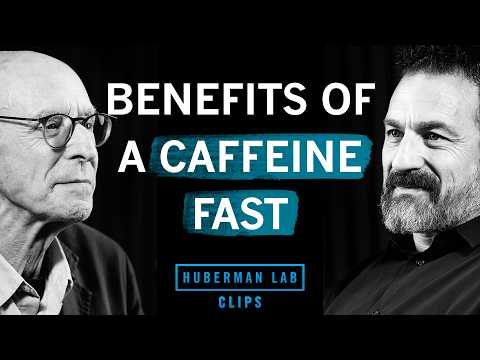
Michael Pollan and Dr. Andrew Huberman discuss fasting from caffeine for three months, what withdrawal felt like, and why that first cup back beat any psychedelic.
Michael Pollan is a renowned author, journalist and professor at UC Berkeley. Dr. Andrew Huberman is a tenured professor of neurobiology and ophthalmology at Stanford University School of Medicine and host of the Huberman Lab podcast.