 Veritasium
AI Summary
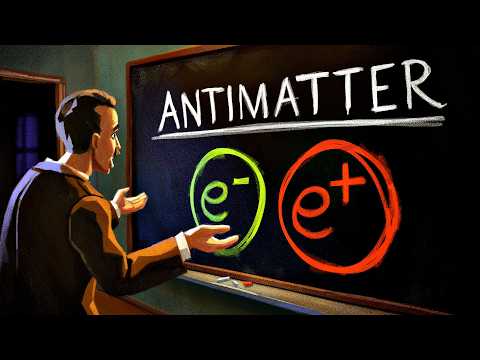
The 1928 Lecture That Shook Quantum Physics
In 1928, a quiet 25-year-old British physicist took the stage in Germany and delivered a detached, matter-of-fact lecture—which Eugene Wigner later remarked sounded like a recitation of a technical text with no sign of enjoyment. Yet the equation he presented sent leading quantum physicists into turmoil: Werner Heisenberg called it "the saddest chapter in modern physics" and wrote to Niels Bohr in despair that he was turning to another field, while Wolfgang Pauli reportedly declared he was quitting quantum physics to write a utopian novel.
The young physicist was Paul Dirac, and his attempt to unify Albert Einstein's special relativity with quantum mechanics had uncovered an apparent absurdity: particles with negative energy.
Relativity Meets Quantum Mechanics: Where Schrödinger Fell Short
In 1905, Einstein showed that because the speed of light is always measured at roughly 300 million meters per second regardless of an observer's uniform motion, space and time merge into four-dimensional spacetime, and mass and energy are linked through $E = mc^2$. Combining rest mass ($mc^2$) and momentum ($p$) yields the relativistic energy-momentum relation:
$$E = \pm\sqrt{(pc)^2 + (mc^2)^2}$$
In classical physics, the negative square-root branch ($-E$) was simply discarded as physically meaningless.
Meanwhile, quantum mechanics emerged to describe atomic scales where energy is discrete and particles like electrons exhibit wave interference. In 1926, Erwin Schrödinger formulated his wave equation by substituting quantum energy and momentum operators into the non-relativistic kinetic energy formula ($E = \frac{p^2}{2m}$), yielding a wave function ($\psi$) whose modulus squared gives the probability of finding a particle.
However, because Schrödinger's equation was non-relativistic, it failed for fast-moving electrons in heavy elements with strongly charged nuclei—predicting, for instance, that gold would look silvery-gray like other metals and that mercury would be solid at room temperature rather than liquid.
The Klein-Gordon-Fock Equation and Its Flaws
In 1926, Oskar Klein—and independently Walter Gordon and Vladimir Fock—inserted quantum operators directly into Einstein's relativistic energy-momentum relation, producing the Klein-Gordon equation. Although useful for certain particles, Dirac and Pauli rejected it for electrons because squaring the energy operator produced a second-order time derivative ($\frac{\partial^2 \psi}{\partial t^2}$):
-
Unlike Schrödinger's equation (first-order in time), knowing $\psi$ alone at an initial moment was no longer enough to predict future evolution; you also needed its initial time derivative.
-
Redefining probability density introduced negative probabilities, which Dirac dismissed as physical nonsense.
Paul Dirac's Derivation: Matrices, Spin, and Beauty
Nicknamed "The Strangest Man" by Niels Bohr—famous for three-hour silent dinners, having colleagues define a "Dirac" as one word spoken per hour, and climbing trees in three-piece suits—Dirac prized mathematical beauty and deductive reasoning. At the 1927 Solvay Conference, he told Bohr he was still searching for a true relativistic theory of the electron.
To eliminate the second-order time derivative, Dirac sought an equation linear in both time and space derivatives, writing:
$$E = c(\alpha_x p_x + \alpha_y p_y + \alpha_z p_z) + \beta mc^2$$
Squaring both sides and matching terms against $E^2 = p^2 c^2 + m^2 c^4$ required four conditions:
-
$\alpha_x^2 = \alpha_y^2 = \alpha_z^2 = \beta^2 = 1$
-
All cross-terms must vanish: $\alpha_i \beta + \beta \alpha_i = 0$ and $\alpha_i \alpha_j + \alpha_j \alpha_i = 0$ (for $i \neq j$).
Ordinary numbers ($\pm 1$) failed because multiplication commutes ($\alpha\beta = \beta\alpha$), making $\alpha\beta + \beta\alpha = \pm 2$ instead of $0$. Drawing on geometric transformations and Werner Heisenberg's 1925 matrix mechanics (where non-commuting multiplication $xp \neq px$ underlies the uncertainty principle), Dirac realized he needed matrices—and that $2 \times 2$ matrices were too small to satisfy all four coefficients simultaneously. Expanding to $4 \times 4$ matrices solved every condition cleanly, yielding the Dirac equation.
Uncovering Electron Spin Automatically
Because the $4 \times 4$ matrices required a four-component wave function ($\psi_1, \psi_2, \psi_3, \psi_4$), Dirac's equation naturally predicted four quantum states. Two of those states automatically accounted for electron spin (spin up and spin down)—an intrinsic angular momentum that acts like a tiny magnet, interacting with the magnetic field experienced in the electron's frame of reference and splitting atomic hydrogen spectral lines into closely spaced doublets, even though Dirac had never set out to include spin.
Negative Energy, Antimatter, and the Discovery of the Positron
The remaining two components created the 1928 crisis: for an electron at rest ($p = 0$), the equation yielded two positive-energy solutions ($+mc^2$) and two negative-energy solutions ($-mc^2$). If negative-energy states existed, ordinary electrons should endlessly emit photons and cascade downward into an infinite abyss of negative energy.
In 1931, Dirac rescued his equation by proposing a bold physical interpretation: the negative-energy solutions corresponded to a previously unknown particle with the exact same mass as an electron but opposite positive charge—an antielectron (representing spin-up and spin-down antielectrons alongside spin-up and spin-down electrons). Just one year later, in 1932, Caltech postdoctoral researcher Carl Anderson accidentally discovered the particle in cloud-chamber photographs of cosmic rays—observing a track as light as an electron curving in the opposite direction in a magnetic field—and named it the positron.
Physicists resolved the infinite-cascade paradox in stages:
-
The Dirac Sea: Dirac initially pictured the vacuum as completely filled with negative-energy electrons; by the exclusion principle, positive-energy electrons could not drop into occupied states, while a vacant "hole" behaved like a positively charged positron (an idea that later found a close mathematical parallel in condensed-matter valence and conduction bands).
-
Antiparticles Moving Backward in Time: In 1941, Ernst Stueckelberg noted that flipping the sign of energy and time together ($-E \times -t = +Et$) leaves the wave function unchanged, meaning a negative-energy electron moving backward in time is mathematically equivalent to a positive-energy positron moving forward in time—an insight Richard Feynman formalized in 1948 with Feynman diagrams.
Antimatter's Legacy and Dirac's Life
Every fundamental particle is now known to have a corresponding antiparticle (such as antiprotons and antineutrinos). When matter and antimatter meet, they annihilate into photons, and high-energy photons can reversibly generate particle-antiparticle pairs (Breit-Wheeler pair production). In the hot, dense early universe after the Big Bang, equal production should have caused complete mutual annihilation—meaning roughly one extra matter particle per billion had to survive to form the matter-dominated universe we inhabit today, an enduring mystery in modern physics.
Dirac shared the 1933 Nobel Prize in Physics with Erwin Schrödinger. Through his friend Eugene Wigner, Dirac met Wigner's sister Margit Wigner in 1934; despite opposite temperaments—he reserved and laconic, she warm and talkative—their marriage thrived, summed up by a friend's remark: "He gave her status, she gave him a life."
Full Transcript
00:00- In 1928, a young man shuffled onto a stage in Germany
00:03to present a lecture on his recent work.
00:06He had a slightly unusual presentation style.
00:09Physicist Eugene Wigner described the lecture as detached,
00:12almost like a recitation of a technical text.
00:15He said, "The man spoke
00:16without giving any sign of enjoying his own lecture."
00:20But the work this strange unassuming man presented
00:22was about to send some of the most famous quantum physicists
00:25of the 20th century spiraling.
00:26(suspenseful music)
00:28After the lecture,
00:29Werner Heisenberg described the man's theory as,
00:31"The saddest chapter in modern physics."
00:33Heisenberg also wrote to Niels Bohr and said,
00:35"I find the present situation quite absurd
00:38and, on that account, almost out of despair,
00:40I have taken up another field."
00:42Legend has it that Wolfgang Pauli
00:44even announced that he was abandoning quantum physics,
00:46and then he started writing a utopian novel.
00:50What had the young man said
00:51to disrupt the world of quantum mechanics so profoundly?
00:55But he had been working on a problem
00:56that physicists are still tackling today.
00:59The unification of Einstein's relativity
01:01and quantum mechanics,
01:03and his work had revealed something troubling,
01:05a particle unlike any scene in the world,
01:08a particle with negative energy.
01:11(suspenseful music)
01:13In 1905,
01:14Albert Einstein published his special theory of relativity.
01:18It was based on the simple idea
01:19that for anyone moving with constant speed,
01:22the laws of physics should be the same,
01:24and this includes any measurement of the speed of light.
01:27So, it doesn't matter how you're moving
01:28relative to a beam of light,
01:30you should measure its speed
01:31to be 300 million meters per second.
01:34This means that things that we ordinarily think of as fixed,
01:37like time and space, have to transform,
01:39so that the speed of light
01:41is always measured to have the same value.
01:43In making this discovery,
01:44Einstein realized that space and time
01:46are not really separate dimensions at all.
01:48They're linked in a four-dimensional fabric
01:50called spacetime.
01:51(pensive music)
01:53When Einstein applied this idea to an object emitting light,
01:55he found something peculiar.
01:58When an object loses energy by emitting photons,
02:00its mass must also decrease,
02:03and the change in the object's mass
02:04is equal to the energy of the photons emitted
02:06divided by the speed of light squared.
02:09In other words,
02:10he found that energy must be equal to mc squared.
02:14E equals mc squared.
02:16- [Einstein] Mass and energy
02:18are but different manifestations of the same thing.
02:22- So, a particle's total energy comes from its momentum
02:25and its rest mass,
02:27giving it new relationship between energy and momentum.
02:30(pensive music)
02:31Now, if we take the square root of both sides,
02:33we get an expression for the energy of a particle
02:35in terms of its mass and momentum.
02:37And if we plot energy versus momentum in a single dimension,
02:40we get this curve, where mc squared,
02:42the rest mass energy of the object,
02:44is the lowest possible value for energy.
02:47But really, when we took the square root,
02:49we should have put a plus/minus out front,
02:51which would give us two curves:
02:53one for positive energies and another for negative energies.
02:57But we don't observe things that have energy less than 0.
03:01I mean, what would that even mean?
03:03So, in classical physics, the solution is simple.
03:06You just ignore the negative energy solutions.
03:08They can't physically represent anything, right, Casper?
03:12- Well, sure, that sounds right.
03:14But around the same time that Einstein
03:15was coming up with his special theory of relativity,
03:18physicists began observing some strange phenomena
03:21in atomic physics
03:22that were overthrowing all of these classical assumptions.
03:25First of all,
03:26they noticed that when looking at the energy levels
03:28of subatomic particles, like electrons,
03:30they weren't continuous at all, they were discrete.
03:33And they also didn't just behave as particles, but as waves.
03:37So, if you would take electrons
03:38and fire them through two narrow slits,
03:40then they would create interference patterns,
03:42just like light does.
03:43What they were discovering
03:44was the new field of quantum mechanics.
03:46(suspenseful music)
03:48And in 1926, Erwin Schrodinger formalized this field
03:51by coming up with his now-famous wave equation,
03:53which describes how quantum mechanical systems
03:56evolve over time.
03:58- This was the most radical new theory of the 20th century,
04:03and would remain so.
04:04This is not a bit like Newton or a bit like Maxwell.
04:08This was radically new.
04:11- [Casper] The equation solution,
04:12called the wave function, psi,
04:14does not describe a particle with a precise position
04:16and momentum as classical laws would.
04:19But instead, the modular squared can give us the probability
04:22of finding the particle in a specific location
04:24at a specific time.
04:25- Deriving the Schrodinger equation
04:27is actually surprisingly simple.
04:29Just start by writing down the total energy,
04:32which, for a free particle, is just its kinetic energy,
04:351/2 mv squared.
04:37And we can rewrite it in terms of momentum,
04:39mass times velocity.
04:41So kinetic energy is just momentum squared divided by 2m.
04:46Now, we're going to make this quantum,
04:48and to do that, we need two things.
04:50The first is the wave function, psi,
04:52which describes how particles act as waves
04:55at quantum scales.
04:56And the second is something called a quantum operator.
04:59This is just a mathematical tool
05:01that extracts information from the wave function
05:04to reveal a specific property of the particle,
05:06like its position, energy, or momentum.
05:09The operators for energy and momentum look like this.
05:14By inputting these operators,
05:16we can make each side of the equation
05:17act on the wave function,
05:19and that gives us the Schrodinger equation
05:21for a free particle.
05:22(pensive music)
05:24For particles that aren't free, like electrons in atoms,
05:27you need to factor in potential energy, too,
05:29which gives you the full Schrodinger equation.
05:31(pensive music)
05:32- But there are some places
05:34where it doesn't produce the right prediction.
05:36For example, take the element gold.
05:38The Schrodinger equation
05:39suggests that it should be a silver gray color,
05:42just like all the other metals.
05:44But it's not, I mean, it's gold.
05:45And for mercury, the Schrodinger equation
05:48predicts that it should be a solid at room temperature,
05:51but it's a liquid.
05:52So, what is wrong?
05:53Well, I'll give you a hint,
05:54because both gold and mercury are heavy elements.
05:58- [Derek] They have a high number of protons
05:59in their nuclei,
06:00which attract orbiting electrons more strongly.
06:03So, if you're thinking in a classical sense,
06:05the electrons would be bound tighter in,
06:08and they'd be whizzing around at higher speeds
06:10than in other elements.
06:11And for electrons in some orbits,
06:13those speeds start to get a little too close
06:16to the speed of light.
06:17(pensive music)
06:18So, let's go back to the Schrodinger equation.
06:20There, we had the kinetic energy was p squared over 2m.
06:24But for particles moving at relativistic speeds
06:26close to the speed of light,
06:27that equation isn't the right one.
06:29The correct equation is the energy momentum relation
06:32from special relativity.
06:34- Schrodinger's equation is not consistent
06:36with the theory of relativity, so it's...
06:38Technically, it's not right.
06:39(pensive music)
06:41- So, the solution seems simple enough.
06:43Just start with the relativistic energy momentum relation
06:46and use that to derive a new wave equation.
06:48(pensive music)
06:50Well, this is exactly
06:51what a physicist named Oskar Klein did in 1926.
06:54He subbed in the same energy
06:55and momentum operators that Schrodinger used,
06:58and found this equation.
06:59(pensive music)
07:01Klein's work was pretty well-received
07:03by a number of his colleagues.
07:04In fact, it turned out the two other physicists,
07:07Walter Gordon and Vladimir Fock,
07:09had independently arrived at the same equation
07:11in that same year.
07:13It became known as the Klein-Gordon equation,
07:15which was a bit of a burn for Fock.
07:18(graphic whooshing)
07:19(graphic twinkling)
07:20But that's often how it goes.
07:22You do all the hard work and then no one notices.
07:25Things have changed a little since Fock's time,
07:27but the key to recognition is still visibility.
07:30And these days, that means having a website.
07:33Simple enough,
07:34you just need to write a couple thousand lines of CSS,
07:37JavaScript, or HTML,
07:39or else pay someone a few thousand dollars to do it for you.
07:42Oh, and then there's the hosting costs and the maintenance.
07:46Or you could check out today's sponsor, Hostinger.
07:49Not only will they get your website online,
07:51their intuitive tools let you build it yourself.
07:54There's no need to learn multiple coding languages.
07:56The Hostinger builder can get you most of the way there
07:59with just one prompt.
08:00You can optimize the website
08:02with their built-in tools for SEO rating,
08:04logo design, and e-commerce.
08:06And once you're happy, you're online immediately
08:08on a domain that's included with the plan.
08:11That whole process is fast and straightforward,
08:13and a subscription is just a few dollars a month.
08:16So, sign up now to get an 85% discount in the sale
08:20and use the code VERITASIUM for an extra 10% off.
08:24Just scan this QR code
08:25or follow the link in the description to get started.
08:28I wanna thank Hostinger
08:29for sponsoring this part of the video.
08:31And now, back to Klein, Gordon, and Fock.
08:35The Klein-Gordon-Fock equation even made its way over
08:38to one of the fathers of quantum physics, Niels Bohr,
08:41who must have been impressed,
08:42because at the 1927 Solvay Conference,
08:45Bohr was chatting to a promising young physicist
08:47about what he was working on.
08:48The young man said,
08:49"I'm trying to get a relativistic theory of the electron."
08:52Bohr replied, "But Klein has already solved this problem."
08:55The young man disagreed.
08:57So, who was this bold 25-year-old?
09:01He was Paul Dirac,
09:02a man who Bohr would later give the nickname
09:04The Strangest Man because he was truly one of a kind.
09:08- First time I went to Princeton,
09:09I met a couple who invited Dirac and his wife.
09:13And Dirac, for the whole meal, which lasted three hours,
09:16didn't say a single word.
09:19Not one word.
09:21He wasn't sulky, he wasn't angry.
09:23He just saw no reason to speak.
09:26- That's crazy.
09:27- [Derek] Dirac was a man of so few words
09:29that his colleagues invented a special unit, a Dirac,
09:33equivalent to speaking one word per hour.
09:35Legend also has it that he liked to relax
09:38by climbing trees in three-piece suits.
09:40And that wasn't his only strange hobby.
09:43As a student, Dirac had attended seminars
09:45on Einstein's theory of relativity,
09:47and he'd kind of fallen in love with it.
09:49He was impressed by the elegance
09:51and beauty of its mathematics.
09:52To Dirac, this got to the core
09:54of what a good theory must do.
09:56He once said, "It is more important
09:58to have beauty in one's equations
09:59than to have them fit experiment."
10:01(pensive music)
10:03- [Casper] Do you know why Dirac was so drawn to relativity?
10:06- Einstein went in there and did it all...
10:09Not all, but almost all by deductive reasoning.
10:12That made a huge impression on Dirac, right?
10:15He realized that it was advanced mathematics
10:18was really important
10:20to understanding the way that nature works.
10:23- So, Dirac found a new hobby,
10:25obsessively updating classical equations
10:27with Einstein's theory of relativity,
10:29so that they would now work
10:31for relative physics scenarios as well
10:32that are those approaching the speed of light.
10:35He later said this was like a game for him,
10:37and so it's maybe not too much of a surprise then
10:40that he was one of the people
10:41trying to unite quantum physics and relativity
10:44because a theory that would cover both of these
10:47would be truly beautiful in his eyes.
10:50- Dirac didn't see the beauty
10:52in Klein, Gordon, and Fock's relativistic update
10:54of the Schrodinger equation,
10:55and he wasn't alone.
10:57Fellow physicist, Wolfgang Pauli,
10:58after reading Klein's paper, wrote him a letter,
11:00wishing his physics a speedy recovery.
11:03Pauli was known for being pretty savage.
11:05And actually, the Klein-Gordon equation
11:07is useful in some cases,
11:09but he and Dirac were both concerned
11:11with one particular feature of the equation.
11:14- And that's because the Klein-Gordon equation
11:16contains this term.
11:17That's a second-order time derivative.
11:19So the wave function is being differentiated twice
11:21with respect to time.
11:23Now, remember, the Schrodinger equation
11:25also contains a second-order derivative,
11:27but that's with space, not with time.
11:29Time is just first-order.
11:30So, why is this such a problem?
11:32Well, think of a very simple second-order time derivative.
11:35Something like d squared y over dt squared
11:39is equal to 3.
11:41Now, to figure out what y is,
11:42the function that satisfies this equation,
11:44we just have to integrate it twice.
11:46(pensive music) (record scratching)
11:50But notice, to find the solution,
11:52we now two integration constants, c and D.
11:56And the problem is that we can only find that
11:59if we know both y at a given time
12:02and if we know the first derivative of y at a given time.
12:06This makes sense physically,
12:07if you think about, say, throwing a ball in the air.
12:10If you want to predict the ball's future motion,
12:12well, then, you need to know where you threw it from,
12:14that's its position,
12:15and how hard you threw it, that's its velocity.
12:19Or in other words, you need to know both the position
12:22and the first derivative of the position.
12:24(suspenseful music)
12:26- Similarly, to predict a quantum systems future state
12:28using the Klein-Gordon equation,
12:30you'd need the initial wave function
12:31and the initial first derivative of the wave function.
12:33(suspenseful music)
12:35Now, the beauty of the Schrodinger equation
12:37was that if you knew only the wave function of a system
12:40at a given time,
12:41you could use it to determine all the future states
12:43of that system.
12:44But in the Klein-Gordon equation,
12:45the wave function no longer told the whole story.
12:48And this introduced a further problem.
12:50The probability of finding a particle in a given area
12:52could no longer be simply described
12:54by the modulus of the wave function,
12:56as it was for the Schrodinger equation.
12:58For the Klein-Gordon equation,
12:59a new equation was needed to describe the probability
13:01using the wave function,
13:02which takes a while to derive,
13:04so we won't get into that here, but it looks like this.
13:08And the problem with that equation
13:09is that unlike the simple modulus of the wave function,
13:12it can have negative solutions, negative probabilities.
13:16How can the chance of something happening be less than zero?
13:20As Dirac put it, that, of course, is physically nonsense.
13:23(suspenseful music)
13:26So, Dirac did what Dirac does best,
13:28and he set out to find his own solution
13:30that contained no second-order time derivatives.
13:33First, he rewrote
13:34the relativistic energy momentum relationship like this,
13:37which is a linear equation.
13:39So no squaring E, that is no squaring the energy operator,
13:43which is what gave rise to that second-order time derivative
13:45in the Klein-Gordon equation.
13:47Now, he just had to solve this equation
13:49and find the coefficients,
13:50alpha x, alpha y, alpha z, and beta,
13:53and he would have a solution.
13:55(pensive music)
13:57To do this,
13:58we can start by squaring both sides of the equation.
14:00Next, we can expand the momentum on the left-hand side
14:03into its three dimensions,
14:04and then expand the right-hand side
14:06to end up with this long equation.
14:08It might look pretty complicated,
14:10but there is a trick we can use.
14:12(pensive music)
14:13And notice that all these terms on the right-hand side
14:15are multiplied by pmc cubed,
14:17but on the left-hand side,
14:19there are no terms containing pmc cubed.
14:21So that tells us
14:22that when you multiply these coefficients together,
14:24like the alpha times beta and beta times alphas,
14:27all of that must be 0.
14:29And similarly, notice that these terms are multiplied
14:31by two different momenta,
14:32like px and py times c squared,
14:35which also don't have a counterpart on the left-hand side.
14:38So these alpha times alpha terms must also be equal to 0.
14:42And that just leaves this top row.
14:44These terms do match on both sides,
14:46which tells us that alpha x squared must be equal to 1,
14:49and so must alpha y squared, alpha z squared,
14:51and beta squared.
14:53So Dirac now had a set of simultaneous equations
14:55for alpha x, alpha y, alpha z, and beta
14:59that he just needed to solve.
15:01That sounds easy, right?
15:02But it's not that straightforward.
15:04- To see why, let's do some examples.
15:06So say alpha x is 1 and beta equals minus 1.
15:11Well, then, we get 1 squared, which is 1,
15:13equals minus 1 squared, which is also 1,
15:16so that satisfies the top equation.
15:18But if we fill it in here, we get 1 times minus 1,
15:22which is just minus 1,
15:23plus minus 1 times 1, which is, again, minus 1,
15:27for a total of minus 2.
15:30So, that doesn't work.
15:31So, let's try another number.
15:33Say alpha x is 1, and now it's alpha z that is minus 1.
15:38Well, in that case, we get 1 times minus 1.
15:41So, again, we get minus 1,
15:43plus minus, 1 times 1,
15:45again, minus 1.
15:46So we, again, get minus 2.
15:49And in fact, if you look at this top equation,
15:51the only numbers that satisfy this relation
15:54is 1 and minus 1.
15:55So all these coefficients have to be either 1 or minus 1,
15:58but if you fill that in,
15:59then the only two possible answers
16:01you're gonna get in these equations
16:03is minus 2 or positive 2.
16:05Now, the two equations
16:07that are giving problems are these two,
16:09and that's because alpha times beta
16:11is the same as beta times alpha.
16:12So, you're always gonna get minus 2 or 2.
16:15So, the only way to get out of this
16:17is to somehow make the order of multiplication matter.
16:20But where do you find something like that?
16:22(pensive music)
16:23- Let's think about a really simple vector,
16:25say 1 in the x-direction and 2 in the y-direction.
16:28If I reflect this vector along the line y equals x
16:31and then reflect it about the x-axis,
16:34I get this.
16:36But if I start again
16:37and instead reflect it first about the x-axis
16:40and then along y equals x,
16:42I get this, which is totally different.
16:44So, the order matters.
16:47How do we express this mathematically?
16:49We need some way to represent transformations,
16:51like reflections as a single coefficient,
16:53which means we need matrices.
16:56Matrices are arrays of numbers
16:58which encapsulate these transformations,
17:00telling us how to reflect, rotate, stretch,
17:02or squish across each dimension.
17:04Mathematically, the order we multiply them matters.
17:08Since we multiply the rows of the first matrix
17:10by the columns of the second,
17:11(pensive music) (graphic whooshing)
17:15A matrix that reflects along y equals x looks like this
17:18and a matrix that reflects about the x-axis looks like this.
17:21(pensive music)
17:23And if I apply them to that original vector one by one,
17:25you can see how we end up with different results.
17:28(pensive music)
17:29And actually, using matrices in quantum mechanics
17:32was not completely out there.
17:34Dirac had already seen it done by Werner Heisenberg,
17:36his new, if unlikely, friend.
17:39Dirac and Heisenberg were very different characters.
17:42Heisenberg was charming and outgoing,
17:44Dirac hated socializing and small talk.
17:46Once the two were on a cruise ship to a conference together
17:49and Heisenberg spent a lot of time
17:50dancing with women on board.
17:52So, Dirac asked him, "Why do you dance?"
17:55Heisenberg replied,
17:56"When there are nice girls, it is a pleasure."
17:59Dirac thought about this for a bit before saying,
18:01"How do you know beforehand that the girls are nice?"
18:05So, they were pretty different guys,
18:06but Heisenberg had a profound impact on Dirac.
18:09(upbeat music)
18:11- Do you know what drew him to quantum mechanics initially?
18:14- He always said that Heisenberg gave him his start,
18:17he always said that.
18:18In later life, he used to begin lectures when he was 70,
18:22even 80 years old, with the following words.
18:24- Quantum mechanics was discovered by Heisenberg in 1925.
18:30- As a PhD student,
18:31Dirac had closely followed Heisenberg's work,
18:34and a few years earlier,
18:35Heisenberg had founded for certain properties,
18:37like position and momentum.
18:39The order of multiplication matters.
18:41So x times p is not the same as p times x.
18:44This was actually the beginning
18:46of Heisenberg's famous uncertainty principle,
18:49which says that there's a limit
18:50to how precisely we can know certain pairs
18:52of physical properties in quantum systems.
18:55It turns out that if the order of multiplication matters
18:58for two properties like position and momentum,
19:00then that means there's an inherent uncertainty
19:03in their combined measurements.
19:04The order we measure them in will change the outcome.
19:08Heisenberg's mentor, Max Born,
19:10suggested that he could represent this mathematically
19:12by using matrices,
19:13because there, the order of multiplication also matters.
19:16(pensive music)
19:17This led Heisenberg to a new form of quantum mechanics,
19:20which was mathematically equivalent
19:22to Schrodinger's equation,
19:24but it was based on matrix algebra.
19:27- Dirac recognized something similar in his coefficients
19:29where the order of multiplication clearly mattered.
19:32So, he thought matrices might be the solution.
19:35For his coefficients,
19:36he tried 2x2 matrices
19:38since they're the smallest, simplest matrices
19:41that could make the order of multiplication matter.
19:44He found that some worked with the equations.
19:46In fact, those reflection matrices
19:47we tried earlier worked well,
19:49but he just couldn't find solutions
19:51for all four coefficients that all worked together.
19:54- So this is not simple.
19:55Dirac is one of the smartest people of the 20th century
19:57in physics, right?
19:58But it was not easy.
19:59You don't have just to twiddle
20:01with bits of the Schrodinger equation.
20:03You'd have to do something completely radical.
20:06His working is in there,
20:07and you could see him really struggling.
20:09- Then, Dirac had a stroke of genius.
20:12He said, "I suddenly realized
20:14that there was no need to stick to quantities,
20:16which can be represented by matrices
20:17with just two rows and columns.
20:19Why not go to four rows and columns?"
20:22(compelling music)
20:30With these four 4x4 matrices,
20:31Dirac got these solutions to his simultaneous equations,
20:35a matrix with 1s on the diagonal
20:36is mathematically equivalent to a 1,
20:39and a whole array of 0s is the same thing as 0.
20:42So, all of the equations were satisfied.
20:44Dirac had found coefficients that worked.
20:47Now, we can substitute those matrices back
20:49into Dirac's linear equation,
20:51then rewrite the three momenta
20:53and alpha coefficients as vectors.
20:55And just as we did with the Schrodinger
20:57and Klein-Gordon equations,
20:58we can use the energy and momentum operators
21:00to make both sides act on the wave function.
21:03If we substitute those operators in,
21:05we get Dirac's final equation
21:07for the relativistic free electron.
21:09(compelling music)
21:11The young man who spent his life
21:12looking for mathematical beauty
21:14had found, perhaps, his most beautiful equation of all.
21:18- The people were expecting the solution to be horrible,
21:21and it turned out to be a thing of beauty, right?
21:24It was something you look at and you think,
21:25"That is absolutely amazing."
21:27It's a pattern that Dirac found deep in nature.
21:31Nothing like that has been seen in physics at that time.
21:34(suspenseful music)
21:35- To see some of that beauty,
21:36you only have to compare it to the Schrodinger equation,
21:39which you can see right here.
21:40Now, the two look very similar,
21:42but there is a lot hidden in the Dirac equation.
21:45First of all, it's relativistic,
21:46so it works at really, really high speeds
21:49because it uses Einstein's energy momentum relationship,
21:51unlike the Schrodinger equation which breaks down there.
21:54But what's even more beautiful is that if you look at this,
21:57Dirac's equation isn't just first order in time derivatives,
22:01it's also first order in spatial derivatives.
22:04Whereas the Schrodinger equation
22:05was second order in spatial derivatives.
22:07So you might wonder, "Well, why does that matter?"
22:09Well, because not only
22:10does going first order in all derivatives
22:12solve the second-order time derivative problem
22:15of the Klein-Gordon equation,
22:16it now also treats time and space symmetrically.
22:19And it becomes really important
22:21if you start thinking about relativity,
22:22where time and space are not separate dimensions,
22:26they're intertwined in a four dimensional spacetime.
22:28And while the Schrodinger equation
22:30had just a single component wave function,
22:32to make the wave function work with these 4x4 matrices,
22:36in Dirac's case,
22:37you actually need a wave function that has four components.
22:40So, it'll look something like this.
22:42Psi one, psi two,
22:45psi three,
22:47and psi four.
22:49- The four-component wave function
22:51means that the Dirac equation describes four possible states
22:54for any quantum system,
22:56which reveals something
22:57Schrödinger's single wave function didn't.
23:00An electron at a given energy level
23:02actually has two possible states
23:04due to different orientations
23:06of its intrinsic angular momentum,
23:08spin up and spin down.
23:10(pensive music)
23:11This spin creates a tiny magnetic field.
23:13So these two states are like tiny magnets
23:16pointing in opposite directions,
23:17and that has an interesting implication.
23:21Take hydrogen, which has one proton and one electron.
23:24Classically, the electron whizzes around the proton.
23:27But if you switch to the perspective of the electron,
23:30well, now, it's the proton that's moving.
23:32And since it's positively charged,
23:33that moving charge creates a magnetic field
23:36in the electron's frame of reference.
23:38So, now you've got this electron,
23:39which has its own mini magnetic field,
23:41interacting with a larger magnetic field,
23:43and that interaction will be slightly different
23:46for a spin up and a spin down electron.
23:49And as a result, some energy levels of the electron
23:52split into two closely-spaced energy levels.
23:55And you can actually see this
23:57if you zoom into the emission spectrum for a hydrogen atom.
24:00(suspenseful music)
24:01Schrödinger's equation didn't predict that splitting
24:04since it just had one solution for each energy level.
24:07But with Dirac's four-component solution,
24:09the top two wave functions
24:10now described two different spin states
24:12with two slightly different energies.
24:14- Dirac admitted himself
24:15that he had never set out to capture spin in his equation.
24:18- I started out this work without any intention at all
24:23of bringing in the spin of the electron.
24:27- [Casper] But hold on, because if an electron
24:29at a given energy level only has two possible spin states,
24:32then why do we have a four-component wave function?
24:34Why are there four states and not just two?
24:37(compelling music)
24:39- [Derek] Well, that's what brings us
24:40back to that 1928 lecture at the start,
24:42the one that seemed to drive
24:43even the most well-established quantum physicists mad.
24:46Because that strange man presenting his work
24:49was actually Paul Dirac
24:50sharing his new equation with the world.
24:53It was Dirac's beautiful equation that Heisenberg called,
24:56"The saddest chapter in modern physics."
24:59(somber music)
25:02- To understand why all those physicists
25:04were losing their minds,
25:05we only have to look at the simple case
25:07when a particle is at rest.
25:09This term right here describes the momentum.
25:11So, when the particle doesn't move,
25:13this becomes 0 and it drops out, which gives us this.
25:17Next, we can sub in the energy for this quantum operator
25:20to get this.
25:21So now, we know that beta times mc squared
25:24must be equal to the particle's energy.
25:26And if we write out beta and multiplied by mc squared,
25:30then we find two positive solutions
25:32and two negative solutions for the energy.
25:35So, negative energy solutions
25:37are baked right into the Dirac equation.
25:39(pensive music)
25:40This idea that a free electron could have negative energy
25:43was impossible for any of these physicists to accept.
25:47Because think about it.
25:48If electrons can have a negative energy,
25:50then that means
25:51that they could continually radiate positive energy,
25:53that is emit photons,
25:55and drop into lower and lower negative energy states.
25:58There would be no limit
25:59to how far they could fall into the negative energy abyss.
26:02(compelling music)
26:03- It looked like, to many very smart people,
26:06and Dirac was smart enough to know they had a point,
26:09that this equation,
26:10it got the mass and the magnetic moment of the electron.
26:14Yes, but on the other hand,
26:15it predicts this ridiculous situation,
26:17where you have negative energy values.
26:19- Right. - That's nonsense.
26:21So, Heisenberg said, "I give up.
26:24This is just ridiculous."
26:26So, Dirac, he had, in some very clear sense,
26:30had to rescue his equation.
26:31(pensive music)
26:32- [Derek] Dirac spent three years sticking to his guns.
26:35He tried all sorts of ways to interpret his new equation
26:38to explain where the negative energy was coming from.
26:42Then, in 1931,
26:43he proposed something radical
26:45to explain the negative energy solutions.
26:47(suspenseful music)
26:50A new kind of particle unknown to experimental physics,
26:53having the same mass and opposite charge to an electron.
26:56We may call such a particle an anti-electron.
26:59We should not expect to find any of them in nature
27:02on account of their rapid rate
27:03of recombination with electrons.
27:05(suspenseful music)
27:08So, Dirac was proposing that those four states
27:11described in his four-component wave function
27:13are a spin up electron, a spin down electron,
27:16a spin up antielectron, and a spin down antielectron.
27:19- When Dirac said that,
27:21people didn't start running around saying,
27:22"Where's this antielectron?"
27:23They just ignored it. - Yeah.
27:25- Cut to the laboratory at Caltech.
27:29- In 1932,
27:30a Caltech postdoc named Carl Anderson
27:32was working on a project
27:33trying to identify the charge particles
27:35produced by cosmic rays.
27:36He photographed the tracks these particles left
27:39in a cloud chamber containing a uniform magnetic field.
27:42Anderson noticed several instances of a similar track.
27:45It looked a lot like the tracks he'd seen left by electrons.
27:48Only, it curved in the opposite direction
27:51in the magnetic field.
27:53Kind of like the tracks of positively charged protons.
27:56But there was no way it could be a proton
27:58based on the length of the track.
28:00It had traveled farther in air,
28:02and therefore it had to be much lighter.
28:04It had to be something with around the same mass
28:06as an electron,
28:07but opposite charge.
28:09A positive electron, or as he named it, a positron.
28:13He actually also tried to rebrand electrons as negatrons,
28:17but that one didn't quite stick.
28:20Just one year after Dirac proposed the antielectron,
28:24Carl Anderson found it entirely by accident.
28:27(uplifting music)
28:29- But this alone doesn't get rid
28:30of the negative energy problem.
28:32Remember what we said earlier.
28:33If any particles, like these positrons,
28:36can have negative energy,
28:37then they could continually radiate energy
28:39and drop into lower and lower negative energy states.
28:42Fortunately,
28:43Dirac proposed a solution to this problem as well,
28:46although it was a little crazy.
28:48(suspenseful music)
28:51- He theorized something called the Dirac sea,
28:53describing a vacuum as an infinite sea of electrons
28:56occupying all available negative energy states.
28:59And since no two electrons can occupy the same state,
29:02this prevents observable positive energy electrons
29:05from falling into the negative energy states.
29:08A hole or vacancy in this sea then becomes a positron.
29:12When an electron and a positron meet and annihilate,
29:15well, that's just an electron falling back into the sea
29:18and filling that hole.
29:19The theory is mathematically sound.
29:21Of course, it's Dirac we're talking about,
29:24but if you feel like it's hard to come to terms
29:26with the idea that we're floating
29:27on an infinite sea of electrons,
29:30well, you wouldn't be alone.
29:33- It's not even that crazy
29:34if, I don't know, several decades later,
29:36people find that exact model in a physical system.
29:40In condensed matter physics,
29:42you see an exact analogy of also having electrons
29:46in the conduction band and say valence-covalence band.
29:49- Yes, that's true. That's true.
29:51But Dirac really was, you know, out there.
29:54You see what I mean?
29:55Maybe it was people like...
29:56He doesn't see it, really seeing that people are saying,
29:58"This is nonsense."
29:59But it was a way of Dirac's rectilinear thinking,
30:02thinking, "Well maybe this is..."
30:03And then it drove him to antimatter.
30:07- Thankfully, in 1941,
30:09a Swiss physicist named Ernst Stueckelberg
30:11had a clever idea.
30:12The way function contains a term that looks like this,
30:15where energy is multiplied by time.
30:17So, we can see that if we just change the sign of time
30:20when the energy is negative,
30:22then we get the same result
30:24because a negative multiplied by a negative
30:26gives us a positive.
30:27Stueckelberg took this,
30:28and he suggested that negative energy electrons
30:30traveling backwards in time are mathematically equivalent
30:34to positive energy antielectrons, that is positrons,
30:37traveling forwards in time.
30:40- A few years later, around 1948,
30:42Richard Feynman took this idea and used it
30:44in one of the most powerful tools in modern physics,
30:46the Feynman diagrams.
30:48In his sketches of particle interactions,
30:50he showed antiparticles
30:51traveling the opposite way to particles backwards in time.
30:54(pensive music)
30:55It was a brilliant trick.
30:57Negative energy solutions
30:58no longer had to mean there was negative energy
31:01or a Dirac sea.
31:02They simply indicated the presence of an antiparticle.
31:05(suspenseful music)
31:10We now know that there's a corresponding antiparticle
31:12for every subatomic particle,
31:14with the same mass, but opposite charge.
31:16So, the proton has the antiproton,
31:18the neutrino has the antineutrino, and so on.
31:21- According to his friend, Heisenberg,
31:23that was the biggest leap in 20th-century physics
31:26to say there's a whole slew of antiparticles
31:31corresponding to particles,
31:32and Dirac got that through this crazy model.
31:34(pensive music)
31:35- But all is not solved.
31:38This new antiworld introduces some big questions
31:41about the very nature of our universe.
31:43Because particles and their antiparticles
31:45are equal and opposite,
31:46when they come together,
31:47they annihilate and produce two photons
31:49with energy equivalent to their mass and kinetic energy.
31:52And this process is reversible.
31:54Two photons with the right energies
31:55can produce a matter and antimatter pair.
31:58This is called Breit-Wheeler pair production.
32:00(suspenseful music) (Big Bang exploding)
32:01During the first moments after the Big Bang,
32:03the universe was hot, dense,
32:05and full of these pairs popping into and out of existence.
32:08If an equal number of matter
32:10and antimatter particles were created,
32:12you would expect them to all annihilate each other
32:14in this dense environment,
32:15leaving behind only energy.
32:17But that didn't happen.
32:19We ended up with a universe full of matter.
32:22If we work backwards from how much matter and antimatter
32:25is in the universe today,
32:26it's actually estimated
32:28that only one particle per billion of matter
32:31needed to survive this hot, dense era
32:33and not get annihilated.
32:35That tiny difference
32:36would give us the makeup of our universe today,
32:39where matter dominates.
32:41- So what allowed that one particle per billion
32:43to escape annihilation?
32:45Why did matter win out over antimatter?
32:47(compelling music)
32:51Well, that's a pretty big question
32:52with some not so simple answers.
32:54So, we're doing an entire second video
32:56where we have some pretty spectacular stuff happening.
33:00We're getting into the beast.
33:01It's absolutely insane.
33:02I feel like I should not be in here.
33:05So you're making anti-atoms?
33:06- Yes.
33:07(energy humming)
33:08- [Casper] It's so cool.
33:09(compelling music)
33:11- Dirac is probably less well-known
33:13than people like Heisenberg or Schrödinger,
33:15but his contribution to quantum physics was immense,
33:18and he was recognized for it.
33:20He shared the 1933 Nobel Prize with Schrödinger
33:23for the discovery of new productive forms of atomic theory.
33:27And perhaps this gave strange, quiet Dirac
33:30some newfound confidence,
33:32because that physicist in the audience
33:33of his 1928 lecture at the start, Eugene Wigner,
33:37actually became a reasonable friend of Dirac's.
33:39And in 1934, introduced Dirac to his sister, Margit Wigner,
33:44a woman who would change Dirac's life,
33:46perhaps more than any equation or Nobel Prize.
33:49(pensive music)
33:52- They were antiparticles, right?
33:54They had completely different personalities.
33:57He had almost no empathy, right? And he knew it.
34:01She had buckets of it.
34:03He hardly talked, she couldn't stop talking.
34:05You could just go on,
34:06like they are completely different people.
34:08But the marriage did work.
34:09My great friend Lilia Harris Chandra, who knew them,
34:12she came out with a great line, great line,
34:15which is, "He gave her status, she gave him a life."
34:20- So, I guess there is one particle-antiparticle pair
34:23that never annihilated.
34:25(pensive music)
34:28(graphic beeping)
34:30(pensive music)
34:37- Hey, one last thing, in case you didn't already know,
34:40we just launched the official Veritasium game.
34:43It comes with 800 questions,
34:45and it's the perfect way to challenge your friends.
34:47Every time we play it at Veritasium,
34:49things get a little bit heated, and that is so much fun.
34:52If you want to go check it out,
34:54then head over to our Kickstarter,
34:56where you can pre-order your own version.
34:58And right now, we've enabled global shipping,
35:00so no matter where you are in the world,
35:02you can get your own version.
35:03We're coming close to the final few days
35:05of the Kickstarter campaign.
35:07So, this is your last chance
35:08to get your hands on the exclusive launch edition.
35:11So, if you wanna support us,
35:13head over to Kickstarter
35:14by clicking the link in the description
35:16or scanning this QR code.
35:17I wanna thank you for all your support,
35:19and most of all, thank you for watching.
Description
How Paul Dirac uncovered the anti-universe.