 Veritasium
AI Summary
The Physics of Spider Silk: Specific Strength and Toughness
In Spider-Man 2, Peter Parker stops a runaway train using stretchy, snapping webs—a comic-book feat rooted in the remarkable properties of real spider silk. At the Blackledge Spider Lab at the University of Akron, researchers study how spiders produce up to seven distinct types of silk, each thinner than a human hair and specialized for a different task: anchoring the web, forming stretchy spirals, trapping prey with sticky droplets, wrapping captured insects, and building the web's structural frame and spokes.
The strongest structural fiber is dragline silk (major ampullate silk), which absorbs the kinetic energy of flying insects colliding with the web. Pulling a strand extracted from an anesthetized garden spider measures two key properties: stress (force divided by cross-sectional area) and strain (change in length divided by original length). At first, the silk stretches elastically and springs back; pulled further, it deforms permanently before snapping at its ultimate tensile strength—roughly 600 megapascals for that sample. Scaled up to a rope with a one-square-centimeter cross-section (about the width of a little finger), that corresponds to roughly 60,000 newtons of force, enough to hold a fully grown African elephant.
In Madagascar, Darwin's bark spider spins webs spanning up to 25 meters across open rivers, producing dragline silk with an ultimate tensile strength of around 1,600 megapascals—more than twice that of typical garden spider silk. While experimental ultra-high-strength steel reaches nearly 3,000 megapascals (roughly three times typical dragline silk), steel is about six times denser. Comparing ropes of equal mass and length gives spider silk six times the cross-sectional area, resulting in roughly twice the specific strength (strength relative to mass) of ultra-high-strength steel.
Why Stretch Makes Spider Silk Tougher Than Kevlar
Strength alone cannot stop a moving object without generating destructive forces—just as a climbing rope must stretch to gradually absorb a climber's kinetic energy, and a spiderweb must yield rather than bounce prey away like a brick wall. The tested dragline sample stretched to 70% of its original length before breaking.
The total energy absorbed before fracture—the area under the stress-strain curve—defines toughness:
-
Kevlar: Up to 50 megajoules per cubic meter (very strong, but stiff, snapping before stretching far)
-
Ultra-high-strength steel: Around 170 megajoules per cubic meter
-
Tested garden spider silk: Roughly 205 megajoules per cubic meter
-
Darwin's bark spider silk: Up to 520 megajoules per cubic meter—roughly three times tougher than steel and 10 times tougher than Kevlar
Spiders manufacture this material at room temperature using water-based chemistry rather than high heat or caustic solvents. Inside the fiber, silk proteins (spidroins) combine two complementary structures:
-
Nanocrystals: Uniform, tightly aligned spidroin stacks (resembling stacked egg trays) stitched together by hydrogen bonds to provide high tensile strength.
-
Amorphous regions: Less-ordered, flexible protein chains linking the nanocrystals like elastic cords, allowing the fiber to stretch and absorb energy across the network.
Why Spider Farming Fails—and How Spiders Spin Silk
For centuries, attempts to harvest natural spider silk at scale have run into severe obstacles. In 1709, Frenchman François Xavier Bon boiled and spun hundreds of spider egg sacs into stockings for the royal court, noting the extreme difficulty of collecting enough material. Centuries later, Simon Peers and Nicholas Godley spent years in Madagascar mobilizing workers to hand-collect more than one million golden orb-weaver spiders to weave a single embroidered cape. Farming spiders directly fails because spiders are cannibalistic—requiring vast space to isolate individuals—and yield only around 100 to 300 yards of silk per cooperative milking. As a result, natural spider silk sells for roughly $700 per 100 milligrams—about $7 million per kilogram, or 50 times the price of gold.
Engineering microbes, plants, and animals to make spidroin proteins—such as DuPont inserting silk genes into E. coli and yeast in the late 1990s, a German team engineering tobacco and potatoes in 2001, and Canadian firm Nexia creating genetically modified "spider goats" whose milk contained silk proteins—solved protein production, yielding powders, gels, or milk solutions. Turning those raw proteins into strong fibers, however, requires replicating the spider's internal spinning process:
-
Tail and Storage Sac: Cells secrete spidroins—composed of hydrophilic N-terminal and C-terminal ends flanking a hydrophobic repetitive region—into the gland. C-terminals pair up, while carefully tuned salts and pH give N-terminals a net negative charge so crowded proteins repel each other instead of clumping, organizing into spherical micelles and larger globules.
-
S-Shaped Spinning Duct: As globules flow through the narrowing duct, wall friction creates shear forces that stretch the proteins, water is drawn out, and a drop in pH adds positive hydronium ions that neutralize negative charges—allowing N-terminals to link into long chains.
-
Drawdown Taper and Spigot: Pulled rapidly through a narrow exit, the aligned chains lock into rigid beta-sheet nanocrystals interspersed with flexible amorphous regions.
Transgenic Silkworms and Swinging From Silk
Because artificially replicating a spider's spinning duct at industrial scale remains difficult, Michigan biotech company Kraig Biocraft Laboratories turned to an insect domesticated for nearly 5,000 years and famously smuggled out of China in hollow canes by two monks for Byzantine Emperor Justinian: silkworms, where each moth lays roughly 500 eggs every 30 days.
Using microscopic glass capillaries and half-micron tungsten needles, researchers inject spider silk DNA into silkworm eggs alongside piggyBac—a natural "jumping gene" (transposon) first discovered in the cabbage looper moth that cuts and pastes DNA at four-letter TTAA sequences—paired with a green fluorescent protein marker so successful transgenics glow under filtered light. Because TTAA sites appear randomly throughout the genome, only 6% to 10% of the resulting fiber is spider DNA, yet the hybrid silk achieves roughly 60% of natural spider silk's strength at low cost (producing around half a ton of cocoons in a year). Newer CRISPR-Cas9 "knock-in/knock-out" techniques aim to target a specific 20-letter sequence inside the silkworm's own silk gene to replace native silk proteins completely.
Meanwhile, companies worldwide—including AMSilk in Germany, Spiber in Japan (working with brands like Goldwin and The North Face), U.S. Army ballistic panel projects, and medical company Newrotex developing silk-based nerve repair—are exploring commercial applications.
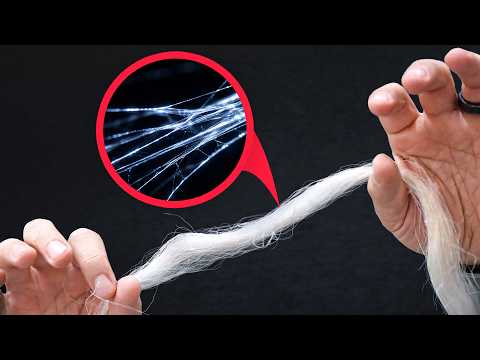
Put to the ultimate physical test in a climbing gym using a continuous multi-filament strand of transgenic spider silk, the line held human body weight during a swing—proving its remarkable tensile strength, while its thin diameter sliced into the swinger's finger, demonstrating both the raw power and practical handling challenges of ultra-thin, high-strength fibers.
Full Transcript
00:00- This is the largest amount of spider silk
00:02that's ever been put together for a test like this.
00:05So I'm gonna put it to the ultimate test,
00:06and try to be the first person ever to swing
00:09from spider silk.
00:10I don't know if it's going to hold my weight, so let's see.
00:12In three, two, one. (Derek yelling)
00:17- In "Spider-Man Two,"
00:18Peter Parker is on a runaway train full of passengers.
00:21And to stop it from derailing,
00:22he stands in front of the train,
00:24fires webs at the buildings around him, and holds on.
00:27The webs stretch, some of them snap,
00:29but they do just enough to slow down the train
00:31and save everyone on board.
00:33It sounds like something straight out of a comic book.
00:36But real spider silk,
00:37the fiber that makes up a spider's web,
00:39well, it truly might be this incredible.
00:42It's reportedly stronger than steel. It's pretty strong.
00:45That's crazy!
00:46And 10 times tougher than Kevlar.
00:49To find out if that's really true,
00:50I went to the Blackledge Spider Lab
00:52at the University of Akron,
00:53one of the world's leading research centers
00:55studying spider silk.
00:56Before I went to the lab,
00:58I'd always assume that a spiderweb was made
01:00from just one kind of silk.
01:01But that's actually not the case.
01:03One type of silk anchors the web to a surface.
01:05Another forms this stretchy spiral,
01:07and a different sticky silk catches prey.
01:10Once something's trapped,
01:11the spider switches to yet another silk to wrap it up.
01:14- The threads are all thinner than your hair,
01:16so they're going to look pretty similar to each other
01:18unless you use a microscope.
01:20- [Henry] All in all,
01:21there are seven different types of silk,
01:22but the strongest is the dragline silk,
01:24which holds the web in its place.
01:27- We've got the two main structural threads in this web.
01:30So the spokes on the wagon wheel
01:33and the outer framework here, that's all the dragline silk.
01:36It's called major ampullate silk if you want the fancy word.
01:39- The major ampullate is that one
01:40that commonly compared to steel?
01:44- Yes! - Okay.
01:45- Absolutely.
01:46And that's partly because it's function in a web like this.
01:49A bug hits it, to stop that moving bug,
01:52most of the work is done by the dragline silk.
01:55- [Henry] To do this,
01:56the dragline silk has to be incredibly strong.
01:58So to find out how it compares to steel,
02:00we wanted to run a test,
02:02but it turns out that getting the sample isn't so easy.
02:05All right, we've taken a garden variety spider
02:07and knocked it unconscious using CO2.
02:10We brought it over here and we put it down with tape.
02:12I then started pulling out the dragline silk by hand.
02:15It's so light that you can barely feel it.
02:17We've attached it to this big rotating mechanism
02:20which they custom made to milk spiders.
02:22(bright music)
02:26No spiders were harmed in the making of this video.
02:29Now that we've got our silk,
02:30we can put one strand into a machine
02:32that slowly pulls on our sample.
02:34And as it pulls, we'll monitor two key properties.
02:37When you pull on the silk,
02:38that force is spread over a tiny cross-sectional area.
02:41If you divide the force by that area, you get the stress.
02:44Now, as you pull, the silk is also stretching.
02:47To see just how much, we divide the change in length
02:49by the original length to get a measure called the strain.
02:53At first, as the stress increases,
02:54the strain increases roughly in proportion.
02:57And if we stop pulling here,
02:58the silk would spring back to its original length.
03:01But keep pulling and eventually it passes a point
03:03where some of that stretching becomes permanent.
03:06And it's pulling.
03:08- [Videographer] All right.
03:09You film that, I'm going to be filming this.
03:11- [Henry] And it broke. - [Videographer] Wow!
03:13- [Henry] Eventually, if you keep pulling on the silk,
03:15it will break.
03:16And at that point, the force applied,
03:18divided by the cross-sectional area
03:20is called its ultimate tensile strength.
03:22- We're at about 600 megapascals.
03:25- [Henry] To put that in perspective,
03:26if you had a rope of spider silk
03:28that had a cross-sectional area of one square centimeter,
03:30roughly the size of your little finger,
03:32it could support about 60,000 newtons of force.
03:35That's the weight of a fully grown African elephant.
03:38And that's not even the strongest spider silk out there.
03:40- Breaking stress wasn't incredible for this piece of silk.
03:45- [Henry] Deep in the jungles of Madagascar
03:46lives the Darwin's bark spider.
03:48Its diet consists of flying insects
03:50that zip over wide rivers.
03:51So to catch its prey, the Darwin's bark spider
03:54has to spin giant webs that stretch up to 25 meters
03:57over open water.
03:59And to survive that kind of distance and tension,
04:01its silk has to be incredibly strong.
04:03It has an ultimate tensile strength
04:04of around 1,600 megapascals.
04:07That's more than twice the strength of our sample.
04:09But experimental ultra high strength steels
04:11can reach an ultimate tensile strength
04:13of nearly 3,000 megapascals.
04:15That's about three times that of typical dragline silk,
04:18but steel is also about six times denser.
04:21So for two ropes with the same mass and length,
04:23the silk rope has six times the cross-sectional area.
04:26Six times the area at one third the strength,
04:28well, that gives a rope that can take twice the force
04:30before it snaps.
04:31This measure of strength relative to mass
04:33is called specific strength.
04:35And it means that for the same mass and length,
04:37spiderwebs can withstand roughly twice the force
04:39of ultra high strength steel before breaking.
04:42- So that's where ounce for ounce,
04:44spider silk is quite strong.
04:46You got to think about what is the application
04:49you're talking about using this material in.
04:51Is it somewhere where you don't care about weight,
04:53and you need the strength?
04:54Then steel's going to be perfectly fine.
04:55But if weight matters,
04:57spider silk is really the champion there
04:59for tensile strength.
05:01- [Henry] But strength alone isn't enough.
05:03To see why, look at rock climbers.
05:05If a rock climber was just hanging, all we would care about
05:08was if the rope could support their weight.
05:09That's strength. But climbers don't just hang, they fall.
05:14And now the rope has to bring them to a stop,
05:16which means absorbing that kinetic energy.
05:18Stop the fall in a short distance,
05:19and the energy has to be absorbed quickly.
05:22The forces are enormous.
05:23Stretch it out and that same energy is absorbed gradually,
05:26so the forces are lower.
05:28So to absorb more energy without snapping,
05:30it has to stretch further.
05:32And that's actually not so different from spider silk.
05:34- So a bug hits this web, you've got to stop the flight
05:39of that bug pretty quickly.
05:40And you could do it by just building
05:42a really stiff structure.
05:43Think like a brick wall, you throw a tennis ball against it.
05:46You're gonna stop that ball instantly.
05:48But that doesn't work very well if you want to catch a meal.
05:51- It'll bounce off. - Because it'll just fall out.
05:53And so it helps to slowly decelerate the insect
05:56so that the web has time to stick to it,
05:59and keep the meal for the spider to subdue.
06:02- [Henry] So the spider silk has to be quite stretchy.
06:04- This piece of silk stretched to 70% of its length
06:09before it broke,
06:10which is really exceptional for dragline silk.
06:12- [Henry] Now, every tiny bit of stretching
06:14absorbs a little bit of energy.
06:16If you add all these tiny amounts together,
06:18the result is the total energy the material absorbs
06:20before breaking.
06:21On a stress/strain graph,
06:22it's proportional to the area under the curve.
06:25This is the material's toughness.
06:27Kevlar, the material used in bulletproof vests,
06:29whose whole job is to take the energy of a bullet
06:31and spread it out before it reaches the body, well,
06:34it has a toughness of up to 50 megajoules per cubic meter.
06:37Experimental ultra-high strength steel
06:39has a toughness of around 170 megajoules per cubic meter.
06:42But spider silk?
06:44- This piece of silk had a toughness
06:47of about 205 megajoules per cubic meter.
06:50- Oh, okay. So that might be like four times Kevlar.
06:53But the silk from the Darwin's bark spider
06:55can have a peak toughness of 520 megajoules per cubic meter.
06:59That's roughly three times the strongest steel out there,
07:01and 10 times as tough as Kevlar.
07:03See, Kevlar has a very high tensile strength,
07:05but it's also quite stiff.
07:07Compared with stretchy spider silk,
07:09that means that the stress/strain graph rises sharply
07:11and fails before it can stretch very far.
07:14So it's not able to absorb as much energy.
07:16And that's why spider silk wins on toughness.
07:19- But it's the ultimate in green chemistry.
07:21They're not using the high temperature,
07:23or the caustic solvents that most of the polymer industry
07:27uses to make high performance threads.
07:30They're doing it at room temperature, inside a living body,
07:33with the same basic building blocks
07:35that you use to build your hair and your skin.
07:37- Now, the secret to spider silk's
07:39unbelievable natural strength
07:40lies in how those building blocks are arranged.
07:43If you look inside a silk fiber,
07:45you'll find spider silk proteins called spidroins.
07:48In some regions,
07:49the spidroins are arranged in similar size and shape,
07:52and they're closely aligned along its length.
07:54They're kind of like stacked egg trays.
07:56These are nanocrystals.
07:58In other areas, the spidroins aren't so uniform.
08:00Here they're less ordered,
08:01and they can move and change shape more freely.
08:04These are called the amorphous regions.
08:06Together, they work like a network of tiny rigid blocks
08:09connected by elastic cords, which I have in front of me.
08:12When I pull on the network,
08:13the cords stretch, and they absorb energy.
08:15The blocks don't stretch much,
08:16but each one connects to several cords,
08:18which spreads the pull across the network.
08:21So the amorphous regions let the silk stretch
08:23while the nanocrystals help it withstand a much larger pull.
08:26Together, they allow the silk to absorb
08:28a tremendous amount of energy before breaking,
08:30which makes it so tough.
08:32The result is a material that's stronger than steel
08:34by weight and also tougher than Kevlar.
08:37It sounds perfect for making climbing ropes,
08:39parachute cords, airbags, even bulletproof vests.
08:42But we actually aren't using spider silk for any of that,
08:45even though we've been trying to for centuries.
08:47In 1709, a Frenchman named Francois Xavier Bon
08:50painstakingly collected hundreds of spider egg sacs,
08:53boiled them, combed them like wool, spun them into thread,
08:57and then used them to make stockings
08:58that attracted the attention at the royal court.
09:01But this was harder than it sounds.
09:03As he later said,
09:04"The only difficulty now lies in procuring
09:06a sufficient quantity of spider bags
09:08to make any considerable work of it."
09:10Three centuries later, Simon Peers and Nicholas Godley
09:13led a years long project in Madagascar,
09:15in which teams of Malagasy workers gathered
09:17more than a million golden orb weaver spiders
09:20in the jungle by hand.
09:21They extracted their silk and painstakingly wove
09:24and embroidered it into a single golden cape.
09:27Why hadn't they tried farming the spiders instead?
09:29Well, attempts to do that all run into the same problem.
09:32Spiders are cannibals.
09:34The big problem with spiders is that they eat each other?
09:38- That's one of the big problems.
09:39And then you can't just keep them
09:40in a tiny little container.
09:42You're going to have to have a lot of real estate
09:43if you're going to have a farm with 10,000 spiders on it.
09:46- [Henry] Even if you could get your hands
09:48on that many spiders, as we've seen,
09:49milking them is difficult,
09:51and the spiders don't always cooperate.
09:53- Really cooperative spider will give you 300 yards of silk.
09:57100's a lot more typical,
10:00but they kind of have their own individual personalities.
10:02Some of them will just break the thread right away,
10:04and not even cooperate with you.
10:06- That's why natural spider silk is so scarce.
10:08One supplier charges $700 for 100 milligrams,
10:11which works out to roughly $7 million per kilogram.
10:14That's roughly 50 times the price of gold.
10:17Okay, so we can't farm spiders for their silk,
10:19but we know what the proteins are,
10:21so surely we can just make them?
10:23Well, scientists have tried.
10:24By the late 1990s, researchers at DuPont took the genes
10:27that code for spider silk proteins
10:29and put them into E. coli and yeast.
10:31These living cells are like protein factories.
10:34One engineered cell quickly becomes millions.
10:37It worked,
10:37but scientists wanted an even more efficient method.
10:40So in 2001,
10:41a team in Germany tried implanting spider silk genes
10:44into plants like tobacco and potatoes.
10:46But if you really want to produce a lot of protein
10:49in a concentrated form, look at milk.
10:51To feed their young,
10:52mothers produce milk with high concentrations of proteins.
10:55So around the same time,
10:57a Canadian company called Nexia
10:58tried something much stranger.
11:00They put spider silk genes into goats,
11:02creating genetically modified spider goats.
11:05No, no, really, they made spider goats.
11:07These goats produce milk chock-full of spider silk proteins.
11:11In one sense, it worked.
11:12All the experiments were able
11:13to produce spider silk proteins,
11:15but they ran into the same problem.
11:17From E. coli or yeast,
11:19these proteins were purified as a fine white powder.
11:21From plants, the purified proteins formed a viscous,
11:24gelatin-like liquid.
11:26And from goats, it was dissolved in the milk.
11:28None of these even vaguely resemble spider silk.
11:31- And that's one of the secrets that any company
11:34that really wants to mimic spider silk
11:36at an industrial scale needs to kind of figure out
11:39is how to process silk proteins the way spiders do.
11:44- But that's easier said than done.
11:46In a spider, it all starts in the silk gland
11:49in a region called tail.
11:50Cells here make proteins called spidroins,
11:53and they secrete them into the fluid inside the gland.
11:56Every spidroin has three main parts.
11:58One end is called the N-terminal,
11:59and the other the C-terminal.
12:01And between them is a long repeating sequence
12:03of amino acids.
12:05This is called the repetitive region.
12:06Once inside the tail, the C-terminal ends pair up,
12:09which links neighboring spidroins together.
12:11But the N-terminal ends stay mostly separate.
12:14So the spidroins are still loose enough to bend,
12:16coil, and move around.
12:18Next, they move into the storage sac,
12:20where they're packed together at high concentrations.
12:23Normally, proteins this concentrated
12:24would stick to each other, and clump into a solid,
12:27but this can be modified with a careful balance of salts
12:30and by changing the pH.
12:31The pH is a measure of the concentration
12:33of hydronium ions in a solution.
12:35And because hydrogen ions are little positive charges,
12:38you can think of the pH like a dial
12:40that controls the electrical charge
12:41on different parts of the protein.
12:43In the storage sac, the pH is tuned
12:45so that the N-terminal ends carry a net negative charge.
12:48Every protein carries the same charge.
12:50And since like charges repel, when you crowd them together,
12:53they shove apart instead of sticking together.
12:55Now, the spidroins are still crowded
12:56in this aqueous solution, and at such high concentrations,
12:59they begin to gradually rearrange.
13:01The N-terminals are attracted to water.
13:03These are hydrophilic.
13:04While the repetitive region is repelled by it,
13:06this is hydrophobic.
13:08So the spidroins rearrange,
13:10and you end up having these hydrophilic parts
13:11facing outward towards the water.
13:13And hydrophobic parts tuck themselves inside away from it.
13:16They then form these tiny structures called micelles.
13:19And the micelles cluster together into larger globules.
13:23These globules next enter the spinning duct.
13:26- For the dragline silk, the duct is kind of S-shaped,
13:30but it gets skinnier and skinnier.
13:33- [Henry] As the globules go through the narrow duct,
13:35the liquid near the walls rubs against the surface,
13:37and it moves more slowly,
13:38while the liquid in the middle moves faster.
13:41So the layers slide past each other,
13:42which is known as shear.
13:44These shear forces stretch and deform the globule.
13:47- You also remove some water, so water goes out.
13:51You get a drop in pH, so it becomes a little bit more acidic
13:56as you go down this duct.
13:59- So the proteins are then being changed
14:00in two ways at once.
14:01Mechanically, they're being pulled and aligned.
14:04And chemically, that drop in pH
14:05means that there are now more positive hydronium ions
14:08in the solution.
14:09These bind to the negative parts of the proteins,
14:11neutralizing them.
14:13Now all the proteins don't repel each other as strongly,
14:15and so the N-terminal ends begin pairing,
14:18linking the proteins into long chains.
14:20These chains are pulled through a tiny narrowing
14:22called the drawdown taper, which leads to the spigot.
14:25Here, the spider pulls the liquid through a small opening.
14:27This forces the liquid to speed up.
14:29And as it speeds up, it stretches.
14:31It's this final stretch that pulls neighboring spidroins
14:34tightly alongside one another.
14:36Now, depending on the sequence of amino acids,
14:38some sections fold into zigzag strands.
14:41These strands then interlock
14:42and rows of hydrogen bonds stitch them into rigid,
14:44sheet-like structures,
14:46which stack together into the nanocrystals
14:48that give the spider silk its strength.
14:50In other sections, the spidroins don't fold as neatly.
14:53That's how you get the amorphous regions
14:54which give the silk its stretch.
14:56Exactly how the proteins assemble
14:58inside the spinning duct is still being studied.
15:00No one fully understands it yet,
15:02and that makes recreating the process
15:03in a lab quite difficult.
15:05So scientists wondered,
15:06"What if instead of starting from scratch,
15:08you used an animal that already has a spinner?"
15:11This is exactly what researchers
15:12at Kraig BioCraft Laboratories,
15:14a biotech company in Michigan, have been working on.
15:17What's more, they're doing it with an insect
15:18that humans have been farming for nearly 5,000 years.
15:23According to legend,
15:24a Chinese empress was relaxing in her garden,
15:26when something fell into her teacup.
15:28She looked inside, and saw a cocoon.
15:31The hot water loosened it.
15:32And when she lifted it out,
15:34it unraveled into a single shimmering thread.
15:36So long that it stretched across her entire garden.
15:39This was silk.
15:41Whether or not that story's true,
15:42people eventually learned to farm the insect
15:44that made the thread.
15:46(jaunty music) Silkworms.
15:47They're the caterpillars of the domesticated silk moth.
15:50Silk quickly became one of the most valuable materials
15:53in the land.
15:53It dressed emperors and spurred trade
15:55connecting East Asia and Europe.
15:57So much so that it gave the trade route its name,
15:59the Silk Road.
16:01For nearly 2,000 years, China guarded the secret.
16:04But of course, people were always trying to steal it.
16:08By the mid-sixth century,
16:09the Byzantine Empire was in trouble.
16:12Plague had devastated the population.
16:13And on top of that,
16:14the purchase of silk was draining its gold.
16:17The problem was that Byzantines couldn't make silk.
16:19Most of it had to come through Persia,
16:21the very empire it was fighting.
16:23So Emperor Justinian made a secret deal with two monks.
16:27They would travel east, find the source of silk,
16:29and then smuggle it back.
16:31They returned with a secret
16:32hidden inside their hollow canes.
16:34Silkworm eggs.
16:36This may be the first recorded case
16:37of industrial espionage in history.
16:39With that, Byzantium could finally make its own silk.
16:43Nowadays, we farm them by the millions.
16:45- One moth lays 500 eggs. - [Henry] Okay.
16:48- So when you talk about growing productions, right?
16:50Like my wife and I had a baby.
16:53These guys, they have 500 babies.
16:55And they do it every 30 days.
16:57- So the researchers at Kraig wondered,
16:58"What if we could make the silkworm
17:00spin spider silk instead?"
17:02- When we create a transgenic silkworm,
17:04we're taking the genetics of a silkworm,
17:06and the genetics of a spider,
17:07and we're putting those together.
17:08We're taking the best aspects of both.
17:10And that's what we're doing to create our fibers.
17:12- [Henry] They start by gluing eggs onto a slide,
17:14which they line up under a microscope.
17:16- So this is the microinjection station.
17:18We're talking about eggs
17:19that are the size of the head of a pen.
17:21We're talking about needles
17:22that are half a micron in diameter.
17:23- This part is the, I want to inject.
17:26So as you see, this is the tungsten needle
17:29and this is the glass capillary.
17:32And first we poke a hole with the tungsten needle.
17:36I will actually move the eggs to the capillary and poke.
17:41- The fluid carrying the spider DNA
17:43is then injected into the part of the egg
17:45that will eventually become the silkworm.
17:47But at this point, the genes are still separate.
17:49They have to become part of the silkworm's own DNA.
17:52And luckily, nature already has a way of doing that.
17:54If you take an insect like a moth
17:56and look inside its genome,
17:57you'll see some stretches of DNA that move around.
18:00They jump from one place in the genome to another.
18:03These are called jumping genes, or transposons.
18:06One specific one is called piggyBac,
18:08and it was first identified in a cabbage looper moth.
18:12PiggyBac is a piece of DNA
18:13with two short sequences at its ends,
18:15and it works together with an enzyme
18:17that recognizes these ends, cuts the whole piece out,
18:19and inserts it somewhere else in the genome,
18:22kind of like a natural cut and paste system.
18:24What scientists realized is that if the enzyme
18:26only looks at the two ends,
18:28then you can keep those ends the same,
18:29but change what sits in the middle,
18:31and use that to implant the DNA of your choosing.
18:34So in the lab, the DNA in the middle
18:36is replaced with the spider silk gene.
18:38This, together with separate instructions
18:39for making the enzyme,
18:40is what's then injected into the silkworm egg.
18:43And inside the egg,
18:44the enzyme recognizes the familiar end sequences and cuts
18:47and inserts the spider silk gene into the silkworm's DNA.
18:50If everything works, it becomes a permanent part
18:52of the silkworm's genome.
18:55Now with silkworm where the edit worked
18:56looks almost exactly like one where it didn't.
18:59- [Jon] The first approach we used
19:00was creating transgenics with the glowing cocoon.
19:03A green fluorescent protein is what's making these guys glow
19:07that green color under this particular wavelength
19:09with that particular light filter in front of it.
19:11- [Henry] It feels magical.
19:13And there's a living thing inside of it.
19:15- [Jon] Mm hmm, yep.
19:16- [Henry] And it's creating the glowing effect.
19:17- [Jon] Yeah.
19:18- [Henry] But even if the DNA insertion is successful,
19:21it might not have ended up in the right place.
19:23- If I create the world's best recipe
19:25for chocolate chip cookies,
19:26and I stick it in the pasta section-
19:28- [Henry] Yeah.
19:29- You're probably not going to make
19:30a lot of chocolate chip cookies, right?
19:30'Cause you're not going to see it.
19:31- [Henry] Yeah. - Same thing for this, right?
19:33We want the recipe in the right section
19:35of the right cookbook.
19:36- That's why getting the spider silk gene
19:38into the silkworm isn't enough.
19:40- We really want the spider silk get incorporated
19:43into their silk gland, not any other tissue.
19:47- [Henry] But piggyBac only looks
19:49for a four-letter DNA sequence.
19:51TTAA.
19:52- There's so many TTAA in their genome.
19:56You couldn't really control where they were.
19:59- [Henry] So it's like there are a lot of different places
20:00where they could park. - Yeah, yeah, that's true!
20:03- And that means that it won't spin pure spider silk.
20:06If you had to estimate, of the transgenic silk,
20:08like what percentage is spider DNA?
20:10- Like 6%, 10%. - That's insane to me!
20:13So even with this limited gene transfer,
20:15the fibers still achieve much of the mechanical performance
20:17of pure spider silk.
20:19- Our average samples are usually about
20:2160% of spider silk, right?
20:24Which, show me any other place in the world
20:26where you can get materials that perform at 60% the strength
20:29of spider silk that you can make cost effectively, right?
20:31- [Henry] To push the 60% average even higher,
20:33the insertion needs to be more targeted.
20:35- The next step is to create pure,
20:38what are called knock-in/knockout transgenics
20:39where we will completely remove all aspects
20:42of the silkworm's native DNA for the silk,
20:44and replace that completely with the spider silk protein.
20:46- And to do that, most of the leading labs in the field
20:49are exploring CRISPR-Cas9.
20:51This tool has two parts.
20:53The first is a guide, a short piece of genetic code
20:55designed to match one exact stretch of DNA.
20:58Unlike piggyBac,
20:59which recognizes a sequence just four DNA letters long,
21:02this guide matches about 20 letters,
21:04making it far more specific.
21:06The second is a cutting protein.
21:07When the guide finds its matching sequence,
21:09the protein cuts the DNA.
21:11Here, that spot is inside the silkworm's own gene
21:13for making silk.
21:15The cell immediately tries to repair the break,
21:17and scientists take advantage of this
21:18by also injecting donor DNA, carrying the spider silk gene.
21:22As the cell repairs the cut, it copies in that donor DNA,
21:26stitching the spider silk gene
21:27into this one precise location.
21:29But this process is still an active development.
21:31And Kraig is not the only group
21:33chasing the dream of spider silk.
21:35In Germany, AMSilk is making proteins for fibers,
21:38coatings, powders, and hydrogels.
21:40And in Japan, Spiber is brewing protein fibers
21:42through fermentation.
21:44Brands like Goldwin and The North Face
21:46have already used a version of these fibers
21:48in their clothing.
21:49And the military has been interested too.
21:51In 2016, the US Army funded Kraig
21:53to produce ballistic shoe packs,
21:54panels layered with transgenic silk
21:56that are designed as potential body armor.
21:59And it's even being explored in medicine.
22:01For centuries,
22:02surgeons have stitched wounds together with silk.
22:04But now a company called Newrotex is using spider silk
22:07to help repair damaged nerves.
22:10So if it can be produced cheaply,
22:11spider silk could find its way into clothing,
22:13armor, implants, even nerve repair.
22:16But to do that, we're going to need a lot of it.
22:19- And this is our specialized spider silk. There you go.
22:24- This is the transgenic spider silk.
22:25- [Jon] This is spider silk.
22:26This is transgenic spider silk.
22:28- What? This is like a bale.
22:29This is a hay bale of spider silk.
22:30- So last year we produced about a half a ton
22:35of spider silk cocoon. - Half a ton.
22:37- And this is silk from that.
22:38- But what about our original question?
22:40Can you use transgenic spider silk to swing like Spider-Man?
22:44So Derek, I've got you here in a climbing gym
22:47for a very good reason.
22:49And the reason is underneath this dirty dish towel.
22:52- Unveil it, unveil it. Yeah, go.
22:53All right, okay. This looks very uninspiring.
22:58- [Henry] So what's interesting is
23:00this is one continuous filament.
23:02- This is just one strand.
23:03- But each one of these strands
23:05is actually 10 individual silk filaments
23:07that are kind of connected. - All right.
23:09So you want me to hang from this?
23:11- I do want you to hang from it, yes.
23:13I actually want you to do more than just hang from it.
23:14I want you to swing.
23:16- This will be the first time ever
23:18anyone has ever swung from actual spider silk.
23:22Granted this spider silk came from other organisms, but...
23:25(mysterious music)
23:29I don't know if it's going to hold my weight, so let's see.
23:32In three, two, one.
23:40- You really came close! (Derek and Henry laughing)
23:43(dramatic music)
23:53(dramatic music continues)
23:58- Don't tell anyone, but Spider-Man.
24:02(dramatic music)
24:07- Okay, so we've seen it can hold your weight
24:09pretty reasonably.
24:10We could swing, but I do want to put it to the ultimate test
24:13and get you up there.
24:15How much do you trust spider silk?
24:16- Tensile strength doesn't lie.
24:18- All right, let's get you up there.
24:20(tense music)
24:21- We used the title,
24:22"Risking my life to settle a physics debate" too early.
24:26(tense music)
24:31It feels like it's going to dig into my fingers.
24:34- [Speaker] This is crazy. (tense music)
24:46(tense music continues) (Derek yelling)
24:47- I'm going to go. I'm going to go!
24:50(tense music)
24:52- [Henry] Whoo! (Derek yelling)
24:54Let's go!
24:57- You got to see my finger, man!
25:00- [Henry] Ooh, damn!
25:01- Yeah. This is the problem with spider silk.
25:05Just, it's thin, it's strong,
25:09and it just rips you open.
25:11- Now, if it isn't clear,
25:12we're not exactly web-swinging experts.
25:14But we'd love to get the silk into of the hands
25:16of someone who is.
25:18- Tom Holland, this is a challenge.
25:19Yeah, I'm calling out Tom Holland.
25:21I'm calling out all them guys.
25:22Andrew Garfield, Tobey McGuire.
25:27That's right. Come at me, bro.
25:30(electronic music)
25:33- See, spider silk is so strong
25:35and so thin that it actually cut Derek's skin.
25:37And that's actually a great way
25:38to explain the design flaw with modern razors.
25:40Thanks to Henson Shaving for sponsoring this video.
25:43See, facial hair resists more than you think.
25:45And many razor blades are engineered so thin
25:47that they bend under that resistance.
25:49This is called blade flex.
25:51Now, most razors actually build this flex in.
25:53They use springs, pivots,
25:55and flexible mounts that allow the blade to move.
25:58It's supposed to make the shave feel gentler,
26:00but it means that the cutting angle is constantly changing.
26:02When unsupported, the blade bends mid-stroke
26:05and instead of slicing cleanly,
26:06it tugs the hairs, micro-cutting the skin.
26:09That's what causes irritation.
26:11The usual fixes are lubrication strips or extra blades,
26:14but they don't solve the real problem.
26:16The blade is still allowed to flex.
26:18We assume that razor bumps and irritation are inevitable,
26:21but that's shaped by bad design.
26:23But Henson is designed by aerospace machinists
26:26who control cutting forces with high precision.
26:28And their razors use a single precisely-machined blade.
26:31Instead of letting it move,
26:32Henson's design supports the cutting edge
26:34with tight machining tolerances,
26:36holding the blade securely so the angle is consistent.
26:39Remove the flex, remove the irritation.
26:41Use code "Veritasium" for 100 free blades
26:43with any razor purchase.
26:44Just add both the razor and blades to your cart.
26:46Thanks to Henson Shaving,
26:47and as always, thanks for watching.
Description
Can you really swing from spider silk?