 Cleo Abram
AI Summary
Neutrinos: The "Ghost Particles" Unlocking Extreme Cosmic Events
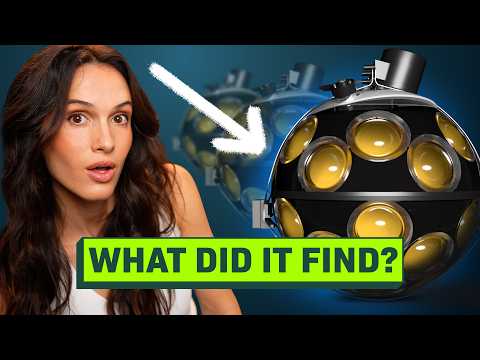
Off the coast of Sicily, hundreds of spherical optical sensors—spooled into large bundles and unrolled deep underwater to nearly twice the height of the Empire State Building—feed signals to a computer station inside a converted winery. In 2023, that array detected a particle far smaller than an electron traveling at nearly the speed of light, generating a signal roughly 30 times stronger than any comparable event previously recorded. When telescopes worldwide pointed toward the sky to locate its source, they found nothing—highlighting both the mystery of deep space and the promise of a new observational window.
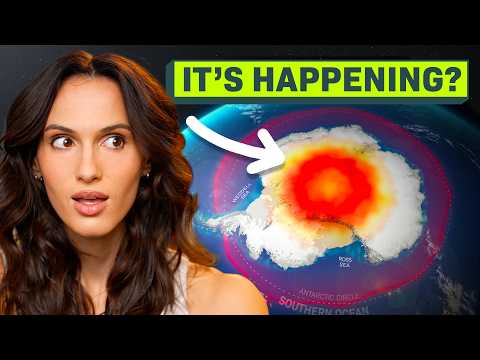
Together with KM3NeT in the Mediterranean Sea and IceCube—which uses over 5,000 optical sensors buried deep in Antarctic ice—scientists are using elusive particles called neutrinos to probe violent cosmic engines such as supernovae and supermassive black holes.
To grasp how tiny a neutrino is: the distance to the nearest star is nearly 40 trillion kilometers (enough to fit nearly 29 million Suns and take 75,000 years at typical spacecraft travel speeds). Scaled down to a neutrino's scale, interstellar space resembles the distance from a human to an atomic nucleus—allowing neutrinos to pass effortlessly through solid rock, planets, stars, and human bodies. Roughly 100 trillion neutrinos pass through a person's body every single second.
A Fourth Messenger in Astronomy: Why Neutrinos Matter
Until recently, astronomers relied on three cosmic messengers, each with limitations:
-
Light (Photons): Spanning radio, infrared, visible light, and gamma rays—valuable, yet easily absorbed, scattered, blocked by dense gas and dust, or delayed inside dense stellar cores.
-
Cosmic Rays: High-energy charged particles that carry clues about space chemistry, but get deflected by magnetic fields so their origin cannot be traced directly.
-
Gravitational Waves: Ripples in spacetime that signal when a massive event occurs, but do not reveal what happened inside or what material was involved.
Neutrinos offer a fourth option. Because they are extraordinarily small and carry no electric charge, they rarely collide with matter and are not bent by magnetic fields—traveling straight from their cosmic source at nearly the speed of light. Just as medical X-rays reveal bone beneath skin and tissue, neutrinos act like X-ray vision for the cosmos, allowing researchers to look directly inside dense environments like the core of a collapsing star (supernova)—events that occur roughly every 10 seconds across the universe and forge heavier elements such as silicon, oxygen, and iron (including the iron in human blood).
How Detectors Catch a Particle That Passes Through Everything
Because neutrinos interact so weakly that they pass right through ordinary instruments, detecting them requires massive volumes and indirect observation. Assembled by hand in facilities like Caserta, Italy—where technicians seal glass hemispheres with gel, mount mini-computers and 31 photomultiplier tubes (each sensitive enough to detect a single photon) inside Digital Optical Modules (DOMs), and spool strings into LOMs anchored to the seabed (with over 4,000 DOMs planned for the full cubic-kilometer KM3NeT array at depths up to 3,500 meters)—these detectors watch for rare collisions.
When a neutrino occasionally strikes a proton inside a water or ice molecule, it transforms into a heavier particle that moves through water or ice faster than the speed of light in that medium (since light travels slower in water or ice than in a vacuum). Much like a sonic boom forms behind an object moving faster than sound, a particle exceeding the local speed of light emits a faint, brief cone of blue light—which photomultipliers capture and route via sea-floor cables to onshore computers.
To filter out background light from bioluminescent marine life and cosmic particles showering down from above, neutrino telescopes primarily detect particles traveling upward through the Earth—using the planet itself as a giant filter so the detector acts like the back of a telescope viewing events on the far side of the world. Together, KM3NeT and IceCube cover complementary views of the sky.
Landmark Discoveries and the Human Effort Behind Them
Neutrino observatories have already marked major milestones in astrophysics:
-
2017: IceCube detected a high-energy neutrino that prompted telescopes worldwide to observe a flaring active galaxy (blazar) more than 4 billion light-years away, helping confirm active galaxies as cosmic accelerators of cosmic rays and heavy elements—a discovery involving nearly 1,000 co-authors.
-
2022: IceCube identified an active galaxy roughly 50 million light-years away whose core was obscured from optical telescopes by thick gas and dust, offering a direct view inside a cosmic engine that light could not penetrate.
-
2023: KM3NeT's record-breaking signal underscored how much remains unknown about the universe's most extreme phenomena.
Behind these instruments stand hundreds of engineers, technicians, and scientists—including former factory workers and first-time builders—crafting tools that extend human perception into realms our own senses could never reach.
Full Transcript
00:00Ready? If you dove into the ocean off the coast of Sicily, you'd suddenly be surrounded by over
00:06900 of these mysterious balls like ...these. They hook these up on a string, wind them up into
00:13an even bigger ball, and then drop them into the ocean where they unroll to nearly twice the height
00:20of the Empire State Building ... again and again and again, creating this massive forest of floating
00:27spheres. And on the surface, hidden inside an abandoned winery, a computer watches them and waits...
00:37And in 2023, they saw something. Something way smaller than an electron tore through this
00:42forest at nearly the speed of light setting off a signal nearly 30 times more powerful
00:47than anything we'd ever seen like it before. Which means that something huge must have happened way
00:54out there in space. So all of these telescopes all around the world swing in that direction to
00:59see what it might be and they find ....nothing. Now scientists are searching for answers. And this
01:07crazy experiment is getting bigger. But it's not alone. Down at the bottom of the world,
01:13buried deep in Antarctic ice, are over 5,000 more of these mysterious balls. This is Ice Cube and
01:21this is KM3NET. And together they're part of a massive global effort to give us a brand new way
01:29to find and look inside the biggest, most extreme cosmic events in our universe. But to do it,
01:37they need to catch the most elusive particle in all of physics. And we're going to show you how.
01:54This episode was made possible by AT&T, the official connectivity partner of HUGE*If True.
01:59Imagine that you and I get into a spaceship and we fly to the next closest star. It's nearly 40
02:04trillion km away, a distance that could fit nearly 29 million of our sun, which means that we're
02:11flying for 75,000 years. And that's just about the average distance for all the stars in our galaxy.
02:17There's just a lot of space in space. If instead we shrink down to the size of one of the tiniest
02:22fundamental particles in physics, the space between the stars would be like the distance
02:28between the nucleus of atoms to us now. That means that we could zoom right through the atoms
02:33of solid rock as easily as flying between the stars in space. That is what it's like to be a
02:40neutrino. It's another fundamental particle like electrons, but way smaller. If you scaled this
02:46particle up even just a millimeter in size, a human being would be like the size of an entire
02:53galaxy. It's really hard to understand just how close to nothing these particles actually are.
03:00Their nickname is the 'ghost particle' because they pass through basically everything. Stars,
03:05planets, walls, even ... you. Every single second 100 trillion neutrinos pass through your body.
03:14Hold up your thumb right now. That's what's happening right there. But this fly through
03:18walls superpower is what makes neutrinos so awesome as a way to study what's really happening out
03:24there in our universe. Because everything else that we've used so far has a big problem. When
03:30we want to understand what's happening way out there, we can only use what reaches us.
03:34And up until this point, there have been three options. Most of the time, we use option one,
03:38light. Not just visible light, but everything made up of photons, radio waves, infrared, gamma rays,
03:44but other things reach us too. Like option two, these really high energy charged particles called
03:50cosmic rays. Scientists study these to learn about the chemistry of deep space. And option three,
03:56ripples in spacetime called gravitational waves. But while these methods have taught us so much,
04:02the big problem is this one gets blocked, reflected, and warped. This one gets tossed
04:07around by magnetic fields in space. And this one can only tell us when something massive happens,
04:13not what it did or what it's made of. Meaning, there are things that we might never discover
04:17because the evidence took a wrong turn on the way to Earth. That is why neutrinos are special.
04:23They're a new fourth option to study what's out there. Their size means they're incredibly
04:27unlikely to get blocked by anything in their path. And they have no charge, so they don't
04:33get warped by electric or magnetic fields, which means that they travel straight to us at almost
04:39the speed of light. If you can catch neutrinos, you can trace back exactly where they came from
04:46and even see inside whatever made them. A good analogy would be a doctor giving you an exam.
04:51Visible light can show them some things, but if they wanted to see your bones, "you can use X-rays,
04:56right? And the reason X-rays are useful is because they could interact with muscle and
05:01tissue and skin less than ordinary kinds of light do." So catching neutrinos is like developing X-ray
05:07vision for our universe. So, for example, around every 10 seconds, somewhere in the universe, a
05:12star collapses in a supernova, releasing a massive burst of energy, blasting particles out into the
05:19universe at up to 40,000 km/s. We think these explosions are the primary sources of elements
05:26like silicon and oxygen and iron. And those elements make up the universe and planets and
05:30us. The iron in your blood can be traced back to a supernova, which is why these events are called
05:36cosmic engines. Scientists think that cosmic rays come from here, but they can't be positive
05:40cuz we can't trace them. And light can show us the aftermath of a supernova. But light takes
05:46forever to get out past all this dense matter at the center. So... "if you want to know what's going
05:51on inside the core of a supernova, neutrinos are your messenger." But wait, if the whole
05:58point is that neutrinos are so special to study because they can go through anything, how do you...
06:07...catch one. "The problem is that neutrinos interact so weakly that if it's great for them to pass
06:14through everything, well, they can also pass through our own detectors." How do you study
06:18something that never interacts with you at all? You build a very, very big and very crazy machine.
06:28So right now I'm at the lab in Caserta, Italy, where they're putting together the detectors
06:33that make up this giant underwater experiment. When this experiment is finished, it'll take up
06:38a cubic kilometer in the Mediterranean Sea. That's where its name comes from,
06:42cubic km neutrino telescope. The entire project is technically two telescopes, and we're focusing on
06:48this bigger one over here. Each of these spheres is called a DOM. And inside each DOM is a huge
06:54amount of delicate tech that has to survive in the deep sea. And they piece each one together
07:00here by hand, one hemisphere at a time. You start with one glass half and this aluminum piece right
07:06here that you glue in place with this special gel. "Pay attention to the air bubbles." Okay.
07:14It's done. It's done. "Well done. And sign it, by the way." "Yeah, go on"
07:23Thank you! "You're welcome" That's the HUGE* DOM. Now, the HUGE* DOM needs a brain, a mini computer
07:29that tells it what to do, and 31 of these. These are its eyes, the photo multipliers,
07:36which you fit very carefully into this 3D printed frame. He's checking my work. "Yeah,
07:42you did a good job, all things considered, for the first time." The most important thing here is that
07:47these photo multipliers are incredibly sensitive to light. Each one is sensitive enough to detect a
07:55single photon. That's insane. That's like standing in the middle of a hurricane and hearing a single
08:01drop on a single leaf. But wait, this is a neutrino telescope. Why are we trying to detect light? "So,
08:08we actually cannot see neutrino." Wait...what? "We don't have the technology to do that, even
08:13though there are hundreds of them in every cubic centimeter of space today." So instead,
08:18they found a very clever way to detect what happens in the unlikely times when
08:23a neutrino actually does just happen to crash into something. From the little neutrinos's perspective,
08:31what happens is it's born in some massive cosmic event like a supernova or a super
08:37massive black hole with jets of plasma, but it escapes... and for the next billion years it goes
08:45in a straight line. "Not that they're sentient or something, but if they were, it would be a dull
08:49billion years." And then one day... "and then they come up to this little pale blue dot Earth and
08:55uh they don't really care that it's there. You know, they've traveled through a lot of stuff..." But
08:59not this time. This neutrino just happens to fly right through the Earth... and then just by chance,
09:06it accidentally runs head first into some poor proton. And that proton just happens to be
09:12inside a water molecule right here off Sicily or inside the ice right here in Antarctica, which I
09:19know sounds incredibly unlikely, but remember a 100 trillion of them through your body every
09:23single second. So, statistically, some of them will bump into something. And when that happens...
09:32Wait...slow that down...
09:38The neutrino hits the proton, changing it into a different, heavier particle, which flies through
09:43the water faster than light. This is part of the reason why KM3NET sits 3,500m under water.
09:49And nothing can go faster than the speed of light in vacuum. But light slows down a lot in water. So
09:55there are actually particles that can go faster than the speed of light in water. And when they
10:00do, they create waves of light making this cone shape behind them. Is it sort of like a sonic
10:08boom? Something is moving faster than sound, and so there's like a wave around it in a cone? "It is
10:14exactly like a sonic boom." In this case, instead of going faster than the speed of sound and making
10:19a boom, they go faster than the speed of light in water and make a flash of blue light. THAT is
10:26what these sensors can see. If you were down there in the water with your eyes wide open,
10:30this is visible light, but most of the flash is so faint and so fast that your eyes probably couldn't
10:36see it. But that's what these sensors were built for. "That light is picked up by hundreds or maybe
10:42thousands of these optical sensors." Every detector has to be exactly the same. Every photo multiplier
10:49has to be in perfect sync. When this experiment is fully built, there are going to be over 4,000
10:55of these at the bottom of the Mediterranean Sea. It takes about a month to build and test 18 DOMs,
11:01which is just one single string. And then you spool that string up into what they call LOMs,
11:07which are these giant balls. This is what they're going to drop into the ocean. On the top is a buoy
11:16to hold them up. And on the bottom is an anchor with a base module. And then from the bottom of
11:20the base module, there are these big orange cables that connect all the way to the shore to that
11:25abandoned winery turned science lab where "they're gathered together a computer and uh you know,
11:31next thing you know, some scientists are looking at this and and saying, 'Hey, I think we just saw
11:34a neutrino.'" But it's really hard to make sure that this computer sees just this special blue light.
11:42and not anything else. Because while there's less light down there, it's not zero. They have to
11:49ignore lots and lots of photons created by all kinds of things like bioluminescent microorganisms
11:54and all kinds of other particles raining down on this machine from above. In order to weed those
12:00out, these machines mostly look at particles small enough to pass through the Earth. So, when you're
12:08thinking about this experiment, don't think about it like hundreds of detectors on strings sticking
12:14up out of the ocean and looking up above it. Think about it instead as the back of a giant telescope
12:21where the lens is the entire Earth. KM3NET won't be completely done for a few more years. It's
12:27operational right now, but it's not at its full capacity. But down in Antarctica is its sister,
12:33Ice Cube. That one's been operational for over a decade now. Instead of water, they use ice,
12:39which on its own is a massive engineering feat. And because each experiment is mostly focusing on
12:44neutrinos coming through the Earth...this is what KM3NET sees, and this is what Ice Cube sees. They
12:53complete each other. Just take a second to think about how incredible this is. Humans are amazing.
13:01But what's amazing isn't just the infrastructure. It's also what they found with it. In 2017,
13:08a high energy neutrino tore through Antarctic ice, setting off ice cube and telling scientists
13:13around the world to swing their telescopes in that direction. And they found a flaring active galaxy,
13:20a blazar over 4 billion lightyears away. That we'd seen before with visible light and gamma
13:27rays, but it wasn't until we saw the neutrino that we could confirm this is a cosmic engine,
13:33the source of heavy metals that make up everything, including us, and a source of
13:39cosmic rays. This moment marked the beginning of a whole new era in astronomy. One where we
13:45could use all four options, photons, cosmic rays, gravitational waves, AND neutrinos to see things
13:51in an entirely new way. And it took such a huge effort, just look at this. There are nearly a
13:57thousand scientists on this paper. This was a huge deal and they just kept going. In 2022, Ice Cube
14:05identified an active galaxy nearly 50 million light years away. You can actually see it from the
14:11ground with a normal telescope. But its core was completely hidden by gas and dust. Light couldn't
14:17escape, so we couldn't see inside. But neutrinos could and did. So, we got the first ever look
14:26inside a cosmic engine that light could never show us. "This is one of the most exciting things to
14:31happen in in modern astronomy. Um, it's really a watershed moment, not just for neutrino astronomy,
14:37but for astrophysics in general." And in 2023, when that most powerful signal ever came through KM3NET,
14:44the one that we still don't know where it came from, it showed us that there is so so much more
14:50to discover with neutrinos. "It just opens a whole new kind of eye unto the universe.
14:56This is a truly like, you know, one of a kind of event in human experience so far." We've created a
15:03new way to see inside our universe. And what I love most about this story isn't just what
15:08we could discover with neutrinos. It's also what the effort says about us as humans. "I
15:15was a factory worker before." You're building this incredible thing that is going to move forward our
15:20understanding of the universe. "Yeah, I'm pretty proud of that." That's awesome. Because what are
15:26the machines that we build if not extensions of ourselves to be our brain and our eyes and
15:32our ears and take us places we could never go and show us things we could never see. HUGE* if true.
15:44If you like this and you want more optimistic science and tech stories in your life,
15:48subscribe to support our show. And remember,
15:50this episode was made possible by AT&T, the official connectivity partner of HUGE* If True.
Description
Off the coast of Sicily, there’s a massive underwater machine. It looks like a forest of floating spheres…
And on the surface, hidden in an abandoned winery, a computer watches them and waits. And in 2023, they saw something…
Something WAY smaller than an electron tore through that forest, setting off a signal nearly 30x more powerful than anything like it we’ve seen before, which means something HUGE must have happened way out in space.
This crazy experiment is not alone! Down in Antarctica, buried deep in the ice, are over 5000 more of these mysterious spheres.
Together, these two machines – called KM3net and Ice Cube – are part of a massive global effort to give us a brand new way to find and look inside the biggest, most extreme, cosmic events in our universe.
But to do it, they need to catch the most elusive particle in all of physics.
And in this episode of HUGE* If True, we’re going to show you how…
This episode was made possible by AT&T, the official connectivity partner of HUGE* If True.
Chapters:
00:00 What's the machine hidden under the sea?
02:40 What is a neutrino?
03:24 How do we know what's out in the universe?
06:06 How do you catch a neutrino?
08:08 Why can’t we see neutrinos?
11:42 How do you know you’ve detected a neutrino?
12:27 What’s hiding underneath Antarctica?
13:08 What have we discovered with neutrinos?
14:44 What don’t we know yet?
15:03 Why is this HUGE* If True?
15:44 :)
You can find me on Instagram here: https://www.instagram.com/cleoabram
On TikTok here: https://www.tiktok.com/@cleoabram
Or on Twitter here: https://twitter.com/cleoabram
Bio:
Cleo Abram is an Emmy-nominated independent video journalist. On her show, HUGE* If True, Cleo explores complex technology topics with rigor and optimism, helping her audience understand the world around them and see positive futures they can help build. Before going independent, Cleo was a video producer for Vox. She wrote and directed the Coding and Diamonds episodes of Vox’s Netflix show, Explained. She produced videos for Vox’s popular YouTube channel, was the host and senior producer of Vox’s first ever daily show, Answered, and was co-host and producer of Vox’s YouTube Originals show, Glad You Asked.
Additional reading and watching:
- Astro[sound]bites: Episode 108: 2000 Meters under the Mediterranean: https://podcasts.apple.com/us/podcast/episode-108-2000-meters-under-the-mediterranean/id1485957691?i=1000715791463&l=es-MX
- Dan Hooper’s Podcast “Why This Universe”: https://podcasts.apple.com/us/podcast/why-this-universe/id1523312400
- IceCube and KM3NeT’s YouTube channels: https://www.youtube.com/user/KM3NeTneutrino https://www.youtube.com/c/IceCubeNeutrino
- PhysicsGirl: My first science video in 3 years: https://www.youtube.com/watch?v=B3m3AMRlYfc
- Video from Space: “Highest energy neutrinos ever observed detected deep in Mediterranean Sea” https://www.youtube.com/watch?v=WdxoVeIq31k
- TED-Ed: Why neutrinos matter - Sílvia Bravo Gallart https://youtu.be/nkydJXigkRE?si=Bi4CPBLu3pKhy39X
- KM3NeT: https://www.km3net.org/
- IceCube: https://icecube.wisc.edu/
- IceCubeGen2: https://icecube-gen2.wisc.edu/
- Cosmogenic candidate lights up KM3NeT: https://cerncourier.com/a/cosmogenic-candidate-lights-up-km3net/
- Observation of an ultra-high-energy cosmic neutrino with KM3NeT: https://www.nature.com/articles/s41586-024-08543-1
- Multimessenger observations of a flaring blazar coincident with high-energy neutrino IceCube-170922A https://www.science.org/doi/10.1126/science.aat1378
Evidence for neutrino emission from the nearby active galaxy NGC 1068 https://www.science.org/doi/10.1126/science.abg3395
Special thanks to:
- INFN
- Pasquale Migliozzi
- Marco Circella (for all the incredible archive from KM3NeT)
- Alin Ilioni (for 3D Models)
- Annarita Margiotta
- Tommaso Chiarusi
- Carlos Maximiliano Mollo (for the tour and all the information in Caserta!)
Vox: https://www.vox.com/authors/cleo-abram
IMDb: https://www.imdb.com/name/nm10108242/
Gear I use:
Camera: Sony A7SIII
Lens: Sony 16–35 mm F2.8 GM
Audio: Sennheiser SK AVX and Zoom H4N Pro
Music: Musicbed, Tom Fox
Follow along for more episodes of HUGE* If True: https://www.youtube.com/cleoabram?sub_confirmation=1
—
Hey, welcome to the joke down low!
Are there any good jokes about sodium?
Na
Find a way to use “na” in a comment to let me know you’re a real one who made it to the end of the description :)