AI Agents vs Chatbots: What Is the Difference?
Artificial intelligence has changed the way people interact with software. AI chatbots have become common for answering questions, providing support, and generating content. Now, a newer category of technology—AI agents—is designed to go further by planning tasks and taking actions.
Although the terms are sometimes used interchangeably, AI agents and chatbots are not exactly the same. Understanding the difference can help businesses choose the right technology for their needs.
What Is an AI Chatbot?
An AI chatbot is a software application designed primarily for conversation. It receives a user's message, understands the request, and generates a response.
Modern chatbots can use large language models (LLMs) to understand natural language and maintain context across a conversation.
For example, a customer might ask:
“What is the status of my order?”
A chatbot can retrieve the relevant information and provide an answer.
Chatbots are commonly used for customer support, FAQs, product information, education, and basic assistance.
What Is an AI Agent?
An AI agent is designed to achieve a goal by making decisions and taking actions.
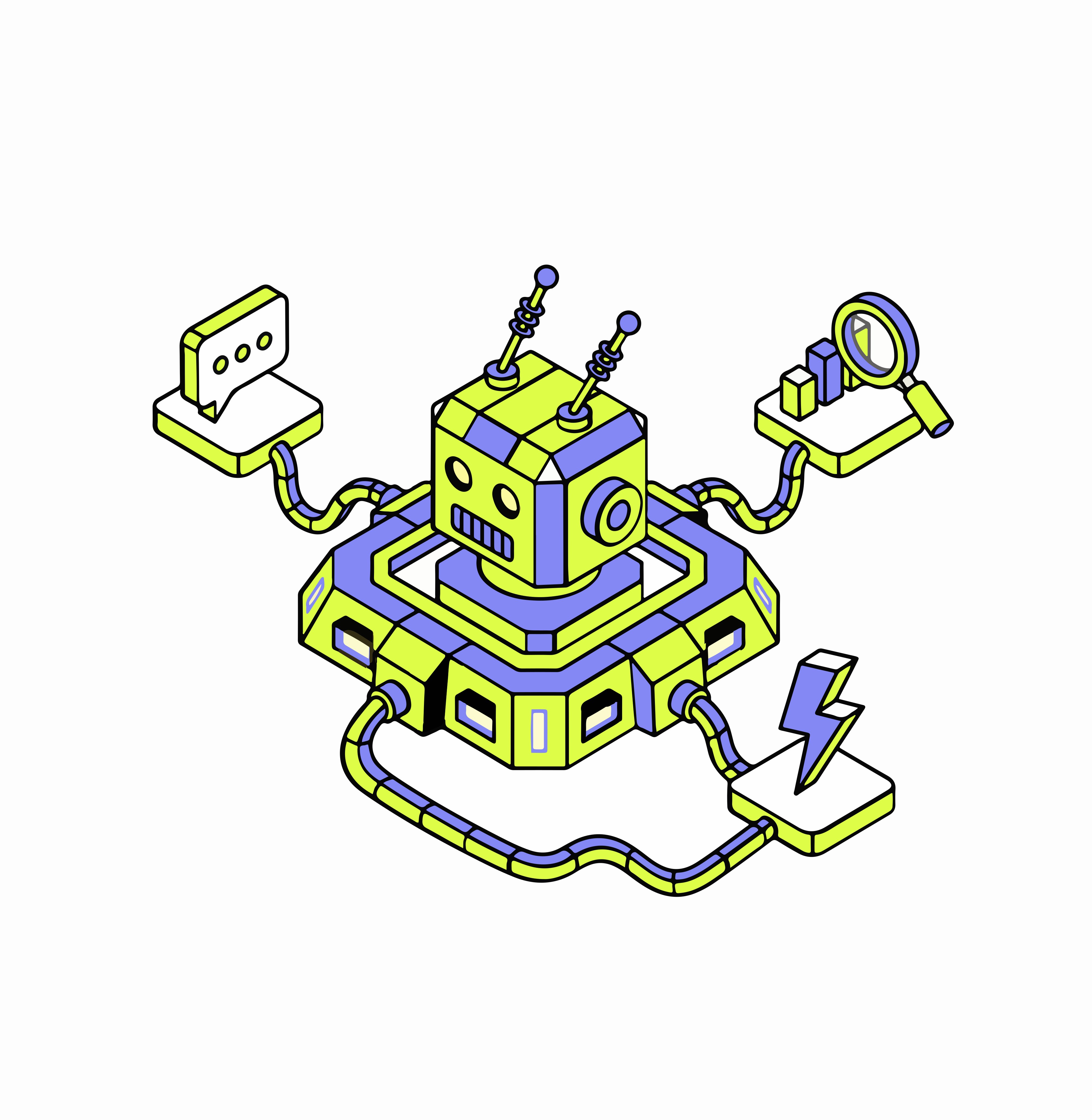
Instead of simply answering a question, an agent can potentially interact with databases, applications, APIs, websites, and other software to complete multiple steps.
For example, a chatbot might explain how to request a refund. An AI agent could potentially verify the order, process the refund through an authorized system, update the customer record, and send a confirmation.
Microsoft describes agents as systems that can use models, instructions, and tools to participate in workflows and take actions.
AI Agents vs Chatbots: The Main Difference
The simplest way to understand the difference is:
Chatbots are primarily conversation-focused. AI agents are goal and action-focused.
| Feature | AI Chatbot | AI Agent |
|---|---|---|
| Main purpose | Conversation | Completing goals |
| Answers questions | Yes | Yes |
| Plans multiple steps | Limited | Yes |
| Uses external tools | Sometimes | Commonly |
| Takes actions | Usually limited | Designed for action |
| Works across systems | Limited | Often |
| Human involvement | Usually interactive | Can be reduced, depending on design |
The boundary is not always strict. Some modern chatbots include agent-like capabilities, while some AI agents have a chatbot interface.
How Do AI Agents Work?
An AI agent typically follows a cycle:
Understand → Plan → Act → Check → Continue
First, it understands the user's goal. It then determines what steps are required and selects appropriate tools.
After taking an action, it can examine the result and decide what to do next.
For example, a business agent asked to prepare a sales report could retrieve CRM data, analyze it, create a report, and send it to an authorized recipient.
This ability to connect reasoning with tools is one of the major differences between simple conversational AI and agentic systems.
Real-World Applications
Customer Service
Chatbots can answer common questions, while agents can potentially handle more complete workflows such as checking an account, updating information, or initiating a service request.
Software Development
AI coding agents can research errors, modify code, run tests, and help troubleshoot software.
Business Operations
Agents can connect different systems to automate processes such as document handling, reporting, data analysis, and workflow management.
Research
An AI agent can gather information, organize findings, analyze data, and prepare a structured report.
Personal Productivity
Agents can potentially coordinate calendars, organize information, manage repetitive digital tasks, and work with connected applications.
Benefits of AI Agents
The major advantage of AI agents is automation beyond conversation.
They can potentially:
-
Handle multi-step workflows
-
Reduce repetitive manual work
-
Connect multiple software tools
-
Work with structured and unstructured data
-
Adapt their actions based on results
-
Support employees with complex tasks
Organizations are increasingly exploring agents for business processes, although implementation requires appropriate governance, security, and monitoring.
Challenges of AI Agents
More autonomy also creates more responsibility.
A chatbot that gives an incorrect answer can be frustrating. An agent that takes an incorrect action could create a much larger problem.
Important challenges include:
-
Incorrect decisions
-
Data privacy
-
Security vulnerabilities
-
Excessive permissions
-
Unpredictable behavior
-
Difficult testing and monitoring
-
Higher operational costs
Research into AI-agent evaluation is increasingly focused on realistic testing, safety, robustness, and cost efficiency.
For this reason, important AI agents should have clear permissions, monitoring, testing, and human approval where appropriate.
What's Next for AI Agents and Chatbots?
The distinction between chatbots and AI agents will probably become less obvious.
Future AI systems may combine conversation, reasoning, memory, tool use, and autonomous actions in one experience.
A user might simply describe the desired outcome while the system determines which tools and steps are required.
However, not every task needs an autonomous agent. A simple FAQ may still be better handled by a chatbot. More complicated workflows may benefit from an agent.
The key is choosing the right level of automation for the task.
FAQ
Is an AI agent the same as a chatbot?
No. A chatbot is primarily designed for conversation, while an AI agent is designed to achieve goals and take actions. However, some modern systems combine both capabilities.
Can a chatbot become an AI agent?
Yes. A conversational system can gain agent-like capabilities when it is connected to tools, data, planning mechanisms, and action workflows.
Are AI agents more advanced than chatbots?
They are designed for different purposes. Agents generally provide more autonomy and action capabilities, while chatbots can be simpler and more suitable for straightforward conversations.
What are AI agents used for?
AI agents can support software development, customer service, research, business automation, data analysis, and other multi-step workflows.
Will chatbots disappear?
Not necessarily. Chatbots remain useful for conversation, information access, and straightforward support. AI agents are an additional layer of capability rather than a universal replacement.
Final Thoughts
The difference between AI agents vs chatbots comes down largely to what they are designed to accomplish.
A chatbot primarily talks and responds. An AI agent can plan, use tools, and act toward a goal.
As AI systems become more capable, the two technologies will increasingly overlap. The bigger change is that software is moving from simply responding to requests toward helping users complete entire workflows.