 Kurzgesagt – In a Nutshell

AI Summary
Cosmic Voids: The Vast Emptiness Shaping the Universe
Most of the universe consists of voids—colossal expanses of empty space stretching hundreds of millions of light-years across that contain almost no galaxies, stars, or light. Rather than being passive empty gaps, cosmic voids grow, drift, collide, and merge over time, stretching space itself and playing a central role in shaping cosmic structure and the long-term future of the universe. More than 8,000 voids and supervoids are known today, with larger voids often bordering massive galaxy clusters and superclusters.
A Cosmic Journey From the Milky Way to the Boötes Supervoid
Zooming outward from Earth at thousands to millions of times the speed of light reveals how small our immediate cosmic neighborhood is within this vast web:
-
The Milky Way and Local Group: Our galaxy contains roughly 200 billion stars and dozens of orbiting dwarf galaxies, while the giant Andromeda galaxy lies 2.5 million light-years away on a collision course. Together with over 50 galaxies bound by gravity, gas, and dark matter filaments, they form our Local Group, spanning about 10 million light-years.
-
The Virgo Supercluster and Local Void: Beyond the Local Group lies the Virgo Supercluster, a massive concentration of more than 2,000 galaxies stretching roughly 100 million light-years—right beside the Local Void, an empty region roughly 200 million light-years wide (which, if luminous rather than dark, would span about 40% of Earth's night sky).
-
The Boötes Supervoid: Stretching roughly 300 million light-years across, the Boötes Supervoid is vast enough to contain thousands of galaxies yet offers near-total darkness, with no visible landmarks or orientation points.
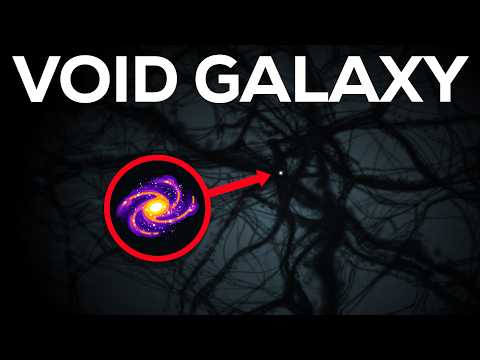
Even inside these dark expanses, faint tendrils of dark matter extend like "cosmic lichen," mirroring the broader web of dark matter filaments outside. At the tips of those filaments sit rare, isolated void galaxies—small, faint, blue, gas-rich galaxies forming stars slowly and calmly compared with galaxies in crowded clusters that experience frequent gravitational tugs, collisions, and mergers.
The Cosmic Web, Gravity, and "Void Galaxies"
Rather than being scattered evenly like uniform dust, galaxies, gas, and dark matter form a cosmic web—sheets and filaments meeting at dense cluster knots around large empty bubbles. Although galaxies move at millions of kilometers per hour, they tend to remain along the rims and walls of voids, much like light reflections on soap bubbles.
Because gravity pulls matter toward regions of higher mass and almost no mass exists inside a void, surrounding superclusters pull remaining matter outward toward the denser walls and knots—like a lopsided tug-of-war in which the empty interior exerts virtually no counter-pull. Over time, voids become emptier while surrounding walls and clusters grow denser. Because void galaxies evolve at a slower, quieter pace with abundant gas, they could potentially remain habitable longer than crowded regions, possibly hosting some of the last stars formed roughly 100 trillion years in the future.
Dark Energy and the Distant Fate of the Universe
Cosmic voids also provide a clearer window into dark energy—the mysterious driver widely thought to accelerate cosmic expansion. Inside dense galaxies and clusters, gravity overpowers dark energy, whereas inside expansive voids, dark energy inflates the empty bubbles.
As voids expand, they stretch and thin out walls of galaxies, pulling matter toward denser margins and merging neighboring voids into larger ones. Over vast timescales, expanding supervoids could gradually tear apart cosmic filaments and dominate the observable universe, leaving behind a vast, cold, and lonely expanse of emptiness.
Full Transcript
00:01The vast majority of the cosmos is voids.
00:05Gigantic, unfathomably large spaces of empty nothingness.
00:10Bubbles of eternal night, stretching hundreds of millions of light-years,
00:14almost entirely devoid of galaxies, stars, or light.
00:20The loneliest places in existence.
00:23Voids are not just the absence of stuff but weird worlds of darkness that are growing,
00:29drifting, colliding and merging with each other – Inside them space itself
00:34is stretched violently and it's almost impossible to enter them.
00:39Simply put: voids are weird and scary.
00:43But they sculpt the entire universe and may ultimately decide its fate.
00:49Today we know of over 8,000 voids and supervoids, and we keep discovering more.
00:55No matter how large a cluster or supercluster of galaxies gets,
01:00there always seems to be an even larger void nearby.
01:04Let’s jump off the cosmic cliff and drop into the heart of cosmic nothingness.
01:12The Loneliest Place in the Universe
01:16You are zooming away from Earth, at thousands of times the speed of light,
01:20leaving our solar system and our solar neighborhood behind.
01:24Now we see the entire Milky Way with its 200 billion stars and
01:27dozens of dwarf galaxies zipping around it.
01:302.5 million light-years away on a collision course
01:33is giant Andromeda and its own swarm of satellite galaxies.
01:38We are now moving a million times faster than the speed of light, seeing the local group of over 50
01:44galaxies woven together by gravity, rivers of gas, and invisible scaffolds of dark matter.
01:52This is our pocket of the universe, 10 million light years across, no human will ever leave it.
01:59Except for you apparently.
02:02As we zoom away even faster we see the Virgo Supercluster,
02:06a colossal wall of more than 2,000 galaxies spread over roughly 100 million light-years.
02:13Careful now, you are right on the edge of the cosmic cliff where the true,
02:17deep darkness begins: the Local Void – a gigantic, empty bubble 200 million light-years across.
02:25If it was a bright thing and not absolute darkness,
02:28it would fill 40% of the night sky we see from earth.
02:32All around us are dozens of other superclusters
02:36and gigantic voids filled with suffocating emptiness.
02:41You are now traveling towards the greatest and
02:44emptiest nothing in existence – right into the center of the Boötes Supervoid.
02:50A cosmic desert around 300 million light-years wide.
02:55So gigantic it should contain thousands of galaxies.
02:58But instead, what do you see?
03:02You are surrounded by perfect darkness, the most absolute blackness the human mind can conceive.
03:09There is no up or down.
03:11No motion.
03:12Nothing to orient yourself.
03:14There is not a single sign that the outside universe even exists.
03:18It’s an inescapable prison.
03:20And this isn’t some exotic corner of the cosmos.
03:23This is how the vast majority of the universe feels to human eyes.
03:28Just silent blackness without any movement.
03:31Everywhere.
03:32Forever.
03:35Although there is something mysterious hiding in the dark – faint tendrils of dark matter,
03:40penetrating into the void like cosmic lichen.
03:43A miniature echo of the much larger forest of dark matter filaments that
03:47forms the scaffold of galaxies and galaxy clusters outside the void.
03:52And at their tips we find faint blueish specs in the ocean of darkness:
03:57Void galaxies, lonely fireflies unable to light up the night.
04:02The rarest galaxies we know, very isolated, very lonely.
04:08A Universe of Bubbles
04:12Before we could look deep into space,
04:14astronomers thought we lived in a uniform cosmos with galaxies spread out evenly.
04:18But instead, we found that galaxies,
04:20cosmic gas and dark matter were arranged into a vast cosmic web.
04:25A recurring pattern of sheets and filaments, organized around enormous empty gaps,
04:31meeting at dense knots with galaxy clusters and super clusters.
04:35But this structure is not static,
04:38it just seems to be because the distances between galaxies are so incredibly vast.
04:43In reality galaxies shoot through space at speeds of millions of kilometers per hour.
04:49They are on collision courses, orbiting each other,
04:51moving towards the center of larger galaxy clusters millions of light years away.
04:56But they always seem to stick to the rims of voids
04:59like reflections of light on soap bubbles – which is kind of weird.
05:04If they are this dynamic, shouldn’t a galaxy shoot into a void occasionally?
05:09Well voids are actually extremely hard to enter for galaxies from the outside – at
05:14least naturally – because gravity becomes weird at their edges and even weirder deeper inside them.
05:20If you didn't know better, you might think voids spit out anything trying
05:23to get inside, pushing galaxies to the edge.
05:27The way gravity works is that everything with
05:29mass in the universe attracts every other thing with mass.
05:32And since there is almost no mass inside,
05:35the cosmic web of galaxy super clusters on their edges are pulling things out of voids.
05:41The emptier a void is, the harder gravity is pulling on what remains.
05:46It's really like a tug of war where one side isn’t even trying.
05:50Over time voids are really only getting even emptier and the
05:54walls and knots around them denser and brighter.
05:58Would it be hard to fly into a cosmic void with a spaceship? Well not technically,
06:02the hardest part is escaping the gravity of your home galaxy.
06:07It also doesn’t make much sense because… what exactly do you want
06:11to visit inside a void? It makes sense to fly into a void if you want to hide.
06:16Like really, really hide.
06:18But what cosmic horror would be scary enough for a civilization to try to escape into a cosmic void?
06:25Galaxies in the crowded cluster regions like our milky way are very active,
06:30since its neighbours’ gravity tugs and pulls at it, they collide and merge.
06:35Void galaxies are so isolated that they are aging in slow motion.
06:39They tend to be smaller, bluer and full of gas, birthing new stars slower and calmer.
06:46So void galaxies could be the last places that will stay habitable in our dying universe.
06:52The last star in the universe will likely be born here.
06:56So maybe in a 100 trillion years or so a desperate alien race will embark on an
07:02impossible journey to stretch their existence just a bit longer inside a void galaxy.
07:08There is one more thing that makes voids unique places: Dark Energy.
07:12The mysterious force that most scientists think is accelerating
07:16the expansion of the universe and will ultimately cause its demise.
07:21We can’t see dark energy do anything inside our galaxy or inside clusters because there is too
07:26much stuff pulling things together via gravity – but we can see its effects inside voids.
07:32Here dark energy blows up the bubbles of nothing.
07:36This is where the acceleration of cosmic expansion becomes visible.
07:42As voids are getting larger and larger, they are breaking the structure of the universe,
07:47the beautiful galaxy filaments are slowly being ripped apart.
07:52As the emptiness encroaches, walls of thousands of galaxies are thinned out
07:57and pulled towards the edges – attracted by much denser regions at the margins,
08:01giving space to the emptiness of two void bubbles becoming one.
08:07In the far, far future supervoids will take over the observable universe.
08:12Crushing clusters, and expanding further and further, until the entire observable
08:18universe is nothing more than a gigantic void of nothingness.
08:23The loneliest place in existence.
08:28Let’s head back to Earth.
08:29When we land, please exit through the gift shop and pick up a few souvenirs.
08:34We created this latest Space Souvenir Drop for all of you who have been
08:37travelling with us for so many years now. While you’re there, take a look around,
08:41you might discover a unique product dedicated to your favorite science topic.
08:45Everything is created with lots of care by our team of scientists and
08:49designers to inspire you and spark your curiosity.
08:53Thank you for traveling with kurzgesagt space tours.
Description
Most of the universe is not made of stars, galaxies, or beautiful glowing nebulae. Instead, the majority of it is what seems to be vast, silent emptiness. Huge cosmic voids stretching hundreds of millions of light years across, containing almost nothing at all. But these dark regions are not just empty space. They are dynamic structures that grow, merge, and shape the entire architecture of the universe.
What exactly are cosmic voids and how did they form? What makes them so strange, and what role might they play in the future of the universe?