 The Diary Of A CEO Masterclass
AI Summary
Early Brain Changes, Genetics, and Midlife Risk
In a conversation with host Steven Bartlett on The Diary of a CEO, a brain-health and sleep researcher (who also shares personal family history involving his father's Alzheimer's dementia as well as his grandmother and her two sisters) discusses when neurodegenerative changes begin, genetic versus lifestyle risk factors, sex differences in Alzheimer's, and daily habits that support brain health. Explaining that the human brain reaches full maturity around ages 25 to 30, the speaker notes that gradual decline and underlying changes can begin in midlife—such as the 30s—long before outward symptoms like memory loss, word-finding trouble, or disorientation typically appear in later decades, and compares visual brain changes (such as cortical thinning, wider spaces between folds/gyri, and enlarged ventricles) to a healthy, fuller brain while recounting Auguste Deter, the 52-year-old patient documented by psychiatrist Alois Alzheimer around 1906.
On genetics, the speaker distinguishes rare inherited mutations (such as presenilin 1, presenilin 2, and amyloid precursor protein, accounting for a small fraction of cases) and conditions like Huntington's disease from common risk variants such as APOE—noting that APOE2 is associated with lower risk, APOE4 increases risk (including public discussion around Chris Hemsworth carrying two copies), and women face higher relative risk from an APOE4 copy than men. Crucially, he emphasizes that APOE4 is a predisposition rather than an inevitable outcome, and points out that women represent roughly two-thirds of Alzheimer's cases—not simply because women live longer, but because midlife hormonal shifts across perimenopause and menopause affect the brain as well as reproductive organs, with brain scans showing differences across women of the same age at different menopausal stages.
Brain Reserve, Risk Factors, and Movement
Introducing the concept of brain reserve—building healthier tissue and resilience earlier in life—the speaker compares it to armor or capacity that helps buffer stress and age-related changes, noting that while some shrinkage can occur with age, lifelong habits (not smoking, limiting alcohol, eating well, and maintaining healthy weight/metabolism) support healthier aging brains. He also outlines a BRIGHT MINDS lens covering multiple risk areas—such as blood flow, retirement/aging, inflammation, genetics, head trauma, toxins, mental health, and diabesity (high blood sugar/weight)—and notes that the hippocampus (central to memory and spatial orientation) is one of the brain regions capable of generating new neurons, while mental engagement/new learning and protecting hearing also matter.
On sitting and physical activity, the speaker cites research showing that prolonged daily sitting (such as 10 or 12 hours versus fewer hours) is linked to higher dementia risk in a non-linear curve, recommends breaking up long stretches of sitting (even simple cues like drinking water and taking short breaks), and notes that the Hadza rest/sit for similar total periods overall but often in postures engaging muscles rather than slumping in chairs, with hunter-gatherer step counts often higher than typical modern sedentary routines. At the same time, he stresses that meaningful health and cognitive benefits begin at accessible levels—such as walking or aerobic exercise (including a lab spin/aerobic study in previously low-fit adults showing gains in mood, memory, and attention/focus, and a trial comparing orienteering, hiking, and a control group where cognitive/executive benefits stood out alongside movement).
Alcohol, Sleep, and Social Connection
Addressing alcohol and smoking, the speaker notes that smoking and excess alcohol harm brain health and increase dementia risk, pushing back against assuming heavy drinking is harmless and noting that even moderate thresholds (often cited around up to one drink daily for women and up to two for men in standard guidelines, though excess intake carries clear risks) should not be treated as a free pass to drink heavily.
On sleep, the speaker explains that sleep is not a simple "bank account" where severe weekday sleep deprivation can be fully repaid by sleeping in on weekends—noting that even a single night of sleep loss or disrupted deep sleep can raise markers like amyloid-beta and tau, and highlighting Maiken Nedergaard's research on the brain's glymphatic clearance system operating most actively during deep non-REM sleep to wash out metabolic waste. He notes a U-shaped pattern in observational sleep-duration data (with roughly 7 to 9 hours often cited as a sweet spot, while very long sleep can sometimes reflect underlying factors like depression rather than sleep itself), and recommends consistent wake/bed times and dimming/turning off excess lights in the hour before bed to cue the brain for sleep.
Social Connection and Protecting the Brain
Highlighting social connection, the speaker points to findings from Blue Zones and Robert Waldinger's long-running Harvard study on happiness and longevity, noting that even brief everyday social interactions—such as greeting a barista—alongside meaningful relationships support well-being and brain health, whereas chronic loneliness acts as a stressor. Closing the conversation, he underscores that you have only one brain, that daily habits in your 20s, 30s, and beyond compound over time, and that staying active, connected, and curious helps protect cognitive health and quality of life.
Full Transcript
00:00Alzheimer's disease, it starts in our
00:0230s, but the first symptoms show up in
00:05our late 60s, 70s, and beyond.
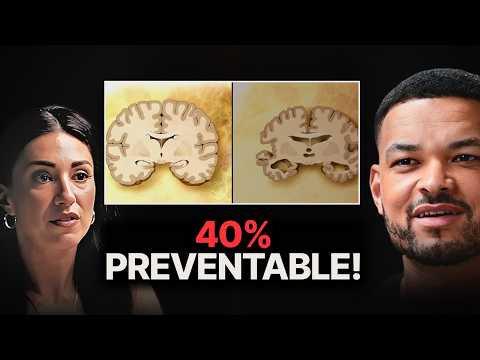
00:08>> Something like 40% of risk of dementia
00:11is preventable.
00:13>> My number one most powerful tool that
00:16you can do to protect your brain
00:20>> When you say starts
00:21>> Yeah. Our brain fully develops at around
00:2425 years old, 25 to 30. And after that,
00:28that's when we if we don't take care of
00:30our brain, we start getting a decline in
00:33these functions over time through things
00:35such as sleep deprivation,
00:37poor diet, lack of physical activity,
00:40environmental toxins. This slowly erodes
00:44at the functioning of the brain. And
00:46over time, this starts to compound
00:48because that's what biology is.
00:50Everything is compounding. One night of
00:52sleep deprivation raises your risk of
00:54amyloid beta, which is one of the
00:56hallmarks of Alzheimer's disease
00:57pathology, by 4%. That's just one night
01:00of sleep deprivation. Imagine a new
01:03mother, or a shift worker, or a
01:05physician in their residency getting
01:08countless nights of sleep deprivation
01:10day in and day out. Imagine all of that
01:13compounding. And what happens? Well,
01:16we end up with either neuronal loss,
01:19which is like the complete atrophy of
01:21certain parts of the brain.
01:23And that's what is mild cognitive
01:25impairment. Mild cognitive impairment is
01:27a pre-dementia state.
01:29>> So, what is this that I have here in
01:30this photo of the brain?
01:31>> And we're looking at a healthy brain on
01:33here. As you can see, I'm going to show
01:35it up here. On the left-hand side, you
01:37can see that the brain is thick. We can
01:39see that the integrity of the gray
01:41matter, which sits out here, is thick.
01:43It's voluminous. Okay? We can see that
01:46the ventricles are smaller. We go over
01:49here and we see thinning of the cortex.
01:51You can see these big spaces between the
01:53gyri. These are thick because the gray
01:57matter has atrophied. It's shrunk. You
02:00can see that the space between the
02:02cortex itself and the skull, there's a
02:05bigger space. You can see these
02:07ventricles here, these butterfly-shaped
02:08ventricles. This is thicker.
02:11This is thinner. We can see atrophy down
02:13here. So, essentially, the brain is
02:16getting smaller and smaller. The first
02:19ever Alzheimer's disease patient,
02:21Auguste Dete, she was 52 years old and
02:24she went to the hospital, her and her
02:26husband went, complaining of
02:28difficulties of word finding,
02:31word fluency, and she couldn't remember
02:34where she put her keys. And her husband
02:37said, "She is delirious."
02:39And Auguste told the doctor on board, he
02:44was a psychiatrist, his name was Alois
02:46Alzheimer.
02:47She said to him, and I quote, "I don't
02:51know who I am anymore."
02:54As I mentioned, this disease robs you of
02:56who you are.
02:57In 1906, 06, Auguste Dete died.
03:02And
03:03that was the first ever patient to be
03:05recorded of having Alzheimer's disease.
03:09If you have a genetic mutation on
03:11chromosome 4,
03:13you will get Huntington's disease.
03:16There is nothing we can do about that.
03:17That's how you were born.
03:19But when it comes to Alzheimer's
03:21disease,
03:22there's around 20 to 30 genes involved
03:24in the disease.
03:25Only around 3%
03:28of the disease cases right now were
03:30driven through those genetic mutations.
03:33The genetic mutations that you are born
03:35with, you get them from mom and dad,
03:38are presenilin 1,
03:40presenilin 2,
03:41and the amyloid precursor protein.
03:45So, you if you have a genetic mutation
03:47in one of these genes, you will get some
03:50form of dementia. A lot of the times
03:52people will ask me,
03:54"Stephen, I'm scared. My mother had
03:56Alzheimer's disease. I'm scared I'm
03:57going to get it."
03:59And we were talking about genetics
04:00before.
04:01And there's another genetic risk factor
04:04that we didn't talk about, the APOE4
04:06gene uh
04:07is
04:08one of the the strongest risk factors of
04:10getting Alzheimer's disease, but it is
04:12not a foregone conclusion that you're
04:14going to get it. So, Chris Hemsworth was
04:16tested and he has two copies of this
04:18gene.
04:19So, you get two copies, one from mom,
04:22one from dad. If you've got a copy of
04:24the APOE2 gene, it protects you against
04:27the disease. But when you have a copy of
04:29the APOE4 gene, it raises your risk by
04:32two to three times.
04:34If you have two copies of the gene, it
04:36raises your risk by 10 times
04:39if you are a male.
04:41Here's the devastating thing.
04:43If you are a female with one copy of the
04:46gene, you are at double the risk than
04:48your male counterpart.
04:50So, one copy of the gene of APOE4 gene
04:53for a female raises your risk by about
04:56sixfold, whereas two copies raises your
04:59risk by 15-fold.
05:01>> And how would one go and get checked?
05:03>> You can get the APOE4 gene checked out
05:05with your doctor. It's a simple blood
05:07test. We used to think that women were
05:11disproportionately affected by
05:12Alzheimer's disease because we lived
05:14longer, because age played a role in it.
05:17But we now have substantial evidence to
05:19show that it's not the fact that women
05:21live longer or people in general,
05:23because dementia and Alzheimer's disease
05:25are not part of the natural brain aging
05:27process.
05:28For women, it is purely because being a
05:31woman is
05:34a risk factor for getting this disease.
05:38>> What most people don't realize is that
05:40um Alzheimer's disease affects more
05:42women than men.
05:44So, almost 2/3 of all Alzheimer's
05:47patients are women,
05:49particularly postmenopausal women.
05:52And this was my question even for my PhD
05:56at the very beginning of my career. And
05:58back then, people would say to me,
06:00"Well, yes, we've known since 1994
06:05that after aging and getting older
06:08itself, being a woman is the most
06:11significant risk factor for developing
06:14dementia.
06:15However,
06:17the explanation back then was that women
06:21live longer than men
06:23and Alzheimer's is a disease of old age.
06:26Therefore, at the end of the day, more
06:29women than men have Alzheimer's disease.
06:31And that never made sense to me, in part
06:33because I have a family history of
06:35Alzheimer's disease that runs in my
06:36family, obviously, and affects the women
06:39in my family.
06:41And I know that this is very common
06:44where
06:45your grandmother has Alzheimer's or
06:47dementia.
06:48And for me, it was my grandmother and
06:51her two sisters who all developed
06:53Alzheimer's disease and died of it. But
06:55their brother, who lived exactly to the
06:58same age, did not.
07:01And so my PhD thesis is actually was
07:04to show that Alzheimer's disease is not
07:07a disease of old age.
07:09It's actually a disease of midlife
07:12with symptoms that start in old age.
07:16So what happens is that Alzheimer's
07:17starts in the brain with negative
07:20changes that take years to reach a
07:23certain threshold before the damage is
07:26so severe that people start losing their
07:28memories, they can't come up with words,
07:30they have attention deficits.
07:33But in reality, Alzheimer's starts for
07:35many people in midlife. The question
07:38becomes, okay, if Alzheimer's starts in
07:41midlife and more women than men end up
07:43with Alzheimer's disease, what happens
07:46to women and not men
07:49in midlife that could potentially
07:51explain the higher lifetime risk of
07:54Alzheimer's disease for women. If you
07:55compare a group of premenopausal women
07:59to men of the same age and look at their
08:01brain scans, there are no differences or
08:04very little differences.
08:06But if you look at women who are
08:07perimenopausal
08:09and compare them to men of the same age,
08:12you see an increase in the amount of
08:15Alzheimer's plaques in the brain already
08:18in midlife.
08:19>> In perimenopause?
08:20>> In peri, so not even
08:22in menopause, but just starting to lose
08:25your skipping menstrual cycles and when
08:27you when your period becomes infrequent
08:30and usually the hot flashes start making
08:32an appearance and the brain fog as well.
08:34And then after menopause, when we
08:37compared postmenopausal women to men of
08:40the same age, then the difference was
08:42quite striking. Where men barely had any
08:45Alzheimer's plaques
08:47and the women had statistically
08:49significantly more
08:51red flags for Alzheimer's disease.
08:53Something happening
08:55in their heads that they feel like their
08:58brain is changing, the feeling of
09:01I don't feel like myself anymore or
09:03there's something happening I have the
09:05brain fog, I have mental fatigue.
09:08In clinical terms we say cognitive
09:10fatigue or mental fatigue. And this is
09:12actually evidence
09:15of what women have been saying all
09:16along, that menopause changes your brain
09:20as surely as it changes your ovaries.
09:23And very specifically changes the
09:25functionality of your brain. So now we
09:27have women who are exactly the same age.
09:31These are all women who are 50 years
09:32old. One has a regular menstrual cycle.
09:36One has irregular menstrual cycle, she's
09:39in peri-menopause.
09:40And this woman is also 50 years old and
09:43does not have a menstrual cycle. Do you
09:45see the differences?
09:46>> I mean, yeah, their brains look
09:47completely different.
09:48>> Thank you. And they're all exactly the
09:50same age.
09:51>> Drastically different. So the the lady
09:52there in pre-menopause, her brain is
09:55really really illuminated.
09:57Um and then the same a different lady
10:00but the same age in post-menopause.
10:04I mean
10:05yeah, I mean if it looks like it kind of
10:07looks like the lights have gone down.
10:08>> You can see this just by eyeballing a
10:10brain scan.
10:11>> It's crazy.
10:12>> And again, these are three cases.
10:14>> As it relates to Alzheimer's, you talked
10:15about those Alzheimer's plaques in the
10:16brain.
10:17>> Yeah.
10:17>> If I exercise more, do women that
10:19exercise more have less of those
10:20Alzheimer's plaques?
10:21>> Yes. Yes, we do have fewer Alzheimer's
10:24plaques and also
10:25what the research shows is that women
10:27who are physically fit
10:29in midlife have 30% lower risk of
10:33dementia in old age as compared to women
10:37who are sedentary in midlife.
10:39So, that's also really important to have
10:41because if I had a pill
10:43that can reduce your risk of dementia or
10:45Alzheimer's disease by 30%, I would be
10:48rich and everyone would buy it.
10:53>> So, brain reserve is the extra tissue
10:56you have to deal with whatever stress
11:00comes your way. Or, let's just take two
11:02soldiers in war.
11:05They're in the same tank.
11:07They go over an IED. So, they're both
11:12the tank is blown up.
11:15One walks away unharmed.
11:19The other one's permanently disabled.
11:22Why?
11:23It's their brain reserve.
11:25The brain they brought into the
11:28explosion
11:30often determines
11:32how they are. So, I argue
11:36we should always be building
11:40reserve.
11:41>> Because your brain is going to shrink
11:43with aging regardless of any
11:45>> It It's going to show. Although, I have
11:47a whole group of
11:50super
11:51brains, people that are 80, 90, 1 105,
11:57like stunningly beautiful brains.
12:00But, they're people that had stunningly
12:02beautiful brain reserve habits.
12:05>> Okay.
12:05>> That they didn't smoke, they weren't
12:08drinkers, they ate well, they were not
12:10overweight.
12:12>> What do you think the cause of
12:13Alzheimer's is?
12:14>> I think there are many causes
12:17of it and
12:19the going wisdom until recently was
12:22excessive beta amyloid plaque formation
12:26caused Alzheimer's and there's a lot of
12:28questions around that theory.
12:32I think
12:34uh I have a mnemonic I like called
12:36bright minds. You want to keep your
12:37brain healthy or rescue it, you have to
12:40prevent or treat the 11 major risk
12:43factors. So, I think there are in fact
12:46many roads
12:47to Alzheimer's disease and so
12:52um bright minds,
12:54blood flow, retirement and aging,
12:57inflammation, genetics, head trauma,
12:59toxins, mental health, diabesity is you
13:03either have
13:05high blood sugar
13:07and or you're overweight. If you're
13:11overweight
13:12or you have high blood sugar
13:15it lowers blood flow to your brain. It
13:17prematurely ages your Why does brain
13:20size matter? You know, when people say
13:21it's going
13:23Why does that matter?
13:25So, I often say the only organ where
13:27size really does matter is your brain.
13:34Because you don't want to
13:36lose
13:38brain tissue.
13:40Right? There is a part of your brain
13:42called the hippocampus which is
13:45on the inside of your temporal lobes
13:49right here and it's really important.
13:53And um
13:55it makes new stem cells every day, about
13:59700.
14:01And if you're
14:03drinking
14:05it's not allowing those new stem cells
14:08to take
14:10hold, to take root. You want to
14:13strengthen them so they will continue to
14:17support mood, memory,
14:21um, spatial orientation, spatial
14:24processing.
14:25>> Loving your job.
14:27>> Absolutely great for your brain.
14:30If
14:32you're learning new things.
14:34People who are in a job that does not
14:37require new learning have a higher
14:39incidence of Alzheimer's disease.
14:42>> So, if you're
14:43>> stagnant in your work, you have a higher
14:44risk of Alzheimer's.
14:45>> Noise pollution.
14:47>> Bad for the brain.
14:49And if if it hurts your hearing, hearing
14:53loss
14:54is actually one of the risk factors for
14:56Alzheimer's.
14:57>> And one big trend at the moment is
14:59neuroplasticity training. Lots of people
15:01are doing games and using other things
15:04to like there's apps you can get that
15:06are neuroplasticity training apps. Does
15:08any of that stuff work?
15:10>> Some of them.
15:10>> Some of it works.
15:11>> And if you're so, for example, if you're
15:14doing memorization games, do them while
15:18you're on the bike.
15:21Now, not in the street, but if you're on
15:23a stationary bike
15:25and
15:27you're doing those games, it's been
15:30found that exercise
15:33increases blood flow to the hippocampus.
15:38Meaning, you're more likely to remember
15:40it and you're strengthening your brain
15:43in the process. So, exercise with new
15:46learning.
15:48Stomach.
15:51>> We know that time spent sitting is
15:53associated with risk of dementia. We
15:55just We just did a big study looking at,
15:57you know, if you if you sit for 10 hours
16:00a day
16:01compared to
16:029 hours a day, it's about a 10%
16:05increased risk of dementia. If you sit
16:06for 12 hours a day, it's about a 60%
16:09increased risk of dementia compared to
16:11sitting for 9 9 and 1/2
16:13>> If you're sitting
16:13>> 60%
16:14>> versus 9 hours a day.
16:15>> Right. So, just a couple more hours,
16:17right? It's it's a non-linear
16:19relationship. So, once you get past
16:22about 9, 9 and 1/2 hours a day, your
16:24risks start going up in in a non-linear
16:26exponential way. And so,
16:29can we alter that? Can we I mean, it
16:31doesn't it doesn't take a lot
16:32necessarily to go from 12 to 8 hours a
16:35day. So, maybe that's easier than
16:38getting people out the door.
16:39>> Does this mean that if I don't do
16:42physical activity, my brain will shrink?
16:46>> That's a good question. I mean, on a on
16:47a broad public health scale, uh yes, you
16:51know, low levels of physical activity or
16:53inactivity is associated with poor brain
16:56health, smaller volumes of key brain
16:58structures, so smaller hippocampal
17:01volumes, for example, and worse
17:03cognition overall, and greater risk of
17:06dementia and Alzheimer's disease. On a
17:07personal level, it's hard to say
17:09specifically, right? Because there's so
17:11many factors that go into your risk of
17:14um of dealing with these conditions, but
17:17I can say that the best way for any
17:20individual to reduce their risk of
17:22cognitive decline is to be physically
17:25active.
17:25>> What exactly is going on in my brain
17:27then when I'm physically active that's
17:28causing my brain to be protected,
17:31insulated from things like Alzheimer's
17:33and dementia, and in some areas of the
17:35brain to actually grow? What is What is
17:37actually happening inside?
17:39>> A lot of fun things. Um so, I mean, one
17:41of the things that happens when we
17:43exercise is we increase blood flow to
17:45the brain, and that helps bring
17:47nutrients and and keep our neurons
17:49functioning properly. But another thing
17:51that happens is that your muscles
17:53actually generate proteins called
17:55myokines, and those travel to the brain,
17:58and they uh interact with neurons in
18:01ways that upregulate neurotrophin. So,
18:04there's this great neurotrophin called
18:06brain-derived neurotrophic factor, BDNF,
18:09and BDNF acts kind of like a fertilizer
18:11for brain cells or for new neurons. So,
18:13BDNF, when it's upregulated with
18:15exercise, um helps both the birth of new
18:19neurons, and it helps them to survive
18:21and integrate into the processes that
18:23they're that they're meant to work for.
18:25And one of the things that we've learned
18:26from working with the Hadza is that, you
18:29know,
18:30people rest a lot. Like the Hadza, they
18:33sit for as or or rest and sit for as
18:35long as we do, which was actually super
18:37surprising us. We thought that wouldn't
18:38be the case. We thought they were going
18:39to be active, you know, all the time,
18:41and there would be much less sitting.
18:42But when we finally actually measured it
18:44with accelerometers, um they're resting
18:46for the same amount of time that we are.
18:48But they're not sitting in chairs.
18:50They're resting in postures that require
18:52a little muscle activity. So, they're
18:54squatting, or they're they're kneeling,
18:56or they're sitting on the ground in ways
18:58that, you know, you have to kind of keep
19:00shifting your body around.
19:02And it's possible that just that kind of
19:04low level of muscle activity, um is is
19:07how our bodies are well adapted to rest.
19:09And what's weird is the invention of
19:12chairs. And what's weird is the
19:13invention of these objects that
19:15completely eliminate the need for our
19:17lower bodies to use muscle activity.
19:19>> Is there some kind of middle ground that
19:21is, um accessible and realistic for us?
19:23>> Yeah, I think the I think the best thing
19:25people can do is just try not to sit for
19:27prolonged periods of time. I mean,
19:29there's no way to eliminate sitting. And
19:31I don't think that standing all day is
19:33is necessarily the answer. I don't think
19:35that that's necessarily a a
19:37benefit full-time. I think breaking up
19:40sitting into smaller periods is probably
19:42the best thing we can do.
19:44Um so, you know, one of the pieces of
19:46advice is I as actually that I always
19:48tell people is, you know, just drink
19:50more water so you got to get up and pee
19:51more. Um that is that's an easy way to
19:54to kind of force yourself not to sit for
19:552 hours at a time.
19:57>> If there was one fundamental
19:58misunderstanding that most people have
20:01that your work and your experience has,
20:05um rebuttled, I guess.
20:07What is that fundamental human
20:09misunderstanding about the nature of our
20:11bodies and how we're supposed to be
20:13living to be optimal?
20:14>> I think
20:16I think the most dangerous
20:17misunderstanding is how much exercise it
20:19takes to get benefits.
20:21>> Right.
20:21>> And I think that's because that acts as
20:23a barrier to people. And what we've seen
20:26from the epidemiological work is that,
20:28you know, the the
20:30there are minimal amounts of activity
20:33that provide big benefits.
20:35More is generally better, but you can
20:37get huge benefits just by moving your
20:39body a little bit every day. And so I
20:41think that's, you know,
20:43as I said, it's a dangerous
20:44misconception because it's a And so um
20:46the Hadza that as we've measured their
20:49step counts are getting a lot. So it's
20:51like, you know, 15 to 20,000 steps per
20:53day in that range, which is quite a bit
20:56of of movement. And that's not to say
20:58that that is the optimal amount, um but
21:00that's what we see in hunting and
21:02gathering lifestyles. The benefits that
21:04we get from a public health standpoint
21:06start to occur at much smaller levels,
21:09right? So, you know, 4, 5, 6,000 steps
21:12per day, you start to see some real
21:14benefits. And as I said, you start to
21:16maybe see diminishing returns as you get
21:18higher and higher level. And there's a
21:19great study that just came out looking
21:21at um it was a randomized control trial,
21:23so they actually randomized people into
21:25either an orienteering group or a hiking
21:27group or a control group. And over a
21:31couple months they found that the
21:32orienteering group actually had uh
21:35better performance on uh cognitive tests
21:37like memory tests and executive function
21:40tests than even the hiking group. Both
21:42of those groups did better than the
21:44control group, but there was actually
21:45this extra boost if they if for the
21:47people who were in the orienteering
21:48group. So we're starting to see that
21:51maybe some different activities could
21:53potentially enhance the effects of
21:55exercise on the brain.
21:57>> What's the conclusion there? What does
21:59that study hint at in terms of cuz
22:01hiking you're out in nature, you're
22:03navigating your way up a hill or
22:04something. Orienteering
22:07that it's a it's almost like solving a
22:08puzzle, right? Because you've got a map
22:09and a compass.
22:11>> Yeah, I mean I think it it fits into an
22:13evolutionary model, at least in my mind,
22:16um where the purpose of being physically
22:19active is to move around a habitat to
22:22find things. Find food, find water, find
22:25firewood.
22:26Um and so physical activity in a in this
22:29sort of ecologically relevant world is a
22:32combination of cognitive challenges and
22:35physical challenges. So I think that
22:38when you combine them in the way that
22:40perhaps orienteering does or maybe some
22:42other sports, you might actually get a
22:44bigger boost for your buck, a bigger
22:46bang for your buck
22:48um in terms of the brain benefit.
22:50>> Does excessive alcohol use and smoking
22:51shrink the brain?
22:52>> They do. They are They are risk factors
22:54in cognitive decline and the development
22:57of dementia and Alzheimer's disease.
22:58>> How much alcohol?
23:00>> We know that excessive, like, you know,
23:01excessive consumption over the sort of
23:04one drink per day or two drinks per day
23:06for a man, one drink per day for a
23:07woman,
23:08um
23:10that level of alcohol consumption is
23:12associated with negative health outcomes
23:14including
23:15risk of dementia and Alzheimer's
23:17disease.
23:17>> So sleep is the other one that's a big a
23:20big factor in cognitive decline, right?
23:22>> It is. And sleep is I mean, a lot of
23:24things happen during sleep um that are
23:26really important. One of the things that
23:28happens during sleep, we think, is that
23:31um it's a time where your brain is
23:33clearing these plaques that can build up
23:36that are associated with
23:39um neurodegenerative disease. And so if
23:42that's the case and there's been some
23:43evidence that suggests that that sleep
23:45is when some of that clearance is
23:46happening, then poor sleep quality
23:49just doesn't allow that function to
23:51occur, allows those uh plaques to build
23:53up. Sleep is weird in some ways because
23:56it's not always more is better.
23:59So uh it follows a U-shaped curve in
24:01terms of risk of developing dementia,
24:03for example, where less sleep
24:06and lots of sleep are both associated
24:09with higher risk. And there's like a
24:11sweet spot, right? There's a sweet spot
24:13of, you know, call it 7 to 9 hours a
24:16night, something like that, um that
24:18that's that is where your lowest risk is
24:20going to be.
24:21>> So you can oversleep.
24:22>> You can. Here's the the the the caveat
24:26to that is what's going on with over
24:28sleepers that you're not able to suss
24:32out in your analysis. So, a lot of times
24:34people over sleep because they're
24:35depressed. And we know depression is
24:37linked with these neurodegenerative
24:39diseases. And so, it's it's possible
24:42that it's those it's not the actual
24:44sleep itself, but it's what's linked
24:46with too much sleep.
24:50>> When did sleep become the thing?
24:53>> It occurred to me or happened to me, I
24:55should say, when I was doing my PhD. I
24:58was studying people with dementia.
25:00And we were trying to understand what
25:03type of different dementia that they had
25:05very early on in the course of their
25:07disease.
25:08And we were looking at patterns of brain
25:10wave activity and it occurred to me that
25:13some of these dementias were eating away
25:15at the sleep centers in the brain and
25:17others would leave them untouched. And
25:19at that moment I realized I'm measuring
25:21my patients at the wrong time. I'm
25:24measuring them when they're awake.
25:26Should be measuring them when they're
25:27asleep.
25:29Started doing that, got amazing results.
25:32And at that point I wanted to ask the
25:34question, well,
25:35I wonder if their sleep problems are not
25:38simply a symptom of the dementia.
25:41I wonder if it's a potential cause of
25:43the dementia. You know, the two most
25:45feared diseases in developed nations are
25:47cancer and Alzheimer's disease. At this
25:49stage, insufficient sleep seems to be
25:51one of the more or one of the most
25:55significant lifestyle factors that can
25:58develop or dictate the development of
26:02Alzheimer's disease later in life. Now,
26:04that's a lifestyle factor. There are
26:05other genetic factors, but certainly we
26:08now know that it's not just that
26:10insufficient sleep
26:12predicts a greater amount of Alzheimer's
26:15pathology in your brain. So, for
26:17example, people who on average are
26:18sleeping 6 hours or less have a far
26:21higher magnitude of amyloid of beta
26:24amyloid, which is the sticky toxic
26:26protein related to Alzheimer's disease,
26:27and another protein called tau protein.
26:29These are the two protein culprits of
26:31Alzheimer's. Both of those are escalate
26:35the less and less sleep that you have.
26:37Now, that's just associational. We also
26:39know, by the way, that two sleep
26:40disorders, insomnia and sleep apnea,
26:42heavy snoring, both of those are
26:44associated with a marked increased risk
26:46of your Alzheimer's disease of
26:48Alzheimer's disease later in life.
26:50That's simply associational. That
26:52doesn't prove causality, but we now have
26:54the causal evidence both in animal
26:57models and in human models. If I deprive
26:59a human being of sleep for a single
27:01night, or I even just deprive you of
27:04deep sleep for a single night, the next
27:06day we can see an immediate increase in
27:09these Alzheimer's disease related
27:10proteins circulating in your
27:12bloodstream, circulating in what we call
27:14a cerebrospinal spinal fluid that bathes
27:16the brain, and using special brain
27:18scans, we can even measure it within the
27:20brain itself.
27:22So, these are causal manipulations. It's
27:24not associational. I manipulate this
27:26thing called sleep, and the consequence
27:29is that I manipulate your Alzheimer's
27:30disease proteins.
27:32That's correlation going to causation.
27:35Then the question is, what mechanism?
27:38What is it about sleep when you get it
27:41that is de-escalating Alzheimer's
27:42disease risk?
27:44In other words, when you don't get it,
27:46what why would it increase your
27:48Alzheimer's risk? And this is a stunning
27:50discovery made by a scientist called
27:52Maiken Nedergaard at the University of
27:53Rochester here in America.
27:56And she found three things. First,
27:57studying mice and rats, she found that
28:01the brain has a cleansing system. Now,
28:03we didn't used to think that your brain
28:05had a cleansing system. Your body had
28:08one, and everyone knows what it's
28:09called. It's called the lymphatic
28:11system.
28:12Um we didn't think the brain had one,
28:14but she discovered that the brain has
28:16one. It's called the glymphatic system,
28:18named after these glial cells that make
28:20it up.
28:21The second thing that she discovered is
28:23that that cleansing system within the
28:26brain is not always switched on in high
28:28flow volume across the 24-hour period.
28:31It was expressly during sleep, and
28:34particularly during deep non-REM sleep
28:36when that sort of sewage system was put
28:40into overdrive and washed away all of
28:43this detritus that built up during the
28:44day.
28:46And the final thing that she discovered,
28:48and this is why it's related to
28:49Alzheimer's disease, is that two of the
28:51metabolic byproducts that build up
28:54during the day in our brain
28:56are beta-amyloid and tau protein.
28:59The two bad actors in Alzheimer's
29:01disease.
29:02So, in other words, what she discovered
29:04is a system of, you know, good night's
29:06sleep clean. That sleep is a power
29:08cleanse for the brain.
29:10And if you're not getting your sleep
29:12every night,
29:13you know, it doesn't mean that you're
29:14going to get Alzheimer's disease next
29:16week. It doesn't mean that you're going
29:17to get Alzheimer's disease, you know, in
29:18a year's time.
29:20But night after night, once again, it's
29:22like compounding interest on a loan.
29:25And that's why we now believe through
29:26this causal mechanism that insufficient
29:29sleep is a risk factor for Alzheimer's
29:31disease.
29:31>> I sometimes thought that, you know, I
29:33could go Monday to Friday and kind of
29:35sacrifice my sleep. This was
29:36specifically when I was really in the
29:38height of like running big businesses,
29:39etc. Um and then on the weekend I'll
29:41just make up for it.
29:43So, I thought, you know, I could go
29:44Monday to Friday, I'll sleep maybe
29:45sometimes 2 hours a night, 3 hours a
29:47night, whatever. Then Saturday, you
29:49know, I'll just do a, you know, 11-hour
29:51sleeping and I'll just make up for it.
29:52>> Yeah.
29:54>> Is that a good strategy?
29:57>> The delightful laughter at the end of
29:59your sentence that uh
30:01I think probably tells you the answer
30:02that, you know,
30:03um
30:04unfortunately, sleep doesn't work like
30:07that. It would be nice if it did. Sleep
30:09is not like the bank. In other words,
30:11you can't accumulate a debt
30:14as you were doing during the week and
30:15then hope to try and pay it off at the
30:18weekend.
30:19Um
30:20So, for example, let me take an extreme
30:22version of that experiment. Let me take
30:24you tonight. I'm going to deprive you of
30:26sleep for an entire night for, let's
30:28say, 8 hours of sleep. And then tomorrow
30:30night, I'm going to give you all of the
30:32recovery sleep that you want, as much as
30:34you wish for. And then the next night,
30:37you can have all of the recovery sleep
30:39that you want. And even on the third
30:40night,
30:41will you sleep longer that first
30:44recovery night after a night of no
30:46sleep? Absolutely, you will sleep
30:48longer.
30:50But across those three or four recovery
30:51nights of sleep, will you get back all
30:54of the sleep that you lost? Not even
30:55close. You'll maybe only sleep back
30:57about four, four and a half of the eight
31:00hours that you lost. In other words, by
31:03that stage, you are four or three and a
31:05half hours in overdraft on your sleep
31:09bank account. You went into debt, and
31:11you only paid about 50% of it back. The
31:14first thing is regularity.
31:16Go to bed at the same time and wake up
31:18at the same time, no matter whether it's
31:20the weekday or the weekend.
31:22Your brain expects regularity. It
31:24thrives best in the conditions of
31:26regularity. When you give it regularity,
31:28you can improve the quantity and the
31:30quantity of your sleep.
31:32The second thing is get some darkness at
31:35night. As I said, we don't get enough
31:37darkness in the modern world.
31:39And so, the trick I would offer
31:42and I don't use it I don't like the word
31:43hack, but the sort of suggestion would
31:45be in the last hour before bed,
31:49try this experiment for everyone
31:50listening for the next week.
31:53Dim down half of the lights or switch
31:55off half of the lights or even a
31:57three quarters of the lights in your
31:59home in the last hour before bed.
32:02>> All of the lights in every room?
32:04>> In all of the rooms, you know, switch
32:06off almost all of the light. Now, I'm
32:08not suggesting be unsafe and walk around
32:10in the darkness in the last hour. That's
32:11not what I'm trying to say. Just dim
32:13down you know, switch off half of the
32:14lights.
32:16You will be surprised at how sleepy that
32:19darkness will make you feel. And it's
32:21also an incredible behavioral trigger
32:26to
32:27signal to your brain that it is time for
32:31sleep.
32:34>> Um I got a call from my mom who said
32:37that my father wasn't feeling well and
32:40that he had gotten lost driving back
32:42from the coffee shop that he drove to
32:45every day, every afternoon for the last
32:4820 years.
32:49And the hippocampus, that structure
32:52critical for memory, is particularly
32:54important for spatial memory. And as an
32:57expert in the hippocampus as I am, I
32:59knew that that was a telltale sign of
33:02dementia and maybe Alzheimer's dementia.
33:06But as I talked to my father and of
33:08course we went and got him a neurology
33:10appointment, I saw that everything that
33:13seemed to be improving in me, that is
33:16memory, focus,
33:18completely and very, very suddenly
33:21diminished in him. His memory was
33:24terrible. He couldn't focus. He was also
33:26very depressed because he could notice
33:28how poor his memory was.
33:31And I think those things together, what
33:34I was noticing in myself, but the
33:36physical effects of the effects of
33:38physical activity on my own brain
33:40function, and seeing my father go
33:43through which what was a really
33:45precipitous loss of his cognitive
33:47functions, that turned out to be
33:49Alzheimer's dementia. First I'm going to
33:51give you the results of a study in
33:53people that are 65 and older. So studied
33:55people that are 65 and older
33:57and asked, "What is the probability of
34:01getting dementia in the next 6 years
34:04depending on the level of activity that
34:06you have?" Just right now.
34:08>> Physical activity.
34:08>> Physical activity. And they measured it
34:10in how many walks you take per week.
34:13And if you took three walks a week or
34:16more,
34:17you were 30% less likely to develop
34:21dementia in the next 5 years.
34:25So ooh, 30%
34:27uh less likely to develop dementia. My
34:30father passed away of Alzheimer's
34:32dementia. That makes me sit up and take
34:34notice. But the But the thing that
34:37should make you as a 31-year-old uh
34:40really sit up and take notice, is the
34:42larger correlations that show that the
34:44longer you have regular physical
34:47activity in your life, the longer you're
34:50able to stave off dementia. The more
34:53active you are over your lifetime. Um
34:56that first study shows that it's never
34:58too late to start. You can start walking
35:00regularly, which is doable when you're
35:03uh perhaps at that age. But the longer
35:05you stay active, the bigger and fatter
35:09and fluffier your brain will be. Why
35:11does that make sense? So,
35:14one key piece of information that I
35:15haven't told you yet,
35:17is that we know that physical activity
35:21is releasing a whole Every single time
35:23you move your body, you're releasing a
35:25whole bunch of neurochemicals in your
35:27brain.
35:28Some of them make you just feel good.
35:30Serotonin, dopamine, noradrenaline,
35:32endorphins. Yeah, I feel good. If I go
35:34out for a walk, I feel better than if I
35:36had been sitting here for eight hours.
35:38But the other thing that gets released
35:40every single time is growth factors. I
35:43like to call it a bubble bath of
35:44neurochemicals that happens every time
35:46you move your body.
35:49What that
35:50growth factor does is it goes directly
35:52into your hippocampus, and it helps
35:54brand new cells grow in your
35:57hippocampus. Hippocampus is only one of
36:00two total brain areas where new cells
36:03can grow. That's not the same as
36:04synapses, which are connections in the
36:06cells that are already there. But the
36:08hippocampus can grow new cells. And this
36:10is really important because many people
36:13know that the hippocampus is attacked
36:16first in Alzheimer's dementia.
36:18And so, exercise is not going to
36:21eliminate that disease state, but if you
36:25start with a huge fluffy hippocampus,
36:27it's going to take that disease that
36:29much longer to actually damage enough of
36:32your hippocampus so that you start
36:33seeing those telltale signs of memory
36:36impairment that comes with Alzheimer's
36:39disease and and dementia in general.
36:41>> So, the first is about dementia and
36:42Alzheimer's. Do we know what's causing
36:44it?
36:45>> No.
36:45>> We still don't know.
36:46>> No.
36:48And there's not
36:50good drugs, unfortunately, right now.
36:53>> There's a lot of links to lifestyle
36:55choices there, right?
36:56>> Yes, absolutely.
36:57And so, of course, from based on what I
37:00just said, my number one most powerful
37:03tool that you can do to protect your
37:06brain from aging and neurodegenerative
37:08disease states is start walking.
37:11Why do I start with that? Because
37:13everybody can walk. You don't need to
37:15buy any new fitness outfits. Just go out
37:18and walk more. All the research shows
37:21that the best kind of exercise that you
37:23can do is anything that gives you
37:26aerobic activity, that is getting your
37:29heart rate up. So, that that goes for,
37:32you know, power walking will get your
37:34heart rate up, soccer. So many different
37:36things. Name your activity. So many
37:39people want to say, "Oh, my favorite
37:40activity, will that work?" And I always
37:42just say, "Is it Is your heart rate up
37:44when you're doing it?" If the answer is
37:46yes, then yeah, that that works great.
37:48We know that that level of aerobic
37:50activity is critical cuz that's going to
37:52release that growth factor maximally to
37:55get into your hippocampus that will grow
37:58those new brain cells. We did two
38:00different experiments in my lab. One in
38:03low fit people, people that are really
38:04not exercising very much at all, less
38:07than 30 minutes
38:09in the last three three weeks you you've
38:12moved your body. And we asked, "What
38:16Could we see any behavioral improvement
38:18in your memory function from your
38:20hippocampus or your ability to shift and
38:23focus attention if we ask you to move
38:26your body in aerobic way for two to
38:29three times a week?" And we collaborated
38:31with a spin class, so clearly very
38:34aerobic. And what we found was in those
38:37people that did successfully do two to
38:40three times a week a 45-minute aerobic
38:42activity,
38:43their mood got significantly better,
38:46their memory function got better and
38:49their ability to shift and focus
38:51attention got significantly better. So,
38:53that gives a little bit of a guideline
38:55for low fit people two to three times a
38:57week can start to give you some of those
39:00some of those cognitive changes. Like
39:02every drop of sweat counted. The more
39:05you exercise, the more change in your
39:08brain we know. I think the most evidence
39:11is around the benefit of the
39:15Mediterranean diet, which is basically
39:17all healthy
39:19kind of organic not organic but
39:21non-processed is the word I was trying
39:24to think of things to eat that are very
39:26very colorful. There's so much evidence
39:29about how good that is generally for the
39:33brain that that is my go-to. Like what
39:36what should I eat? Well, is it on the
39:37Mediterranean diet? If it is, then go
39:40ahead.
39:40>> Is it true that if we have less friends,
39:43if we have less strong relationships, if
39:45we're lonely,
39:45>> Yeah.
39:46>> then our brain will shrink and is more
39:49prone to dementia and Alzheimer's and
39:51things like that?
39:52>> Yes, we are social creatures and um
39:56there are really powerful studies that
39:59have shown the correlation between the
40:01number of social connections that we
40:03have including just saying hello to the
40:05barista at Starbucks. It's not a close
40:08friendship that you develop over 30
40:10years. It's it's just how many people
40:12you interact with and greet and
40:15longevity. The more people you are
40:18regularly interacting with, the longer
40:21you are living. Overall longevity. But,
40:24if you go into brain health, absolutely,
40:26it's also very very healthy for you. It
40:29also brings happiness. So, a friend and
40:33colleague of mine Robert Waldinger
40:35studied
40:36what makes people happy. The study
40:38started in the 20s, 1920s at in Harvard.
40:42And after all of those many many the
40:45answer is
40:47what brings happiness is the strength of
40:50your social connections. So, it makes
40:51you happier, it makes you live longer,
40:54and and yes, loneliness on the on the
40:57flip side
40:58causes stress, long-term stress that
41:01that damages the brain and yeah, in the
41:03long term can can make it smaller and
41:07less healthy.
41:07>> What is the one thing we haven't spoke
41:09about regarding
41:10Betty, the brain over there in the
41:12corner but the brain in front of you?
41:13The most important thing about the brain
41:15that we didn't discuss.
41:18>> You know,
41:21you only have one
41:23and um
41:25we have an opportunity every single day
41:29to make it
41:32as healthy as it could be.
41:34I my I watched my father pass away with
41:37Alzheimer's dementia and um
41:41we have elderly people in my family as
41:42well and
41:46it motivates me even more to to keep my
41:50brain healthy,
41:51to make as many friends as I can, to
41:54have as many connections as I can cuz I
41:57want to be as happy as I can be for the
41:59rest of my life and I want to have
42:02and I want to have a big fat fluffy
42:03brain.
42:04So, you only have one and
42:07there are things you can do right now
42:09today
42:10to make it stronger.
42:11>> If you like the show and you like what
42:12we do here and you want to support us,
42:14the free simple way that you can do just
42:15that is by hitting the subscribe button.
42:17And my commitment to you is if you do
42:19that, then I'll do everything in my
42:20power, me and my team, to make sure that
42:22this show is better for you every single
42:24week.
Description
Dementia can start in your 30s. Six brain experts on how it starts and habits linked to lower risk.
Louisa Nicola explains that Alzheimer's disease starts in our 30s, but the first symptoms show up in our late 60s, 70s and beyond.
Six brain experts, six answers, in one Masterclass built from The Diary Of A CEO with Steven Bartlett: neurophysiologist Louisa Nicola, neuroscientist Dr Lisa Mosconi (Weill Cornell), psychiatrist Dr Daniel Amen, Prof David Raichlen (USC), Prof Matthew Walker (UC Berkeley) and Dr Wendy Suzuki (NYU).
What the experts say in this video:
- Louisa Nicola: when Alzheimer's disease starts, and why the first symptoms can show up decades later.
- Dr Lisa Mosconi: almost two thirds of Alzheimer's patients are women, and she shows brain scans of women of the same age at different stages of menopause.
- Dr Daniel Amen: what brain reserve is, the extra tissue that helps your brain cope with stress.
- Prof David Raichlen: sitting for 12 hours a day is associated with about a 60% increased risk of dementia compared with sitting for 9 to 9.5 hours, and something like 40% of dementia risk is preventable.
- Prof Matthew Walker: why he says insufficient sleep is a risk factor for Alzheimer's disease, and what he says is happening in the brain during sleep.
- Dr Wendy Suzuki: why her number one most powerful tool for protecting your brain is to start walking.
More in The Diary Of A CEO Masterclass